コンタクタ,サーキットブレーカー,ソーラーインバーター,電気メーター,太陽電池

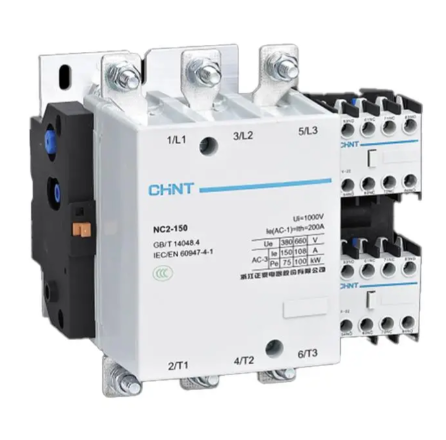
CHINT NXC と NC2 コンタクタの比較
CHINT NXC and NC2 are two ACコンタクタ series with distinct positioning, featuring obvious differences in design philosophy, technical parameters, およびアプリケーションシナリオ. The NXC is a new-generation high-performance product focusing on technical upgrades and reliability, while the NC2 is a mature and stable classic series emphasizing general industrial applications.
- Basic Positioning and Background
– NXC Series: CHINT Kunlun Series, a comprehensive upgrade of the CJX2 series, launched as a new-generation contactor after 2020.
– NC2 Series: CHINT Classic Series, a traditional contactor widely used in industrial fields with a long market verification period.
- Comparison of Core Parameters
| パラメータ項目 | NXC Series | NC2 Series | Difference Explanation |
| 定格電流範囲 | 6A~630A | 115A~800A | NXC covers more precise current specifications (including 6-12A micro models); NC2 focuses on medium and large current applications. |
| 定格電圧 | 220V~690V | 690V (up to 1000V for some models) | NC2 has higher voltage ratings for high-spec models. |
| ポール構成 | Mainly 3P (4P for some models) | 3P, 4P (2P for some models) | NC2 offers more flexible pole options. |
| 制御方法 | Mainly AC control | AC/DC (Z-type optional) | NC2 provides better support for DC control. |
| 周囲温度 | -35℃~70℃ | -5℃~40℃ | NXC has stronger environmental adaptability and can work in harsher conditions. |
| 機械的寿命 | まで 55 million cycles | 約 10 million cycles | NXC has significantly longer service life and maintenance intervals. |
| 電気的寿命 | まで 68 million cycles (AC-3) | Standard level | NXC has obvious advantages in high-frequency operation scenarios. |
| 遮断容量 | 高い (specific value varies by model) | Standard level | NXC adopts an optimized arc extinguishing system with better breaking performance. |
Ⅲ. Technical Features and Design Differences
- Structure and Materials
– NXC Series:
– Designed with a 3D structural motion simulation system for higher precision.
– New low-resistance contact material with strong anti-welding performance, reducing the risk of contact adhesion.
– Compact overall structure with smaller volume.
– Copper core coil + 32-piece silicon steel core, ensuring low heat generation and stable suction.
– NC2 Series:
– Base made of aluminum alloy profile for excellent heat dissipation.
– Integrated coil and magnetic circuit design, directly extractable for easy maintenance.
– Traditional direct-acting and double-break contact system.
- Functional Characteristics
– NXC Series:
– Wide voltage adaptability: Can withstand 70%-120% rated voltage fluctuation, suitable for unstable voltage environments.
– Optimized arc extinguishing system with low arc energy and high safety.
– Built-in 1NO+1NC standard auxiliary contacts, with 2NO+2NC support for some models.
– NC2 Series:
– Rich derivative models: N (reversible), NS (horizontal installation), ノースカロライナ州 (vertical installation), J (energy-saving type).
– Supports multiple control voltages (交流: 110V/127V/220V/380V, 等; DC: 48V/110V).
– Modular structure for easy expansion of auxiliary contacts, delay modules, 等.
- Differences in Application Scenarios
– NXC Series is more suitable for:
– AC motor circuits requiring frequent starting and control, such as hoisting equipment and pumps.
– Remote areas, construction sites, and old residential areas with large voltage fluctuations.
– Scenarios with high reliability requirements and difficult maintenance.
– Applications in harsh environments (high temperature +70℃, low temperature -35℃).
– Upgrade and renovation projects replacing the CJX2 series.
– NC2 Series is more suitable for:
– General industrial control, especially high-current (above 115A) 負荷.
– Special applications requiring DC control.
– Long-term stable operation systems with high reliability requirements.
– Maintenance and replacement of traditional industrial equipment.
– Distribution cabinet designs requiring multiple installation methods (horizontal/vertical).
- Key Selection Reference Points
- Current Requirement:
6-100A range: Prioritize the NXC series for more precise specifications and higher cost-effectiveness.
Above 115A: The NC2 series offers more model options, especially for ultra-high current (above 630A) scenarios.
- 環境条件:
Large temperature fluctuations or unstable voltage: NXC is the first choice.
Standard industrial environment: Both are applicable; the NC2 may be more cost-effective.
- 動作周波数:
High-frequency operation (例えば, 自動化された生産ライン): NXC’s long service life is a distinct advantage.
General industrial applications: The NC2 fully meets the requirements.
- 特別な機能:
DC control required: Select the NC2-Z series.
Reversible control required: Select the NXC-N or NC2-N series.
The NXC Series is CHINT’s future-oriented high-performance contactor, with core advantages of long service life, high reliability, and wide adaptability. It is particularly suitable for modern industrial and harsh environment applications, serving as an ideal replacement for the CJX2 series.
The NC2 Series is CHINT’s mature and stable classic product, characterized by strong versatility, easy maintenance, and complete specifications. It is especially suitable for traditional industrial and high-current application scenarios.
選択の提案: Prioritize the NXC for new project designs or applications requiring high reliability; for cost-sensitive traditional industrial scenarios with high maintenance convenience requirements, the NC2 remains a cost-effective choice.
Translation Notes for Export Business:
- ブランド & Model Consistency: Retained official English brand names (“CHINT”) and model designations (“NXC”, “NC2”, “CJX2”) for global customer recognition and order accuracy.
- Technical Terminology Standardization: Adopted international electrical engineering terms (例えば, “遮断容量”, “補助接点”, “arc extinguishing system”) to ensure professionalism and compatibility with overseas technical documents.
- Parameter Clarity: Standardized unit symbols (例えば, “℃”, “あ”, “V”, “million cycles”) and retained original value ranges for precise technical communication.
- Scenario Adaptation: Used universal industrial expressions (例えば, “自動化された生産ライン”, “hoisting equipment”) instead of region-specific terms, facilitating understanding across different markets.
- Functional Description Precision: Clarified derivative model suffixes (例えば, “Z-type for DC control”, “N for reversible”) and functional features (例えば, “1NO+1NC”) to avoid ambiguity in product selection.
- Business-Oriented Language: Maintained a neutral, objective tone suitable for technical specifications and sales materials, balancing professionalism with readability for customers and engineers.