Contactor,circuit breaker,solar inverter,electric meter,solar batteries

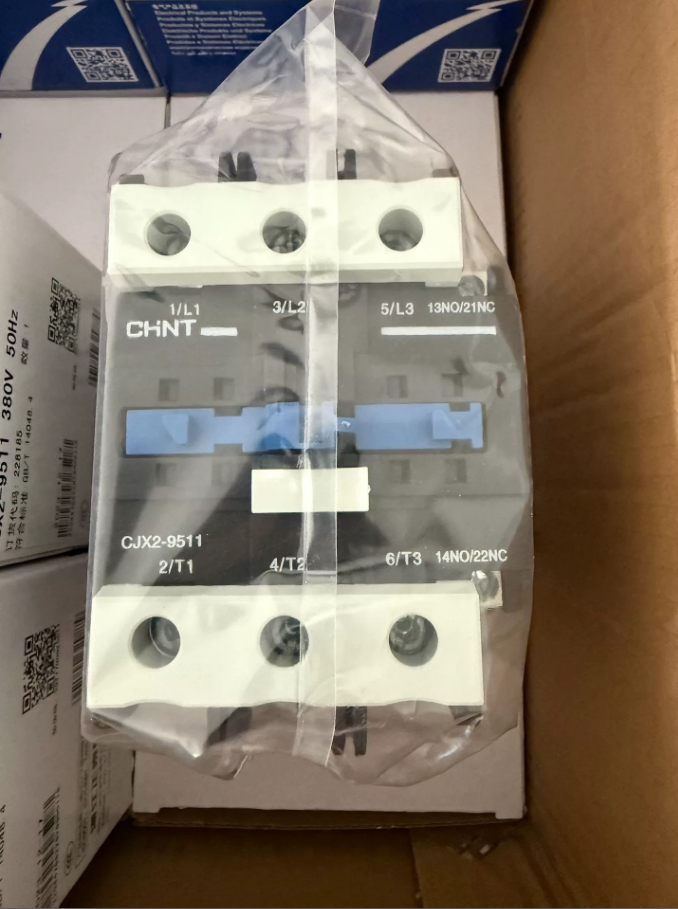

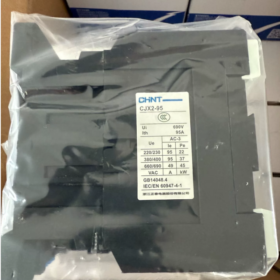
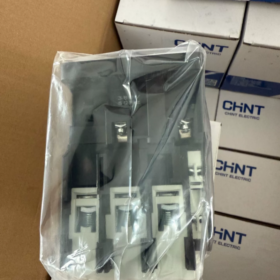
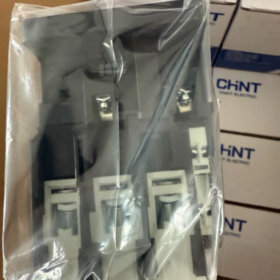
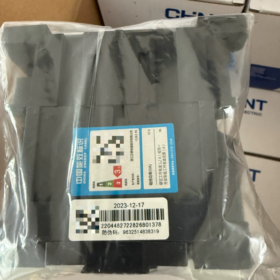
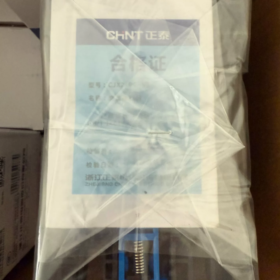
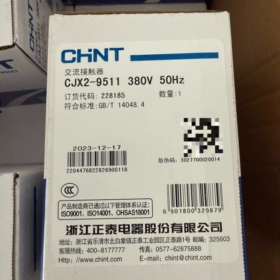
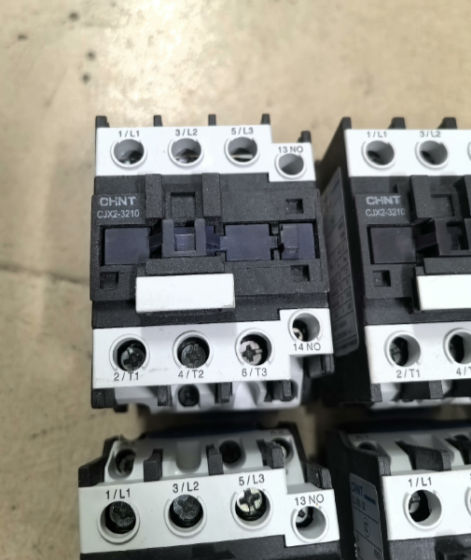
Core Positioning: The Chint CJX2-9511 is a 3-pole AC contactor with a rated current of 95A, equipped with 1 normally open (NO) + 1 normally closed (NC) auxiliary contact. It is suitable for AC 50/60Hz circuits, mainly used for remote switching on/off of circuits, frequent starting and control of three-phase AC motors. It can be combined with a thermal overload relay to form an electromagnetic starter for overload protection.
- Model Interpretation
| Model Segment | Meaning |
| CJX2 | Chint AC contactor series code (equivalent and compatible with Schneider LC1D series) |
| 95 | Rated operating current of 95A (under AC-3 utilization category at 400V) |
| 11 | Auxiliary contact configuration: 1 Normally Open (NO) + 1 Normally Closed (NC) |
- Core Technical Parameters
| Parameter Item | Specification Details |
| Contactor Type | AC coil contactor, 3-pole main contacts + 1NO + 1NC auxiliary contacts |
| Rated Operating Voltage | Main circuit: AC 50/60Hz, up to 690V |
| Rated Operating Current | 95A at AC-3, 400V; 132A at AC-1, 400V |
| Coil Voltage Options | AC 24V/36V/110V/220V/380V, compatible with 50/60Hz |
| Coil Power Consumption | Pull-in power approx. 1800VA, holding power approx. 180VA |
| Rated Insulation Voltage | 800V (complies with IEC 60947-4-1 standard) |
| Rated Impulse Withstand Voltage | 8kV |
| Mechanical Life | Approximately 10 million operations |
| Electrical Life | Approximately 1 million operations at AC-3, 400V, 95A |
| Rated Operating Frequency | Up to 1200 operations per hour (AC-3 utilization category) |
| Control Circuit Voltage | Coil voltage range: 85%~110% of rated voltage |
| Mounting Method | DIN rail mounting (35mm standard rail) or screw fixing |
| Wiring Method | Double-hole terminal blocks, main circuit applicable wire cross-section: 16~35mm² |
| Operating Temperature | -5°C ~ +40°C (can reach +40°C when relative humidity ≤50%, derating required at higher humidity) |
| Protection Class | IP20 (protects against finger contact and solid foreign objects with diameter ≥12mm) |
| Weight | Approximately 1.2kg |
III. Functional Features
- High Compatibility Design: Same dimensions as Schneider LC1D series, directly interchangeable, compatible with various functional accessories
- High-efficiency Energy-saving Coil: Adopts high-quality electromagnetic materials, pull-in/holding power ratio up to 10:1, with significant energy-saving effect
- Multiple Protection Mechanisms:
Built-in overvoltage suppressor in the coil to extend coil service life
Main contacts made of silver alloy material, arc-resistant and anti-welding, improving reliability
Dust cover design, suitable for harsh industrial environments
- Flexible Wiring System: Double-hole terminal block design, more secure wiring, reducing loosening risk
- Wide Voltage Adaptability: Wide coil voltage range (85%~110%), adapting to power grid fluctuations
- Easy Installation: Standard DIN rail mounting, space-saving and convenient for quick replacement
- Application Scope
The CJX2-9511 contactor is suitable for the following industrial scenarios:
- Motor Control:
Direct start/stop control of three-phase asynchronous motors (approx. 45kW at 380V)
Control of continuous operation equipment such as fans, water pumps and compressors
Control of frequent starting equipment such as conveyors and mixers
- Electrical Control Systems:
Remote switching on/off of circuits in power distribution systems
Control of electric heating equipment and lighting systems
Combined with thermal overload relays (e.g., NR2 series) to form electromagnetic starters for overload protection
- Industrial Automation:
Executive component of PLC control systems
Bypass contactor for soft starters and frequency converters
Electrical control of machine tools, printing machinery and packaging equipment
- Selection Recommendations
5.1 Key Selection Points
| Selection Factor | Recommended Considerations |
| Load Type | Select AC-3 rated current for motor loads; select AC-1 rated current for resistive loads |
| Power Matching | Can control ≤45kW three-phase asynchronous motors at 380V (AC-3) |
| Coil Voltage | Select according to control circuit power supply (220V/380V commonly used, 24V/36V/110V optional for special occasions) |
| Auxiliary Contacts | 1NO+1NC meets basic control needs; auxiliary contact modules can be added for more contacts |
| Operating Frequency | For frequent operation (>600 times/hour), derating is recommended or special high-frequency contactors should be selected |
| Environmental Conditions | For high-temperature, humid and dusty environments, derating or protection class upgrade should be considered |
5.2 Alternative Models and Compatibility
| Alternative Model | Brand | Difference Description | Compatibility |
| NXC-9511 | Chint (Kunlun Series) | Upgraded version of CJX2 series with improved performance and compatible dimensions | Fully compatible, can be directly replaced |
| LC1D9511 | Schneider | Original design with consistent performance | Installation and electrically compatible, interchangeable |
| TGC1-9511 | Tengen | Same specification product with more competitive price | Installation compatible, consistent functions |
| CJX2-9501/9510 | Chint | Different auxiliary contact configurations (01: 1NC; 10: 1NO) | Consistent main circuit parameters, different auxiliary contacts |
5.3 Recommended Supporting Products
- Thermal Overload Relay: NR2-93 (setting current 63~93A), directly pluggable with CJX2-9511 to form an electromagnetic starter
- Overload Protection: Motor protectors (e.g., JD-5) can be optionally configured for more comprehensive protection
- Auxiliary Contact Expansion: Auxiliary contact modules such as F4-11 and F4-22 to increase the number of contacts
- Surge Suppression: RC snubber or varistor to protect coils and contacts
- Troubleshooting Guide
6.1 Common Faults and Solutions
| Fault Phenomenon | Possible Causes | Troubleshooting Steps |
| Contactor fails to pull in | 1. Coil not powered; 2. Low coil voltage; 3. Burned coil; 4. Mechanical jamming | 1. Check control circuit power supply and wiring; 2. Measure coil voltage (should be ≥85% of rated value); 3. Measure coil resistance with multimeter (normal value approx. several hundred ohms); 4. Check if iron core is jammed and remove foreign objects |
| Loud noise after pull-in | 1. Oil/dust on iron core end face; 2. Broken shading coil; 3. Low coil voltage | 1. Clean iron core end face; 2. Check shading coil (replace iron core if broken); 3. Adjust coil voltage to rated range |
| Contact overheating/ablation | 1. Overload operation; 2. Poor contact connection; 3. Arc suppression failure | 1. Check load current and replace with contactor of larger capacity; 2. Clean contacts and replace if severely ablated; 3. Check arc chute and ensure it is intact |
| Poor auxiliary contact connection | 1. Contact oxidation; 2. Spring fatigue; 3. Loose wiring | 1. Clean contacts; 2. Replace auxiliary contact module; 3. Tighten wiring terminals |
| Coil burnout | 1. Excessively high voltage; 2. Frequent starting; 3. High ambient temperature | 1. Check power supply voltage and install overvoltage protection; 2. Reduce starting frequency or select high-frequency contactor; 3. Improve ventilation and lower ambient temperature |
6.2 Contactor Status Judgment
| Inspection Item | Normal Status | Abnormality Judgment |
| Coil Resistance | Approx. 300~800Ω (depending on coil voltage) | Resistance of 0 (short circuit) or infinity (open circuit) is abnormal |
| Main Contact Voltage Drop | ≤50mV when closed | Excessively high voltage drop indicates poor contact connection |
| Iron Core Pull-in | No obvious noise and slight vibration | Loud noise and obvious vibration are abnormal |
| Arc Chute | Intact without carbonization marks | Severe damage or carbonization requires replacement |
VII. Installation and Maintenance Precautions
- Pre-installation Preparation:
Confirm that the model matches the load (current, voltage, auxiliary contacts)
Check for no external damage and complete accessories (arc chute, mounting bracket)
Select appropriate installation location (well-ventilated, away from heat sources and vibration sources)
- Installation Specifications:
Install after power cut, live operation is strictly prohibited
Standard DIN rail mounting (35mm), fix firmly
Main circuit wiring: wire cross-section 16~35mm², double-hole wiring to ensure firm connection
Control circuit wiring: wire cross-section 0.75~1.5mm², avoid laying in the same slot as main circuit
Installation direction: vertical installation (iron core upward), tilt ≤5°
- Maintenance Key Points:
Regular inspection (recommended once a month):
Contact status (presence of ablation and oxidation)
Coil temperature (should not exceed ambient temperature +40°C)
Wiring terminals (presence of loosening and overheating)
Arc chute (presence of damage and carbonization)
Cleaning: Remove dust with dry brush, solvent use is prohibited
Lubrication: Oil application is prohibited on iron core end face, keep clean and dry
Replacement Cycle:
Mechanical life: approx. 10 million operations, replacement is recommended after reaching the limit
Electrical life: approx. 1 million operations (AC-3), replacement cycle should be shortened for frequent starting
VIII. Summary
The Chint CJX2-9511 contactor is an industrial-grade contactor with high cost performance and high compatibility. With its 95A rated current and 1NO+1NC auxiliary contact configuration, it is widely used in the control of three-phase motors below 45kW and electrical systems. During selection, comprehensive consideration should be given to factors such as load type, power and coil voltage. Installation and maintenance must strictly follow specifications to ensure safe and reliable operation. Compared with the Kunlun series NXC-9511, the CJX2-9511 has a more competitive price; compared with the Schneider LC1D9511, it has higher cost performance, making it an ideal choice in the field of industrial automation.



NH42-63-318x560.png "CHINT PC-type automatic transfer switches (ATS)NH42-63/4SZ")