Contactor,circuit breaker,solar inverter,electric meter,solar batteries

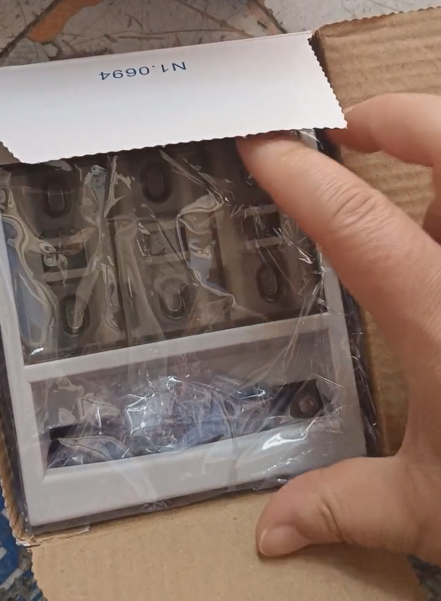

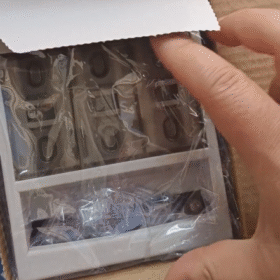

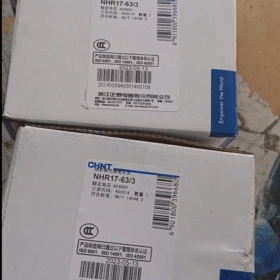
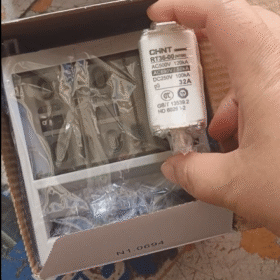
Chint NHR17-63/3 is a fuse-type isolating switch, mainly used in industrial power distribution systems, with short-circuit protection and circuit isolation functions. The following is an analysis of its core information:
I. Product Positioning and Core Parameters
1. Basic Functions
– Used as a power switch, isolating switch, and emergency switch, it can provide protection in power distribution circuits and motor circuits with high short-circuit currents.
– Compliant with international standard IEC 60947-3 and Chinese standard GB/T 14048.3, ensuring safety and reliability.
2. Key Parameters
– Rated insulation voltage: 1000V, suitable for high-voltage environments.
– Rated operating voltage: up to 690V, covering most industrial scenarios.
– Rated current: 63A (conventional heating current), capable of carrying stable loads.
– Pole number: 3 poles, suitable for three-phase circuits.
– Short-circuit breaking capacity: ≥50kA (at 400V), able to quickly cut off fault currents.
3. Structural Features
– Adopts screw-fixed installation, with a compact structure and light weight (approximately 3.26kg for reference to the same series products), facilitating on-site construction.
– Conductive material is brass, ensuring low resistance and high conductivity.
– Equipped with a manual operating handle, which can intuitively display the switch status (closed/open).
II. Application Scenarios and Limitations
1. Applicable Fields
– Industrial power distribution systems: such as isolation and protection of main circuits in factories and substations.
– Motor control: used as a power switch in motor circuits, but direct starting/stopping of a single motor is not recommended (needs to be used with contactors).
– Emergency power switching: quickly cuts off the circuit in case of failure to ensure maintenance safety.
2. Precautions
– Capacitor cabinet limitation: Specifications of 63A and below are not applicable to capacitor cabinets because they cannot withstand closing inrush currents.
– Environmental requirements: Ambient temperature -5℃~+40℃, altitude ≤2000m, pollution degree 3. It should be installed in places without vibration or corrosive gases.
III. Fuse Selection and Replacement
1. Matching Fuse Models
– At 400V: It is recommended to use RT19-125 or NT00 series fuses. The rated current of the fuse link can be 20-63A (needs to match the load current).
– At 690V: Fuses with higher breaking capacity (such as RT16-00 series) are required, with a fuse link current range of 20-100A.
2. Replacement Steps
– Power-off operation: First disconnect the upper-level power supply to ensure no voltage in the circuit.
– Remove the old fuse: Loosen the fixing screws and pull out the fuse link (be careful to avoid electric shock).
– Install the new fuse: Select a matching fuse link, insert it in the original direction, and tighten the screws to ensure good contact.
– Test and restore: After closing, check whether the circuit is normal and whether the fuse indicator light is on.
IV. Installation and Maintenance Recommendations
1. Installation Method
– Fixed to the distribution cabinet or mounting plate with screws, ensuring the mounting surface is flat and not loose.
– When wiring, use wires that meet specifications (recommended cross-sectional area ≥6mm²) and tighten the terminal screws to avoid overheating.
2. Daily Maintenance
– Regularly check whether the contacts are oxidized or ablated, and replace them in time if there is a problem.
– Clean the shell once every 1-2 years to prevent dust accumulation from affecting heat dissipation.
– If the fuse blows frequently, it is necessary to check whether there is an overload or short-circuit fault in the circuit.
V. Alternative Models and Upgrade Schemes
1. Same Series Alternatives
– For higher current requirements, NHR17-100/3 (100A) or NHR17-160/3 (160A) can be selected.
– For auxiliary contact functions, versions with the suffix “1” can be used (such as NHR17-63/31).
2. Competitor Comparison
– Compared with Schneider’s OFA series, NHR17 has a price advantage and supports domestic fuses.
– Compared with Siemens’ 3RV series, NHR17 has a higher breaking capacity at 400V (≥50kA vs 36kA).
Summary: Chint NHR17-63/3 is a cost-effective industrial-grade fuse-type isolating switch, suitable for protection and control in medium and low-voltage power distribution systems. During selection and use, attention should be paid to fuse matching, installation environment, and maintenance requirements to ensure long-term reliable operation.
NH42-63-318x560.png "CHINT PC-type automatic transfer switches (ATS)NH42-63/4SZ")