Contactor,circuit breaker,solar inverter,electric meter,solar batteries

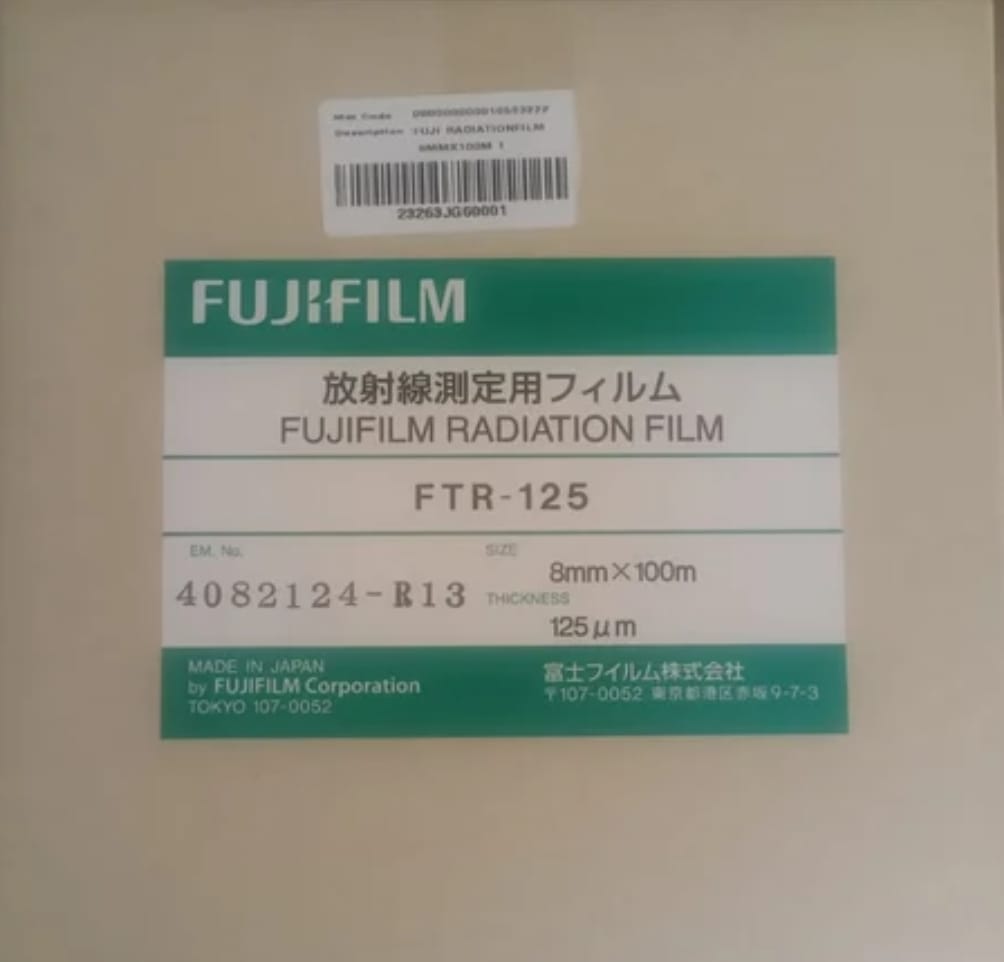
- Product Overview
FUJIFILM FTR-125 is a high‑precision cellulose triacetate (CTA) film dosimeter, specifically designed for electron beam, gamma ray, and ion beam irradiation processing, material testing, and related R&D applications.
It operates on the principle that the absorbance of the CTA material increases upon irradiation. It features a linear dose response, simple measurement procedure, high spatial resolution, and excellent long‑term stability.
- Core Parameters Summary
| Parameter Category | Detailed Specifications | Notes |
| Basic Type | Cellulose Triacetate (CTA) film dosimeter | Colorless transparent film with radiation‑sensitive additives |
| Measurement Principle | Radiation‑induced increase in absorbance of CTA at 280 nm | Absorbance change is linear with absorbed dose |
| Dose Range | Standard: 10 kGy ~ 300 kGy | Custom ranges available on request |
| Energy Response | Electron beam: 50 keV ~ 10 MeV | Low energy dependence, no complex correction required |
| Gamma ray: ¹³⁷Cs, ⁶⁰Co | ||
| Spatial Resolution | Very high | Film thickness is only a few micrometers; enables accurate surface dose distribution measurement |
| Dimensions | Standard: width 12.7 mm, length customizable | Supplied in rolls for continuous measurement and automation |
| Spectral Characteristics | Measurement wavelength: 280 nm | UV spectrophotometer recommended |
| Stability | Un‑irradiated: storable for years at room temperature | Avoid high temperature, high humidity, and direct strong light |
| Irradiated: data stable for months | ||
| Operating Environment | Temperature: 10°C ~ 40°C | Special handling required under extreme conditions |
| Humidity: 30% ~ 70% |
- Detailed Measurement Principle & Characteristics
- Operating Principle
The core of the FTR‑125 dosimeter is a cellulose triacetate film doped with a special radiation‑sensitive agent.
When exposed to ionizing radiation, chain scission and oxidation occur in the CTA polymer, causing a linear increase in absorbance at 280 nm with absorbed dose.
The absorbed dose is accurately calculated from the difference in absorbance before and after irradiation.
- Key Features
Linear response: Good linearity between absorbance change and absorbed dose in 10–300 kGy, high measurement accuracy
Energy independence: Stable response to various electron beam and gamma ray energies, reducing complex energy corrections
High spatial resolution: Thin‑film format enables dose mapping in small areas, suitable for complex‑shaped samples and 3D dosimetry
Easy operation: No chemical processing; only UV absorbance measurement required, reducing human error and test time
Long‑term stability: Unused dosimeters can be stored long‑term at room temperature; irradiated dosimeters maintain stable readings for later analysis and quality control
- Applications & Fields
| Application Area | Typical Uses | Advantages |
| Radiation Processing | Medical device sterilization, food preservation, polymer modification | Precisely monitors radiation dose to ensure product quality and safety |
| Material Testing | Radiation resistance testing, aging studies, new material development | High spatial resolution; measures surface and internal dose distributions |
| Nuclear R&D | Accelerator performance testing, radiation field mapping | Wide linear range, low energy dependence |
| Industrial Irradiation | Wire and cable cross‑linking, heat‑shrinkable material production | Can be integrated into production lines for real‑time dose monitoring |
| Scientific Research | Radiation biology, radiation chemistry, radiation physics | Provides accurate, reliable dose data for research |
- Measurement Procedure & Operation Guide
Standard Measurement Steps:
- Preparation: Remove un‑irradiated FTR‑125 dosimeter from sealed package as blank reference
- Irradiation: Place dosimeter with sample in radiation field, ensuring close contact with sample surface
- Measurement: Measure absorbance of blank and irradiated dosimeters at 280 nm using a UV spectrophotometer
- Calculation: Absorbed dose = (Irradiated absorbance − Blank absorbance) × Calibration factor
- Recording: Save data and parameters for quality control and traceability
Calibration Recommendations:
Calibrate regularly using standard radiation sources (e.g., ⁶⁰Co gamma source)
Verify spectrophotometer performance before each measurement
Record ambient temperature and humidity; apply temperature correction if needed
- Storage & Handling Precautions
- Storage Conditions:
Un‑irradiated dosimeters: sealed, cool, dry, dark environment
Optimum: 15°C ~ 25°C, 40% ~ 60% RH
Avoid contact with organic solvents, strong oxidizers, and heavy metals
- Handling Notes:
Use clean gloves to avoid fingerprints and contamination
Do not fold, stretch, or damage the film surface
Irradiated dosimeters may be sealed and stored for archival records
- Same‑Series Products & Alternatives
| Model | Dose Range | Main Difference | Application |
| FTR-125 | 10 kGy ~ 300 kGy | Standard range | Most irradiation processing and material testing |
| FTR-125L | 1 kGy ~ 50 kGy | Low‑dose type | Low‑dose applications: seed treatment, art preservation |
| FTR-125H | 200 kGy ~ 1000 kGy | High‑dose type | High‑dose industrial irradiation: rubber vulcanization, composite curing |
| FTR-125D | Dual‑sided coating | Dual‑sided measurement for thick samples | 3D dose distribution: internal dose of medical devices |
- Ordering Information & Packaging
| Package Type | Specification | Application |
| Standard Package | 100 pcs/box, 12.7 mm × 50 mm | Laboratory small‑scale testing |
| Roll Package | Length 10 m ~ 100 m, width 12.7 mm | Mass production and automated measurement systems |
| Custom Package | Custom size and quantity | Special applications: integration into equipment |
Note: FTR‑125 is a single‑use dosimeter; it cannot be re‑irradiated for repeated measurement.
Overview of Main Competitors to FUJIFILM FTR-125
In the industrial radiation processing dosimetry market, the FUJIFILM FTR‑125 (CTA film dosimeter) competes with four main categories:
CTA film dosimeters, radiochromic film dosimeters, photoluminescent/fluorescent film dosimeters, alanine/EPR dosimeters, and other special dosimeters.
Below are the major competitors and key comparisons by category.
- Direct Competitors: CTA Film Dosimeters
| Brand/Model | Manufacturer | Key Parameters | Difference vs. FTR‑125 | Application |
| FJL‑01 CTA Dosimeter | China Institute of Atomic Energy | 10~300 kGy | Domestic alternative, similar performance, more cost‑effective | Domestic industrial irradiation, research |
| 280 nm | ||||
| ~125 μm thick | ||||
| Numelec CTA Dosimeter | Numelec, France (discontinued) | Classic CTA design, former industry benchmark | Discontinued in 1977; FTR‑125 is its technical successor | Historical reference, early irradiation |
- Radiochromic Film Dosimeters (Mainstream Alternatives)
These measure dose via radiation‑induced color change without complex pretreatment.
| Brand/Model | Manufacturer | Key Parameters | Features | Advantages Over FTR‑125 |
| GEX B3 Series | GEX Corporation, USA | 0.3~150 kGy, 552 nm, post‑irradiation heat treatment | Mature radiochromic film, high global market share; available as DoseStix for automation | Wider range (covers low‑dose sterilization); visible color change for quick screening |
| GafChromic EBT3/EBT‑XD | Ashland, USA (formerly ISP) | 0.1~100 kGy, μm‑level resolution, 633 nm | Dual‑use for radiotherapy and industrial irradiation; dual‑coated, uniform | Higher low‑dose sensitivity; ideal for 3D dose mapping |
| FWT‑60‑00/FWT‑70‑40 | Far West Technology, USA | 1~100 kGy, fast response, no heat treatment | Designed specifically for industrial irradiation, good stability | Excellent post‑irradiation stability; suitable for long‑term monitoring |
- Photoluminescent / Fluorescent Film Dosimeters
Dose is quantified by radiation‑induced fluorescence intensity, which is linear with dose.
| Brand/Model | Manufacturer | Key Parameters | Principle | Advantages Over FTR‑125 |
| Sunna 535‑nm Series | PNNL, USA (licensed) | 0.3~500 kGy, fluorescence at 535 nm | LiF‑based photoluminescence, ASTM standard method | Ultra‑wide range (food to high‑dose industrial); signal re‑readable |
| Sunna OSL Type | PNNL, USA | 50~300 kGy, optically stimulated luminescence | OSL principle, stable signal, long‑term storage | Ideal for routine food irradiation; stable post‑irradiation |
- Alanine/EPR Dosimeters (High‑Precision Reference Standards)
Measure alanine radical concentration via EPR; used as international dosimetry reference standards, often for calibrating dosimeters like FTR‑125.
| Brand/Model | Manufacturer | Key Parameters | Position | Difference vs. FTR‑125 |
| Harwell Alanine Dosimeter | NPL, UK | 1~1000 kGy, ±1% accuracy, excellent stability | International transfer standard | Requires EPR spectrometer (high cost); much higher accuracy for calibration/arbitration |
| Bruker Alanine Dosimeter | Bruker, Germany | 0.1~1000 kGy, complete EPR system | Commercial alanine system | Suitable for in‑house calibration labs; reusable, low long‑term cost |
- Other Competitive Products
| Type | Representative Product | Manufacturers | Key Features | Application |
| PVC Film Dosimeter | PVC dosimeter | Multi‑national | 25~1000 kGy, 520 nm, temp. coeff. ~0.26%/°C | High‑dose industrial irradiation (cable cross‑linking); low cost for mass use |
| Dichromate Chemical Dosimeter | Fricke / Dichromate system | Lab‑made / commercial | 1~100 kGy, titration, high accuracy | Secondary standard; research and high‑precision measurement |
| Electronic Real‑Time Dosimeter | PTW, IBA | PTW (Germany), IBA (Belgium) | Real‑time online measurement, no lag | High‑end irradiation lines; automated systems needing real‑time feedback |
- Core Competitive Comparison
| Item | FTR‑125 (CTA) | GEX B3 (Radiochromic) | Sunna (Photoluminescent) | Alanine (EPR) |
| Principle | Absorbance increase at 280 nm | Color change at 552 nm | Fluorescence at 535 nm | EPR signal intensity |
| Dose Range | 10~300 kGy | 0.3~150 kGy | 0.3~500 kGy | 1~1000 kGy |
| Energy Dependence | Low (50 keV–10 MeV) | Low (minor correction) | Very low | Very low (international standard) |
| Post‑Irradiation Stability | Good (months) | Requires heat treatment (55°C) | Excellent (years) | Outstanding (decades) |
| Measurement Cost | Medium (UV spectrophotometer) | Medium (visible spectrophotometer) | High (fluorescence reader) | Very high (EPR spectrometer) |
| Spatial Resolution | High (film) | Very high (thin coating) | Medium (film) | Low (pellet/powder) |
| Typical Use | Routine industrial monitoring | Medical sterilization + industry | Food irradiation + research | Calibration + arbitration |
- Market Competitive Landscape
- High‑end market:
Alanine dosimeters (e.g., Harwell) dominate as international standards for dose traceability and calibration.
Routine dosimeters such as FTR‑125 must be calibrated against them.
- Mid‑range industrial market:
GEX B3 and FTR‑125 form a duopoly.
B3 is stronger in medical sterilization (low‑dose range), while FTR‑125 leads in high‑dose industrial irradiation (cable cross‑linking, heat‑shrink materials).
- Low‑end / domestic market:
Domestic CTA (FJL‑01) and PVC dosimeters capture price‑sensitive small and medium irradiation facilities.
- Emerging technologies:
Photoluminescent (Sunna) and electronic real‑time dosimeters are gradually replacing conventional films, especially in high‑end automated lines requiring real‑time data.
NH42-63-318x560.png "CHINT PC-type automatic transfer switches (ATS)NH42-63/4SZ")