Contactor,circuit breaker,sensor,Encoder,PLC,Converter

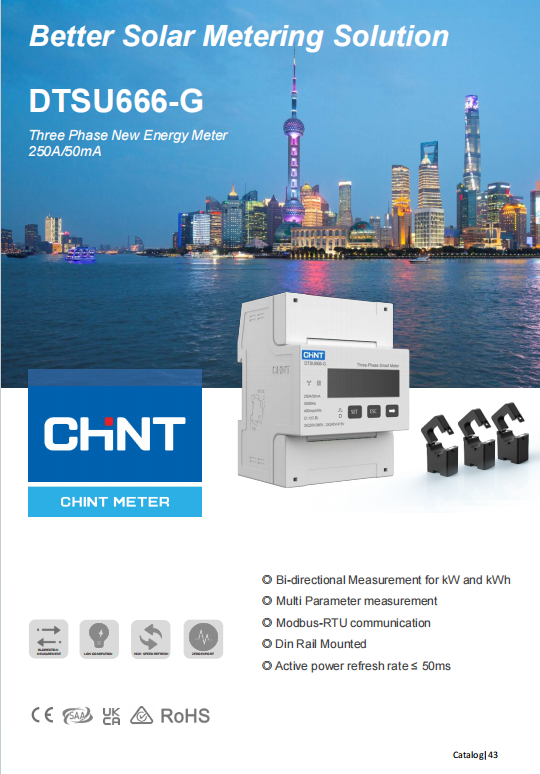


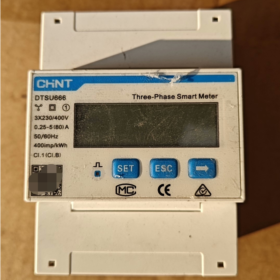
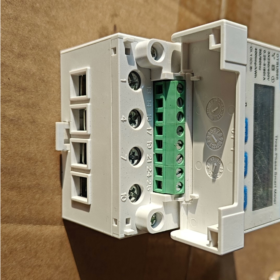
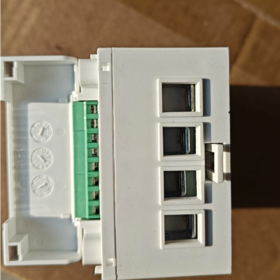
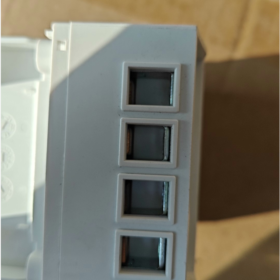
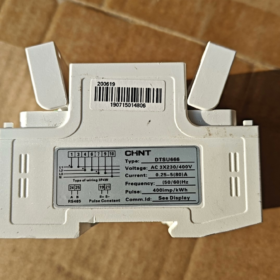

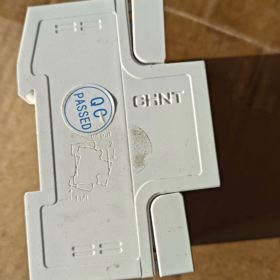
CHINT DTSU666-G PDF is a smart bidirectional energy meter specially designed for new energy scenarios such as PV and energy storage. It adopts standard DIN35mm rail mounting and features high accuracy, high-speed refresh, and bidirectional metering, suitable for residential PV, industrial & commercial energy storage systems and microgrid applications.
- Wiring Guide: CHINT DTSU666G to Inverter Control Board (Meter-485)
| Core Feature | Description |
| Bidirectional Metering | Accurately measures forward (grid input) and reverse (new energy output) kW and kWh energy flow; supports anti‑backflow control. |
| High‑Speed Refresh | Active power refresh rate ≤ 50 ms to meet fast response requirements of new energy systems. |
| Multi‑Parameter Monitoring | Real‑time measurement of voltage, current, power, power factor, frequency and other full electrical parameters. |
| Communication Function | Standard RS485 interface, supports Modbus‑RTU protocol, connectable to energy management systems. |
| Easy Installation | DIN35mm standard rail mounting, 4P (4 modules) compact structure (98×72×65 mm). |
| Wide Temperature Operation | Operating temperature range: ‑25℃ to +55℃, adaptable to various outdoor distribution box environments. |
- Key Technical Specifications
| Item | Specification |
| Meter Type | Three‑phase four‑wire electronic energy meter (DIN‑rail type) |
| Accuracy Class | Active: Class 0.5S / 1; Reactive: Class 2 |
| Reference Voltage | 3×220/380 V (three‑phase four‑wire) |
| Current Rating | 0.015‑1.5(6) A (via transformer), compatible with 5 A secondary side of CT |
| Pulse Constant | 800 imp/kWh |
| Voltage Range | 0.8Un ~ 1.15Un |
| Power Consumption | ≤ 2 W / 10 VA |
| Communication Interface | RS485, baud rate 9600/19200 bps (default 9600), address 1‑247 |
| Display | Segment LCD, supports automatic cycle display and key query |
| Protection Class | IP20 (indoor installation) |
| Auxiliary Power | No external power supply needed; powered directly by voltage signal |
III. Differences from Standard DTSU666
| Item | DTSU666‑G (New Energy Version) | Standard DTSU666 |
| Design Scenario | Bidirectional metering for PV, energy storage and other new energy | General industrial / commercial electricity metering |
| Current Rating | 0.015‑1.5(6) A (more suitable for transformer connection) | Multiple ratings including 0.25‑5(80) A |
| Refresh Rate | ≤ 50 ms (fast response for new energy systems) | Normal refresh rate |
| Function Optimization | Enhanced bidirectional metering accuracy, optimized for anti‑backflow control | Basic electric energy metering functions |
| Application Fields | Residential PV, industrial & commercial energy storage, microgrid systems | Industrial & mining enterprises, hotels, schools, etc. |
- Typical Application Scenarios
- Residential PV Systems: Meter bidirectional energy for self-consumption and grid-feed surplus power, working with inverters for anti-backflow control.
- Industrial & Commercial Energy Storage Systems: Monitor energy flow during charging and discharging to optimize energy efficiency.
- Microgrid Systems: Realize bidirectional metering and monitoring between distributed energy sources and main grid.
- Charging Pile Management: Accurately measure power consumption of three-phase charging piles, supporting remote meter reading and data analysis.
- Installation & Operation Notes
- Mounting: Standard DIN35mm rail mounting, 4P width, suitable for installation in distribution boxes.
- Wiring: Three-phase four-wire system; phases A, B, C connected to terminals 1, 3, 5 respectively; neutral (N) to terminal 7; secondary side of current transformers connected to corresponding current terminals.
- Parameter Setting: Enter programming menu via SET key; default password 700; CT ratio, PT ratio, communication parameters, etc. can be configured.
- Communication Configuration: Supports Modbus-RTU protocol; default baud rate 9600 bps, no parity, 1 stop bit.
- Selection & Ordering Information
Full Model: DTSU666-G 3×220/380V 0.015-1.5(6)A 4P
Matching Suggestion: Used with CHINT current transformers (e.g. BH-0.66 series); select ratio according to actual load.
Alternative Models: Single-phase new energy meter: DDSU666-G; three-phase three-wire: DSSU666-G
CHINT DTSU666-G vs DTSU666: Core Differences & Interchangeability Analysis
Core Conclusion: DTSU666-G is the new energy dedicated version (optimized for PV/energy storage), while DTSU666 is the general-purpose version. They can be temporarily substituted in basic metering scenarios, but DTSU666-G is strongly recommended for new energy systems to ensure bidirectional metering accuracy and fast response.
- Overview of Core Differences
| Dimension | DTSU666‑G (New Energy Version) | DTSU666 (General Version) | Impact |
| Design Purpose | Bidirectional metering for PV/energy storage, compatible with anti‑backflow control | Basic electric energy metering for industrial / commercial / residential use | Optimization direction determined by application scenario |
| Current Rating | 0.015‑1.5(6) A (transformer connection only) | 0.25‑5(80) A (direct connection) / 0.1‑1.5(6) A (transformer connection) | Large difference in connection method and range affects selection |
| Active Power Refresh Rate | ≤ 50 ms (high‑speed response) | Normal rate (approx. 500 ms) | New energy systems require fast power change detection for anti‑backflow control |
| Bidirectional Metering Accuracy | Enhanced design to meet new energy grid‑connection requirements | Basic bidirectional metering, focuses on forward direction | DTSU666‑G provides more accurate metering for grid‑feed surplus scenarios |
| Function Optimization | Adapted for PV inverter control, supports zero‑power output detection | Standard energy metering, no new energy‑specific optimization | DTSU666‑G is more reliable in anti‑backflow protection systems |
| Application Scenarios | Residential PV, industrial & commercial energy storage, microgrids | Industrial enterprises, hotels, schools, general buildings | Performance depends on scenario matching |
- Detailed Technical Parameter Differences
- Current Rating & Connection Method
DTSU666-G: Only available in 0.015-1.5(6) A transformer-connected version, designed specifically for 5 A CT secondary side, suitable for high-current measurement in new energy systems.
DTSU666: Offers multiple ratings including 0.25-5(80) A direct-connected and 0.1-1.5(6) A transformer-connected types for various load scenarios.
- Performance Differences
Active power refresh rate: DTSU666-G ≤ 50 ms (for fast response in new energy systems); DTSU666 uses normal refresh rate (approx. 500 ms).
Starting current: DTSU666-G has lower starting current (0.001In), suitable for low-power output measurement in new energy systems.
Metering accuracy: Both have active Class 0.5S/1, but DTSU666-G offers better consistency in bidirectional metering.
- Software Function Differences
DTSU666-G integrates new energy-specific algorithms optimizing bidirectional power calculation and anti-backflow control logic.
DTSU666 uses general metering algorithms, more suitable for unidirectional or balanced loads.
Both support Modbus-RTU over RS485, but some register addresses in DTSU666-G are optimized for new energy parameters.
III. Interchangeability Analysis
- Interchangeable Scenarios (Temporary Substitution)
Basic energy metering: In general industrial/commercial scenarios where only forward energy measurement is needed, they can be temporarily interchanged (current rating must match).
Parameter monitoring: Functions are consistent when only basic electrical parameters such as voltage, current and power are monitored.
Communication integration: Same Modbus-RTU protocol supported, can access the same energy management system.
- Scenarios Not Recommended for Interchange (Must Match Model)
| Scenario | Recommended Model | Reason |
| PV Grid‑Feed Surplus | DTSU666‑G | Requires high‑precision bidirectional metering; DTSU666‑G has faster refresh and better anti‑backflow adaptation |
| Energy Storage Charge/Discharge Management | DTSU666‑G | Frequent charge/discharge switching requires ≤50 ms fast response to avoid metering errors |
| Anti‑Backflow Control Systems | DTSU666‑G | Dedicated algorithm ensures accurate zero‑power output detection and prevents grid fluctuations |
| Small Load Direct Connection | DTSU666 | DTSU666‑G has no direct‑connected version and cannot adapt to 0.25‑5(80) A loads |
| Power Department Assessment Metering | Per local requirements | Must comply with grid metering standards; some regions explicitly require new energy‑specific meters |
- Notes on Interchange
- Current rating matching: Connection method (direct/transformer) and range must match actual load.
- Parameter setting: After replacement, reset CT/PT ratio, communication address and other parameters; default password for both is 700.
- Function limitation: Replacing DTSU666-G with DTSU666 loses high-speed refresh and anti-backflow adaptation, which may reduce system control accuracy.
- Selection Recommendations
- New energy systems: Prioritize DTSU666-G to ensure bidirectional metering accuracy and system compatibility.
- General industrial/commercial use: Choose DTSU666, select direct or transformer connection based on load type.
- Retrofit projects: When upgrading existing DTSU666 systems to PV/energy storage, replace with DTSU666-G to avoid metering errors and control issues.

NH42-63-318x560.png "CHINT PC-type automatic transfer switches (ATS)NH42-63/4SZ")