Contactor,circuit breaker,sensor,Encoder,PLC,Converter

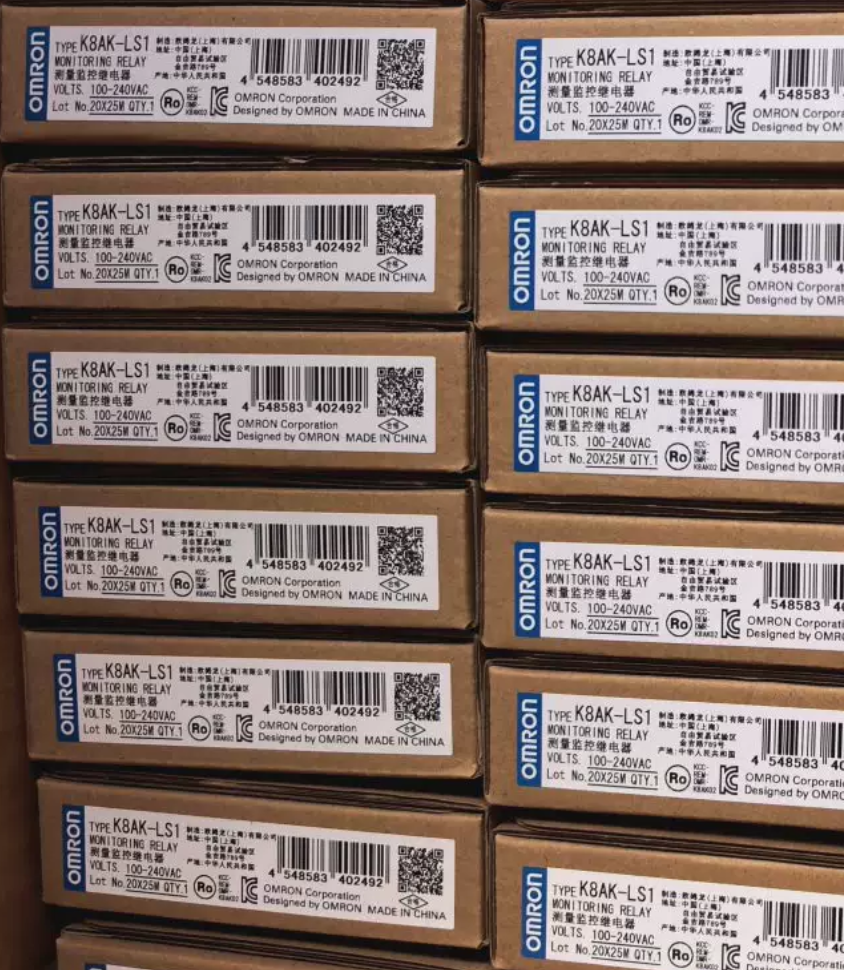

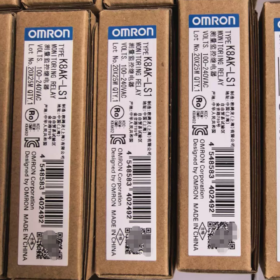
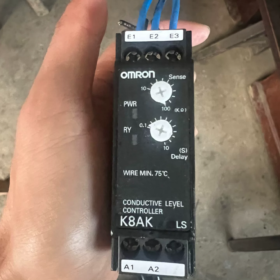
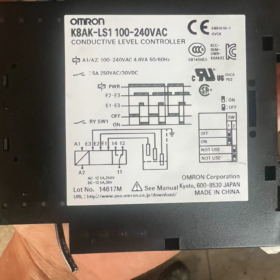
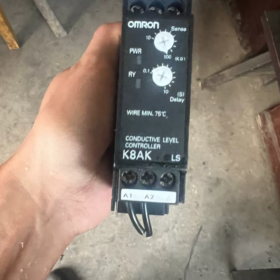
Full Model: K8AK-LS1 100-240VAC
K8AK: Monitoring Relay Series
LS: Conductive Liquid Level Controller (Electrode Type Liquid Level Switch)
LS1: Version with Single Relay Output
100: Power Supply AC 100~240VAC (Market Abbreviation: LS1100)
Alternative model within the same series: K8AK-LS1 24VAC/DC (24V AC/DC universal power supply)
- Main Specifications
| Item | Specification |
| Power Supply | AC 100~240V (50/60Hz) |
| Detection Principle | Conductive Electrode Liquid Level Detection |
| Detection Sensitivity | Continuously adjustable: 10kΩ~100kΩ |
| Operating Delay | 0.1~30s (prevents chattering caused by liquid surface fluctuation) |
| Liquid Level Terminals | 3 electrode terminals (High level, Low level, Common) |
| Output Contact | SPDT 1C (Terminals 11/12/14) |
| Resistive Load: AC250V 5A / DC30V 5A | |
| Mounting | 35mm DIN Rail Mount |
| Dimensions | 22.5(W) × 90(H) × 100(D) mm |
| Operating Ambient | -20℃~+60℃, No Condensation |
| Max. Electrode Cable Length | ≤100m |
| Certifications | CE, UL, CSA |
- Core Functions
- Dual-point Automatic Liquid Level Control (Mode Switch via DIP Switch)
SW1=OFF: Water Supply Mode (Start pump for water replenishment at low level; stop pump at high level)
SW1=ON: Drainage Mode (Start drain pump at high level; stop pump at low level)
- Built-in Latching Logic, No External Latching Circuit Required
- Sensitivity knob adaptable to clean water, industrial water, sewage and other conductive liquids
- Delay function eliminates frequent relay switching caused by liquid surface ripples
- Indicators: PWR (Green, Power), RY (Amber, Relay Actuation)
- Terminal Definition
A1, A2: AC Power Input
Electrode Terminals (Level Probes): COM, LOW (Low Liquid Level), HIGH (High Liquid Level)
Output Contacts
11: Common COM
12: Normally Closed NC
14: Normally Open NO
⚠️ Only applicable to conductive liquids. Deionized water, insulating oil cannot be detected directly.
- Optional Matching Electrodes
BF-1, BS-1, F03 series electrode rods (SUS304/SUS316 material)
- Updated Replacement Model (New Generation)
K8DT-LS1CA (AC100-240V)
Width reduced to 17.5mm, saves cabinet space
Push-in spring terminals, tool-free wiring
Identical function logic and control mode to legacy K8AK-LS1, direct replacement available.
- Common Application Precautions
- Electrodes must be insulated from the tank body; metal tank shell cannot be used directly as common electrode (risk of signal interference)
- Avoid parallel routing of electrode cables alongside power cables to prevent false operation due to electromagnetic interference
- Contaminants adhering to electrodes increase resistance; clean probes periodically
- Do not use for flammable and explosive liquids (low excitation voltage exists between electrodes)
Operating Principle of OMRON K8AK-LS1 (Electrode Liquid Level Relay)
- Basic Detection Principle: Conductive Liquid Sensing
The unit judges liquid level by means of conductive liquid closing the electrode circuit. It only works for conductive media (tap water, sewage, conductive aqueous chemical solutions; not applicable to pure water, oil and other insulating liquids).
- The module generates low-voltage AC detection signal (AC signal prevents electrode electrolysis and polarization scaling), applied to COM, LOW and HIGH electrodes.
- When liquid submerges two electrodes, a conductive path forms and tiny current flows in the loop. The module measures circuit resistance and compares it with the threshold set by the sensitivity knob (10kΩ~100kΩ) to determine electrode immersion status.
Dirty liquid or scaling increases circuit resistance; adjust sensitivity to higher level for adaptation.
- Electrode Definition
COM: Common Electrode (longest electrode, permanently submerged as reference baseline)
LOW: Low Level Electrode (minimum liquid level threshold)
HIGH: High Level Electrode (maximum liquid level threshold)
- Two Control Logic Modes (Selected by DIP Switch SW1)
Mode 1: Water Supply Mode (SW1=OFF, Tank Water Replenishment)
Objective: Start replenishment pump at low level; stop pump at high level
- Liquid level below LOW electrode: Circuit between COM and LOW open → Relay energizes (RY lamp ON) → NO contact 11-14 closes to start replenishment pump
- Liquid level rises and submerges HIGH electrode: COM-HIGH circuit conducts → Relay de-energizes → Pump stops
- Liquid level falls from high position, only submerges LOW without reaching HIGH: Relay remains de-energized (built-in latching logic prevents intermittent cycling)
Mode 2: Drainage Mode (SW1=ON, Sump Drainage)
Objective: Start drain pump at high liquid level; stop pump at low liquid level
- Liquid level rises to submerge HIGH electrode: COM-HIGH circuit conducts → Relay energizes, drain pump starts
- Liquid level drops below LOW electrode: Circuit opens → Relay de-energizes, pump stops
- Liquid level between LOW and HIGH electrodes: Relay stays energized for continuous drainage
- Function of Delay Circuit (TIME Knob: 0.1~30s)
Output state will not change immediately upon receiving detection signal. The delay setting filters transient signals:
Avoid frequent pump start/stop caused by splashing and liquid surface turbulence. Output switches only after stable signal lasts longer than configured delay time.
- Output Execution Unit
Built-in SPDT single-pole double-throw relay contacts:
11: Common terminal
12: Normally Closed NC
14: Normally Open NO
Contact switching controls contactor coil to drive water pump indirectly.
- Key Design Features
- AC detection voltage: Eliminates electrochemical corrosion and scaling on electrodes caused by DC voltage
- Resistance threshold judgment, not simple on/off, compatible with liquids of different conductivity
- Hardware integrated level zone latching logic, no external auxiliary relay required for latching wiring
- Electrode cable length recommended ≤100m; long cables easily introduce electromagnetic interference leading to false triggering
- Simplified Workflow Summary
Liquid submerges electrodes → Conductive circuit closes → Module measures loop resistance → Compare with sensitivity threshold → Process electrode status + DIP switch logic + delay filtering → Actuate internal relay and switch contacts to control pump operation.
Application Scenarios of OMRON K8AK-LS1 (100-240VAC) Electrode Liquid Level Relay
Precondition: Only for conductive liquids (water, salt-containing / acid-base aqueous solutions). Diesel, lubricating oil, pure water, organic solvents and other insulating media are not supported.
Detection principle: Electrode conductivity sensing, matched with 3 stainless steel electrodes to realize automatic dual-point liquid level control.
- General Water Supply & Drainage (Most Common)
1.1 Underground Sump / Sewage Pit (Drainage Mode SW1=ON)
Working Logic: Activate sewage pump when liquid level reaches high setpoint; stop pump when level drops to low setpoint
Industries: Underground parking lots, basement pump rooms, municipal sewage collection pits, building sump pits
Advantages: Built-in zone holding logic avoids frequent pump cycling due to water fluctuation; delay function suppresses false triggering from ripples
1.2 Clean Water Tank, Expansion Tank, Softened Water Tank (Water Supply Mode SW1=OFF)
Working Logic: Start water replenishment valve/pump at low level; stop replenishment at high level to prevent overflow
Applications: Domestic water storage tanks, HVAC expansion tanks, circulating water makeup tanks, intermediate tanks for water purification equipment
- Industrial Fluid Treatment
2.1 Electroplating & Surface Treatment Tanks
Liquid level monitoring for electroplating tanks, pickling tanks and phosphating tanks, automatic replenishment of conductive chemical solution.
⚠️ Select SUS316L electrodes for heavily corrosive media; regularly clean electrode scaling.
2.2 Wastewater Treatment Plants
Liquid level automatic control for regulating tanks, neutralization tanks and chemical dissolving tanks.
Sensitivity knob can be adjusted to adapt to high-resistance sewage with abundant impurities.
2.3 Circulating Cooling Water System
Automatic water replenishment for cooling tower basins and circulating water pools.
Electrode cables should be shielded and routed away from power cables & inverters to avoid interference.
2.4 Washing Equipment & Process Rinse Tanks
Automatic water replenishment for food production washing lines and component cleaning tanks.
- HVAC & Refrigeration Industry
- Chilled / Hot Water Expansion Tanks for Central Air Conditioning
Monitor tank liquid level and control makeup solenoid valve automatically to prevent air intake or overflow.
- Condensate Collection Tank
Automatically start drain pump when liquid level rises in centralized condensate tanks of air handling units.
- Food & Beverage Industry (Conductive Aqueous Media)
Liquid level control for CIP cleaning tanks, ingredient mixing tanks and process water storage tanks
⚠️ Adopt sanitary stainless steel electrodes for food processes; regularly remove protein and dirt deposits to prevent detection failure.
- Equipment OEM Integration
- Standard component for integrated water pump control cabinets and liquid level control boxes
- Small-scale integrated water purification equipment, grey water reuse systems
- Laundry washing equipment, large bath water storage tanks
❌ Unsuitable Scenarios (Selection Checklist)
- Insulating liquids: Engine oil, diesel, hydraulic oil, gasoline, low-conductivity antifreeze, deionized pure water
- Pressurized sealed vessels with no space for electrode installation
- Flammable and explosive fluids (weak excitation voltage exists on electrodes; unit is non-ex-proof)
- Liquids generating persistent heavy foam: Foam is non-conductive and causes incorrect level reading
- Electrode cable length exceeding 100m, high risk of electromagnetic interference and malfunction
✅ Alternative Selection Tips
For oil or pure water applications, K8AK-LS1 cannot be used. Replace with float level switches, capacitive level sensors or ultrasonic level transmitters.


NH42-63-318x560.png "CHINT PC-type automatic transfer switches (ATS)NH42-63/4SZ")