Contactor,circuit breaker,sensor,Encoder,PLC,Converter

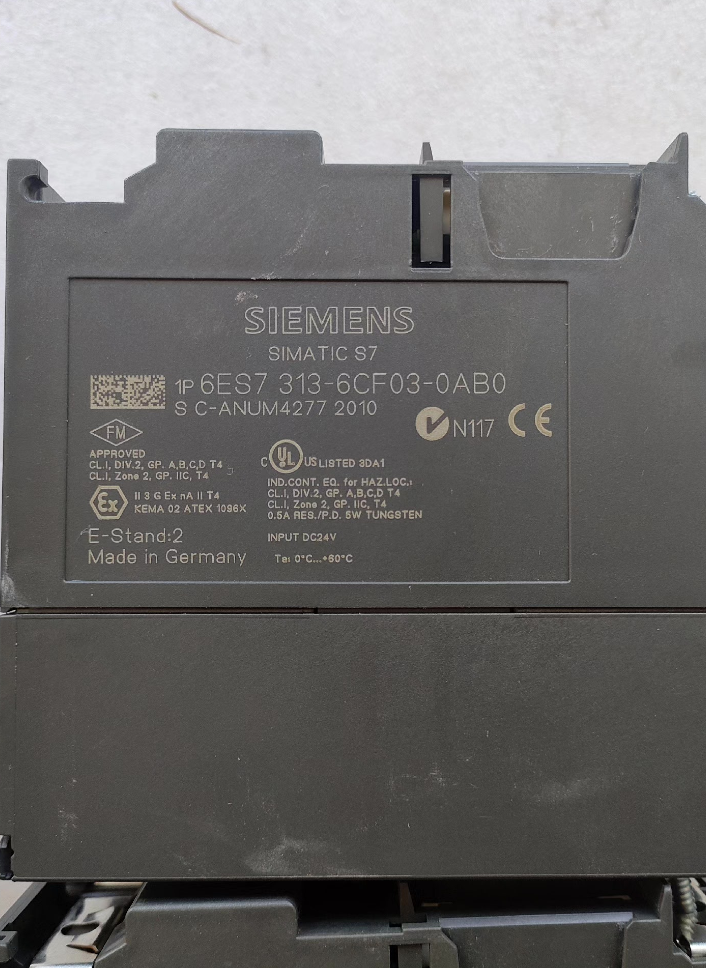

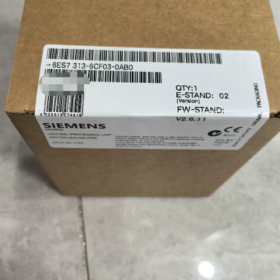
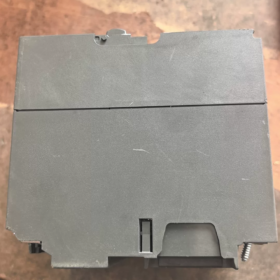
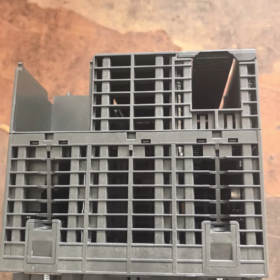
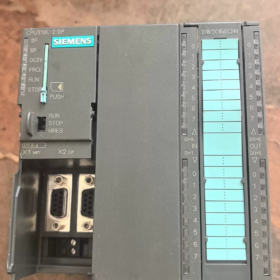
Product Family: SIMATIC S7-300 Compact CPU, Discontinued, spare parts available
Full English Name: SIMATIC S7-300, CPU 313C-2 DP Compact CPU with MPI, 16 DI/16 DO, 3 high-speed counters (30 kHz), integrated DP interface
- Model Code Explanation
6ES7: Siemens S7 automation system module
313: S7-300 CPU313 series
6C: Compact CPU with integrated I/O onboard
F: Version identifier
03: Hardware revision number
0AB0: Product version and packaging version
- Core Hardware Specifications
| Item | Specification |
| Working Memory | 64KB (Program + Data) |
| Firmware Version | V2.6 |
| Power Supply | DC24V, allowable range 20.4~28.8V, typical power consumption 10W, rated current 900mA |
| Onboard I/O | 16DI / 16DO (Transistor output, DC24V) |
| High-speed Functions | 3-channel high-speed counters up to 30kHz; 3-channel PWM pulse output up to 2.5kHz; frequency measurement, PID |
| Communication Interfaces | MPI multi-point interface + integrated PROFIBUS-DP master/slave interface |
| Storage Media | MMC micro memory card mandatory (max.8MB, battery-free, programs and data stored on MMC) |
| Accessories | 40-pin front connector sold separately |
| Mounting | DIN rail, S7-300 standard rack |
| Programming Software | STEP7 V5.3+SP2 or higher |
- Functional Features
- Integrated PROFIBUS-DP: Can act directly as DP master or slave without additional CP communication card. Suitable for distributed I/O, frequency converter and instrument networking. MPI is used for HMI and multi-CPU networking.
- Onboard Technology Functions: Built-in high-speed counting, frequency acquisition, PWM pulse width modulation and closed-loop PID. No extra FM350 technology module required, ideal for packaging, conveying and small positioning equipment.
- Compact Integrated Design: Onboard DI/DO reduces rack occupation, widely used for small-scale machines.
- Maintenance-free: No backup battery. Programs, data and hardware configuration are fully stored on MMC.
- Replacement Models
- Direct Upgrade Replacement: 6ES7313-6CG04-0AB0
Pin assignment, I/O definition and communication are fully compatible; working memory upgraded to 128KB, firmware V3.3. Direct hardware replacement for existing projects with minor configuration adaptation. It is the official spare part after CF03 discontinuation.
- Legacy Compatible Model: 6ES7313-6CE01-0AB0. CF03 is the upgraded version of CE01 and supports downward compatible replacement.
Note: The entire S7-300 series is gradually phased out. S7-1200 / S7-1500 is recommended for new projects.
- HS Code (Reference for Customs Declaration in Foreign Trade)
HS: 8537101190, Programmable Logic Controller (PLC). For pre-declaration reference only, subject to actual customs verification.
- Installation & Configuration Guidelines
- MMC card is mandatory. The CPU cannot start without MMC. Damaged program on MMC will prevent CPU from entering RUN state.
- Both ends of DP bus shall be fitted with terminating resistors. Termination switch is located on CPU DP port.
- Onboard DI/DO: Digital input supports source type. Each transistor output point rated 0.5A, group total current limited by ambient temperature. Freewheeling diode is recommended in parallel for inductive loads.
- Earthing: Single-point earthing for rack and cable shield to avoid interference causing SF/BF alarms.
- Common Troubleshooting
- SF red light steady on: System fault. Priority check: damaged MMC / program error, mismatched hardware configuration, backplane bus fault.
- BF light flashing: PROFIBUS DP bus fault. Inspect DP cable, terminating resistor, disconnected slave station or address conflict.
- All LEDs flashing after power-up: MMC damaged / missing MMC / corrupted program on MMC. Perform MRES reset test and retry with new MMC.
- No output from onboard I/O: Transistor output burnt due to overcurrent. The integrated I/O of this CPU cannot be repaired separately; only CPU replacement available.
- Acceptance Inspection Points for Second-hand Units
- Appearance: No burn marks on housing, no corrosion on backplane, intact DP/MPI port, clear laser engraved serial number.
- Power-on test: Use known good MMC card. Check RUN lamp after power on. Read CPU model, firmware version and diagnostic buffer online via STEP7.
- Communication test: Normal MPI communication. Fit terminating resistor on DP port and test DP bus communication.
- I/O test: Force output signals and measure each 16DI/16DO channel with multimeter to verify no faulty points.
- Backup: Read original project and back up programs inside MMC.
- Typical Application Scenarios
Packaging machinery, small conveyor lines, PID control for fans & water pumps, auxiliary small metallurgy equipment, retrofitting of old production lines with distributed DP I/O, spare part replacement for existing S7-300 equipment.
6ES7313-6CF03-0AB0 (CPU313C-2 DP) Supported Programming Languages
Programming Platform: STEP7 V5.3 SP2 or above (TIA Portal does NOT support this old firmware CPU)
✅ Standard Built-in Languages (Available in basic STEP7)
- LAD (Ladder Diagram): Widely adopted in China, relay-style graphical logic
- FBD (Function Block Diagram): Graphical programming with block wiring
- STL (Statement List): Assembly-style textual instructions with high execution efficiency
✅ Optional Extended Languages (Requires STEP7 Professional add-on package)
- S7-SCL (Structured Control Language): Pascal-like high-level textual language for complex calculation and data processing
- S7-GRAPH: Sequential Function Chart (SFC), suitable for pipeline and sequential process control
- S7-HiGraph: State machine graphical language for multi-state switching equipment (rarely used)
Note: C language is not supported. SCL ≠ C; CFC is exclusive for S7-400 and unavailable for this CPU.
Supplementary Remarks
Multiple languages can be mixed within one project (e.g. FB programmed in SCL, OB1 in LAD)
After program download to CPU, the CPU does not recognize source language type; only compiled machine code is executed.
Built-in high-speed counting, PWM and PID technology function blocks can be called directly via SFB/SFC system function blocks; no extra language required.
6ES7313-6CF03-0AB0 (CPU313C-2 DP) Programming Languages & Applicable Fields
This CPU runs on STEP7 V5.x platform, supporting LAD, FBD, STL, S7-SCL and S7-GRAPH. Combined with onboard high-speed counter, PWM, PID and PROFIBUS-DP hardware features, each programming language fits different process scenarios as follows:
- LAD Ladder Diagram
Features: Relay-style graphic circuit, easy to learn and intuitive for fault diagnosis, most popular among field engineers.
Applicable Fields
General sequential logic: Conveyor belts, sorting machines, fan & pump start-stop interlock
Low-voltage complete sets, HVAC, small sewage control cabinets
Safety interlock, door control, emergency stop, basic DI/DO logic for sensors
Advantage: High readability for on-site commissioning and maintenance technicians, first choice for simple I/O control.
- FBD Function Block Diagram
Features: Graphical block wiring, oriented to control algorithms and suitable for continuous / analog control.
Applicable Fields
Closed-loop PID control of temperature, pressure and flow (fans, heating furnaces, constant pressure water supply)
Instrument data acquisition, analog signal processing, range conversion, alarm threshold judgment
Continuous regulation control of hydraulic and pneumatic circuits
- STL Statement List
Features: Low-level instruction set, high execution efficiency, low memory footprint, supports complex pointers and indirect addressing.
Applicable Fields
Batch data processing, array/buffer operation, pointer addressing
Legacy program migration, high-speed logic with strict scan cycle requirements
Custom low-level function blocks, bit manipulation and register processing
Mostly used by senior developers; poor readability for on-site maintenance.
- S7-SCL Structured Control Language (Pascal-like)
Features: High-level textual language with convenient branch, loop, structure and array functions for complex mathematical calculation.
Applicable Fields
Recipe management (packaging machines, batching systems)
Data statistics, production counting, energy consumption calculation, material traceability
Complex calibration, curve fitting, multi-parameter calculation, communication data parsing
Batch equipment parameter management, fault text processing
- S7-GRAPH Sequential Function Chart (SFC)
Features: Steps + transition conditions, specially designed for time-sequential process flow.
Applicable Fields
Packaging machinery (filling, sealing, packing machines)
Injection molding machines, presses, assembly workstations, automatic loading/unloading equipment
Stepwise operation for production line stations, multi-process interlock and sequential technology
Excellent for sequential machines running step by step; process logic clear, faults can be located to specific step.
Industry Summary Matching CPU Hardware Capability
With onboard 16DI/16DO, 3-channel 30kHz high-speed counter, PWM output and PROFIBUS-DP, this set of programming languages is best suited for the below industries:
- Packaging Machinery: S7-GRAPH for process sequence, SCL for recipe, high-speed counter for encoder positioning
- Material Conveying & Sorting Lines: LAD as primary language, DP network for remote I/O, photoelectric detection and sorting baffle control
- Small Special Processing Machines: Drilling, stamping and assembly equipment; high-speed counter for encoder position acquisition
- HVAC, Constant Pressure Water Supply, Small Sewage Treatment: FBD/LAD for PID regulation and alarm interlock
- Old Production Line Retrofit: Replace legacy S7-300 spare parts, reuse massive existing STL/LAD legacy programs
Limitations
- This language suite belongs to classic STEP7 S7-300 ecosystem. TIA Portal cannot go online directly with this CPU. Not recommended for new projects.
- C language is unavailable, not fit for complex embedded algorithms. Additional communication board required if complex C code is needed.
- S7-GRAPH and S7-SCL require STEP7 Professional edition. Basic STEP7 only includes LAD/FBD/STL.
NH42-63-318x560.png "CHINT PC-type automatic transfer switches (ATS)NH42-63/4SZ")