المقاولين,قاطع الدائرة,الاستشعار,التشفير,بلك,محول

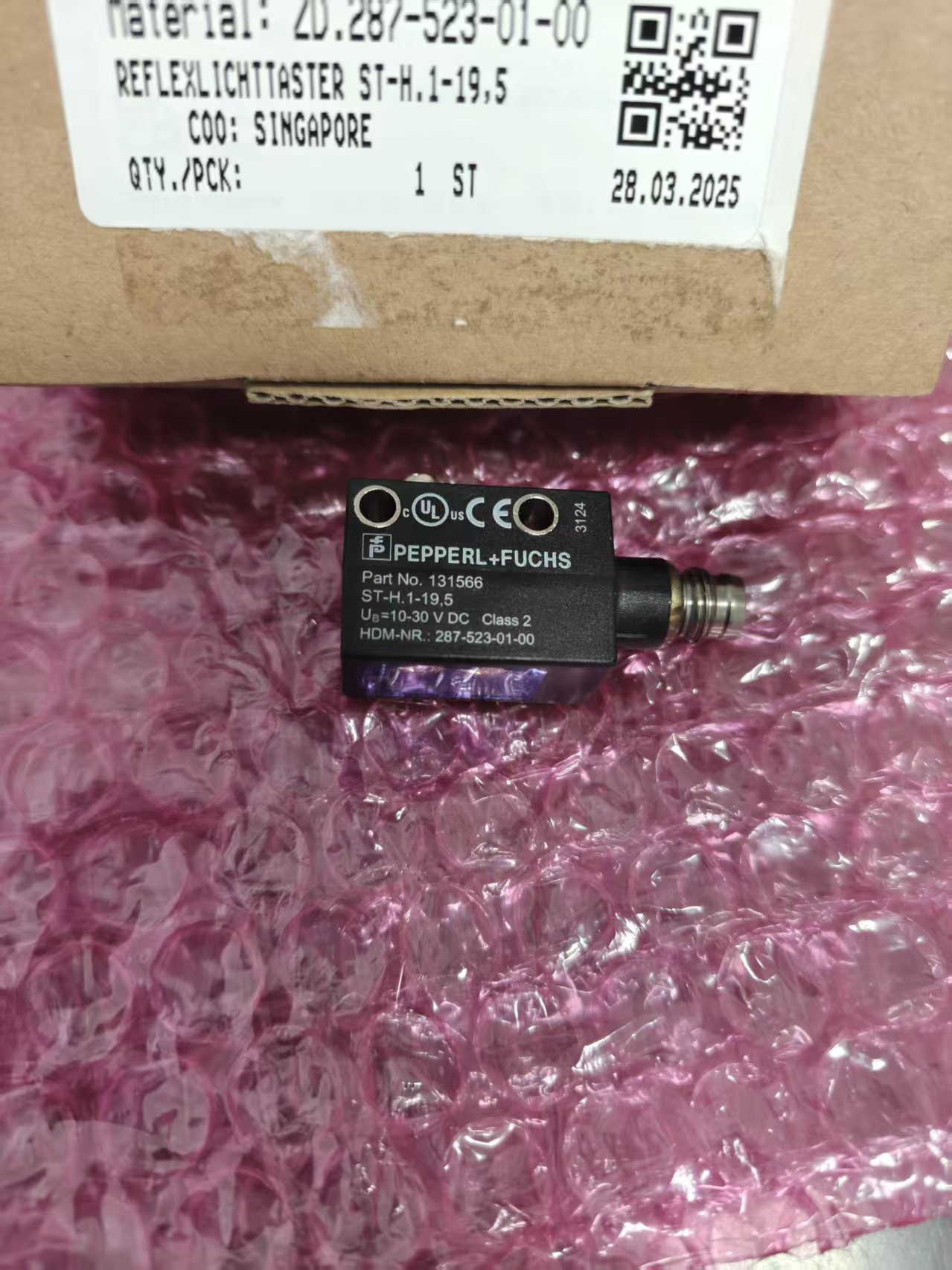

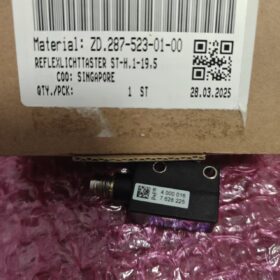
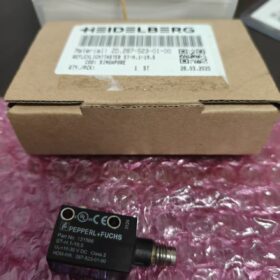
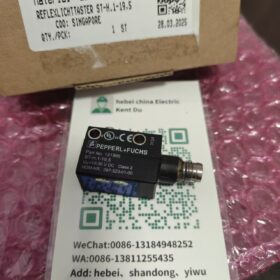
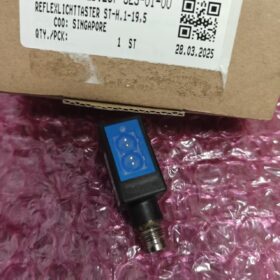
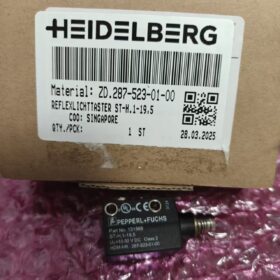
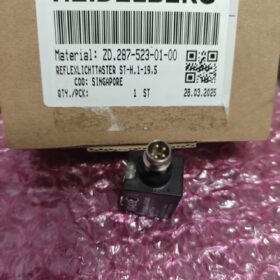
Alternate Designations: HDM-NR-287-523-01-00 / Heidelberg OEM Part ZD.287-523-01-00
المعلومات الأساسية
بيبرل + فوكس رقم الطلب: 131566
P+F Internal Model: ST-H.1-19,5
Heidelberg Machine Part No.: HDM-NR-287-523-01-00 (ZD.287-523-01-00)
نوع المنتج: Diffuse-mode جهاز استشعار كهروضوئي (photocell)
Target Application: Heidelberg Stahlfolder folding machine, sheet-presence detection for printing equipment. Custom OEM-only variant; no public datasheet available on Pepperl+Fuchs official website.
بلد المنشأ: سنغافورة
وزن: تقريبا. 30 ز
كهربائي & المواصفات الميكانيكية
- جهد الإمداد: 10…30 VDC
- اتصال: M12-pin male connector
- السكن: Compact square PBT plastic housing with two mounting screw holes
- فئة الحماية: IP67
- المؤشرات: Dual-LED (قوة, switching status)
- الإخراج: بنب, short-circuit protected
- درجة حرارة التشغيل: -25 … +55 ℃
شرح كود النموذج
131566: Pepperl+Fuchs OEM part number
ST-H.1-19,5: Internal sensor series designation
HDM-NR-287-523-01-00: Heidelberg machine-specific part number, not a Pepperl+Fuchs model; printed on printing-machine accessory labels.
بصلح & ملاحظات المشتريات
- This is a custom OEM sensor for printing-machine applications. Standard off-the-shelf Pepperl+Fuchs photoelectric sensors cannot be directly substituted. Light spot geometry, sensing range and output timing are custom-tuned for folding-machine operation.
- قائمة مراجعة فحص الوحدة المستعملة:
M12 connector pins free of corrosion and pin-retraction damage
Optical lens free of scratches, ink and dirt contamination
Power LED illuminates upon power-on; output state toggles when tested with a reflective target
No short-circuit across supply and output pins
- المصادر: Always specify Pepperl+Fuchs order number 131566. Heidelberg HDM-part numbers cannot be recognized by Pepperl+Fuchs distributors.
تعيين الدبوس (M12-4-pin male, view from connector face)
| دبوس | إشارة |
| 1 | UB+ Power Positive (10‑30 VDC) |
| 2 | إخراج إشارة PNP |
| 3 | 0V GND |
| 4 | غير متصل |
بيبرل + فوكس 131566 التوثيق الفني
Important Notice: 131566 (ST-H.1-19,5) is a custom OEM-exclusive sensor for Heidelberg printing presses. No original PDF datasheet is published by Pepperl+Fuchs. This document is compiled from physical-part labelling, OEM-supplier field measurements and Heidelberg machine manuals, and is suitable for maintenance, procurement, commissioning and second-hand-unit validation.
Alternate designation: HDM-NR-287-523-01-00 (Heidelberg part number, not a Pepperl+Fuchs model)
1 نظرة عامة على المنتج
| غرض | مواصفة |
| Pepperl+Fuchs Order No. | 131566 |
| Internal Model | ST‑H.1‑19,5 |
| Heidelberg OEM Part No. | HDM‑NR‑287‑523‑01‑00 (ZD.287‑523‑01‑00) |
| نوع المنتج | Diffuse‑mode photoelectric sensor |
| Target Application | Heidelberg Stahlfolder folding machine, sheet‑presence detection for printing equipment |
| مصدر الضوء | Modulated infrared LED |
| اتصال | M12‑4‑pin male straight connector |
| مواد الإسكان | البلاستيك الهندسي PBT |
| فئة الحماية | IP67 |
| بلد المنشأ | سنغافورة |
| الوزن الصافي | ≈30 g |
2 التقييمات الكهربائية
| المعلمة | قيمة | ملاحظات |
| Supply Voltage Ub | 10 … 30 V DC | العاصمة, Class‑2 supply |
| نوع الإخراج | PNP normally‑open output | Short‑circuit protection, reverse‑polarity protection |
| الأعلى. Output Load Current | 100 أماه | |
| Quiescent Current | ≤25 mA | |
| انخفاض الجهد | ≤2.0 V | Output ON state |
| Switching Logic | Light‑ON (output active upon receiving reflected light) | Output de‑energized when reflected light is blocked by sheet material |
| تبديل التردد | ≈250 Hz | Customized for high‑speed sheet detection in folding machines |
| درجة حرارة التشغيل | ‑25 … +55 ℃ | Printing‑shop ambient conditions |
| درجة حرارة التخزين | ‑40 … +70 ℃ |
M12-4-pin Pinout (male, view from connector end face)
| دبوس | إشارة | وصف |
| 1 | UB+ | Power supply positive 10‑30VDC |
| 2 | خارج | PNP signal output |
| 3 | 0V/GND | Power supply negative |
| 4 | N/C | غير متصل, leave floating |
ملاحظة الأسلاك: Do not wire pin 4; do not connect pin 4 to 0V, otherwise sensor malfunction will occur.
3 بصري & المعلمات الميكانيكية
- نطاق الاستشعار: 0…19.5 mm (suffix 19,5 denotes nominal sensing distance)
- Light Spot: Small-spot optics optimized for thin-sheet detection. Direct replacement by standard-range commercial photoelectric sensors is not permitted.
- تصاعد: Two Φ3.2 mm mounting holes integrated into housing; M3 mounting screws, recommended torque 0.4-0.6 N·m
- Housing Overall Dimensions: W14 mm × H31 mm × D22 mm
- مؤشرات LED:
Green LED: Power-supply status
Yellow LED: Switching-status indicator (illuminates when reflected light is detected)
4 المعايير & الشهادات
CE-marked, compliant with EN 60947-5-2 for photoelectric sensors
No public UL file (OEM custom variant)
5 تثبيت & Commissioning Instructions
- Recommended mounting gap between sensor and sheet/reference surface: 8-16 مم. Avoid direct contact; do not exceed 19.5 mm maximum sensing distance.
- Optical-axis alignment: Lens must face the sheet-travel path. Keep lens surface clean; ink and dust accumulation will trigger false detection.
- No sensitivity-adjustment potentiometer: Parameters are factory-fixed; no on-site adjustment possible.
- الكابلات: Use M12-4-pin female-cable assembly; connect pins 1-2-3 only, pin 4 unused.
6 جدول استكشاف الأخطاء وإصلاحها
| أعراض الخطأ | Check Points |
| مؤشر LED الأخضر مطفأ | Verify 10‑30 VDC at pin 1; continuity of pin 3 GND; M12‑pin corrosion / bent‑pin damage |
| Green LED always ON, yellow LED never illuminates | Lens fully covered by ink; mounting distance exceeds 19.5 mm; missing reflective target; internal LED failure |
| Yellow LED permanently ON, no response to passing sheets | Lens contamination; misaligned optical axis; output transistor short‑circuit; background‑reflection interference from machine frame |
| Sporadic false triggering | Excessive supply‑voltage drop; poor cable shielding; ink‑paper debris on lens; out‑of‑range installation distance |
7 شراء & Replacement Critical Notes
- Always place orders using Pepperl+Fuchs order number 131566. Pure-reference to HDM-NR-287-523-01-00 will not be recognized by Pepperl+Fuchs channel partners.
- This is an exclusive Heidelberg OEM custom part. Standard Pepperl+Fuchs series (على سبيل المثال. RL31) differ in spot geometry, switching threshold and timing behaviour. Direct drop-in substitution causes missed-sheet and false-detection faults and is discouraged for printing-press use.
- Second-hand unit validation steps:
1) Inspect M12 connector pins for oxidation and pin-retraction damage
2) Check lens for cracks and deep scratches
3) Apply 10-30VDC supply; confirm green power-LED lights up
4) Hold white reflective paper in front of lens: yellow LED turns ON. Remove paper: yellow LED turns OFF
5) Measure pin-2 output with multimeter; confirm PNP level toggles correctly; no internal short-circuit.
8 ملاحظات السلامة
- Do not aggressively wash sensor lens with strong solvents; optical coating will be degraded. Clean only with lint-free cloth.
- Output is PNP sourcing type; connect only to PLC high-level-input channels. Incompatible with NPN-sinking inputs.
- Do not exceed maximum 30 VDC supply voltage; permanent internal circuit damage may occur.
Working Principle of Diffuse-Mode Photoelectric Sensors
Pepperl+Fuchs 131566 is a diffuse-mode photoelectric sensor, with emitter and receiver integrated within one single housing.
Fundamental Principle
Two core internal components:
- Transmitter: الصمام بالأشعة تحت الحمراء: Emits modulated infrared light (modulation suppresses false triggering caused by ambient workshop-lighting and sunlight).
- Receiver: Phototransistor / Photo-IC: Captures light reflected back from targets.
Functional sequence:
- Infrared LED emits light beam outwards.
- Beam strikes the surface of target object (ورق / workpiece).
- Object surface diffusely reflects part of the incident light.
- Portion of reflected light returns to the sensor receiver window.
- Receiver chip detects incoming light → internal circuitry activates and toggles solid-state switching output (بنب / NPN level change).
⚠️ Distinction from retro-reflective sensors (separate reflector plate required):
Diffuse-mode: No reflector plate required. Relies on natural reflectance from target surface. Model 131566 works in this way for sheet-detection.
عاكسة للرجعية: Sensor plus dedicated reflector plate. Light bounces off reflector; object interrupts beam to trigger switching.
Two Standard Switching Logics
- ضوء على: Output becomes active when reflected light is received. When object moves away / blocks return light path, output de-energizes.
✅ Pepperl+Fuchs 131566: ضوء على. When sheet enters detection zone, sheet reflects infrared light, yellow LED illuminates and PNP output turns high. After sheet passes, reflected-light signal vanishes and output de-activates.
- الظلام على: Output becomes active when return-light signal is absent; output de-activates upon light reception.
Key Influencing Factors (Field-fault root-causes for folding-machine installations)
- مسافة الاستشعار
Each sensor has a defined nominal sensing range. For 131566 maximum range =19.5 mm. Target outside this distance yields insufficient reflected-light amplitude for reliable triggering.
- Target Colour / Reflectivity
White paper gives high reflectance and reliable triggering. أسود / matte-dark objects deliver substantially reduced effective sensing range.
- Light-spot Geometry
OEM printing-special sensors use small-spot optics for narrow-sheet detection. Standard-commercial sensors feature large spot sizes and may falsely trigger from metallic machine-frame background reflections. This is the primary reason that 131566 cannot be arbitrarily substituted by general-purpose sensors.
- Lens Contamination
Ink-and-dust fouling blocks outgoing and incoming light paths and causes complete sensor failure; this represents the most-common failure mode within printing-plant environments.
- Modulated-light technology
Emission is high-frequency-modulated infrared. Receiver circuitry only responds to this specific modulation frequency. Unmodulated ambient daylight and workshop-lamps are filtered out for anti-interference performance.
Comparison Table of Three Common Photoelectric Sensor Types
| نوع المستشعر | بناء | مبدأ التشغيل | التطبيقات النموذجية |
| Diffuse‑mode (this unit) | باعث & receiver combined in one housing | Light reflected directly from target object | Sheet‑presence detection, workpiece‑presence monitoring |
| Retro‑reflective | Single‑body sensor + external reflector plate | Light returns from reflector; object blocks beam path | Gate‑way monitoring, conveyor‑belt blockage detection |
| Through‑beam (thru‑beam) | Separate emitter unit and separate receiver unit | Emitter projects beam directly onto receiver; object interrupts beam path | Object counting, long‑range detection |
Practical Application Example for Heidelberg Stahlfolder with 131566
Sensor is mounted in the sheet-transport path of the folding machine, operating gap set to approx. 8-16 mm from sheet plane.
Sheet passing through detection zone: White sheet reflects infrared light back to receiver → yellow LED lights up; PNP output goes high; machine control registers sheet present.
Sheet exits detection zone: Only dark-metallic machine frame is present; return-light amplitude falls below threshold → yellow LED switches off; output de-energizes; machine registers sheet-departure.
Typical Application Scenarios for Diffuse-Mode Photoelectric Sensors
Diffuse-mode photoelectric sensors integrate emitter and receiver within one housing. No reflector plate or paired separate-receiver unit is required. Detection relies on light reflected off target-object surfaces. Simple-to-mount, and among the highest-volume sensor categories deployed across industrial automation.
Representative device: Pepperl+Fuchs 131566 (sheet-detection for Heidelberg folding machines)
1 الطباعة & Paper-processing Industry
- Sheet-presence detection: Folding machines, die-cutters and printing-press paper-paths. Detect sheet arrival, missing-sheet conditions, double-sheet pre-warning and sheet-trailing-edge monitoring. This is the exact application of unit 131566; small-spot variants are purpose-built for thin-paper sensing.
- Label-presence detection: Verify label-in-position and label-web breakage.
- Paper-roll end-of-stock detection: Detect exhaustion of raw-material paper reels.
Industry-specific pain points: Lens fouling by ink and paper dust; large reflectance variation between black-and-white substrates. Prefer small-spot fixed-threshold OEM-grade sensors.
2 Material-handling & Conveyor-line Systems
- Work-piece-arrival detection: Belt-driven and roller-conveyor systems. Detect carton-or-work-piece arrival at workstation to trigger actuators, scanners and stoppers.
- Item counting: Generate switching pulses as objects pass the sensor for production-volume tallying.
- Bin-level presence-check: Detect presence / absence of components inside bins and feeders for missing-part alarms.
- Jam-detection monitoring: Identify material-pile-up conditions within transfer chutes.
3 ماكينات التعبئة والتغليف
- Pouch / carton detection: Confirm feeding-of-packaging material into processing stations; empty-pack identification.
- كاب & component-presence checks: Filling-and-sealing-machinery; confirm component-in-place status.
- Finished-goods ejection confirmation: Verify finished-product output from process stations.
4 Machine-tool & Assembly-automation
- Work-piece-in-fixture validation: Robot-loading / unloading stations; confirm correct part seating.
- Small-component presence-detection: Detect springs, screws and plastic-moulded-parts.
- Hopper low-level alarm: Trigger warning when feed-hopper component stock runs low.
5 تصنيع السيارات
- Component-in-jig confirmation for car-body-assembly tooling.
- Transfer-trolley position-detection.
- Component-transfer-line counting.
6 Consumer-electronics & Light-manufacturing
- PCB-board and plastic-housing presence-detection.
- Conveyor-line object-pass-by monitoring.
- Small-part feeder-output-verification.
7 Lifting-warehousing & General-purpose Machinery
- Fork-position simple-detection.
- Object-presence monitoring for safety-door zones (selected variants).
Diffuse-mode Photoelectric Sensor Selection Criteria & قيود التطبيق (Engineering Focus)
- Strong dependency on target-object colour
Light-coloured / white surfaces deliver high reflectance and extended effective sensing distance. Black and matte-dark targets reduce usable sensing distance drastically; actual range may drop to only 30-50 % of nominal-rated value.
- Background-reflection susceptibility
Bright metallic rear-background surfaces may produce false-triggering. For such deployments specify small-spot or background-suppression (BGS) diffuse-mode sensors.
Pepperl+Fuchs 131566 implements small-spot optics to minimise interference from metallic folding-machine frames within tight-clearance mechanical assemblies.
- Limited absolute sensing range
Standard diffuse-mode sensors typically cover tens-to-hundreds of millimetres. For long-distance detection select retro-reflective or through-beam sensor configurations.
- Poor performance with transparent targets
Glass and clear thin-film substrates cannot be reliably sensed by standard diffuse-mode sensors. Use dedicated transparent-object-detection sensor models.
Quick-comparison Table: Diffuse-mode / Background-suppression / عاكسة للرجعية / من خلال شعاع
| نوع المستشعر | الخصائص الرئيسية | Typical Use‑case |
| Standard diffuse‑mode | Operates on target‑surface reflectance; فعالة من حيث التكلفة; vulnerable to background‑reflection interference | General‑work‑piece & sheet‑detection (Model 131566) |
| Background‑suppression (BGS) diffuse‑mode | Electronically rejects background‑surface reflections; immune to background‑colour variation | Targets located close to metallic frames; work‑pieces with variable‑height profiles |
| Retro‑reflective | Requires dedicated reflector plate; long sensing‑range capability | Chute‑and‑gate beam‑interruption monitoring |
| Through‑beam (thru‑beam) | Physically‑separate emitter‑receiver pair; maximum‑available sensing‑range | Long‑distance detection, transparent‑object inspection |


NH42-63-318x560.png "مفاتيح النقل التلقائي من نوع الكمبيوتر الشخصي CHINT (المنشطات الأمفيتامينية)NH42-63/4SZ")