Contactor,circuit breaker,sensor,Encoder,PLC,Converter

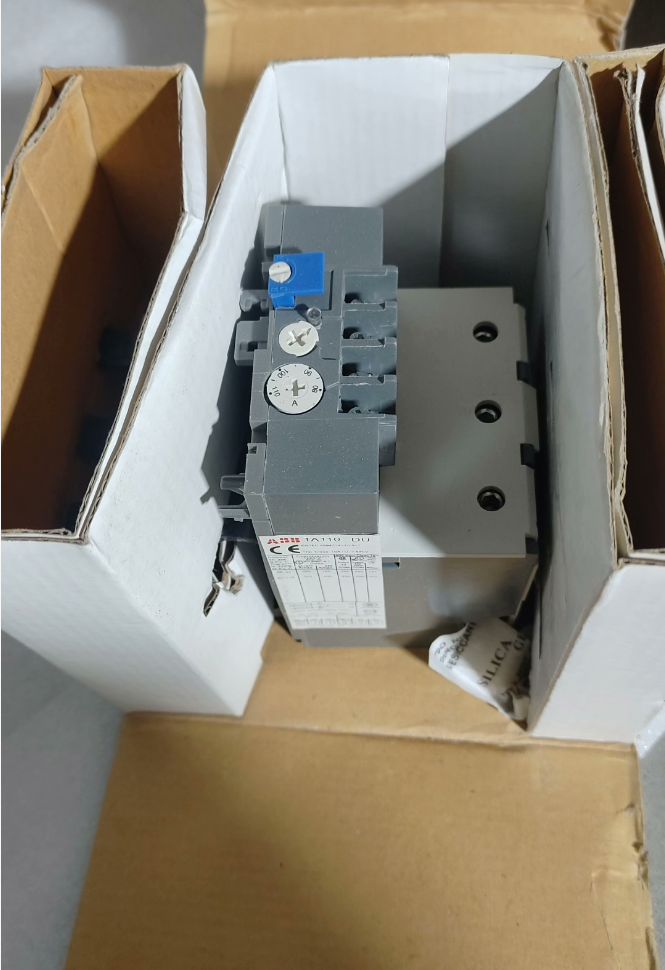

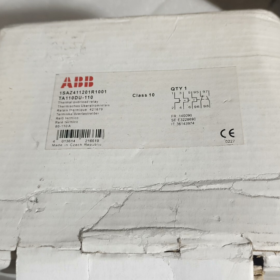
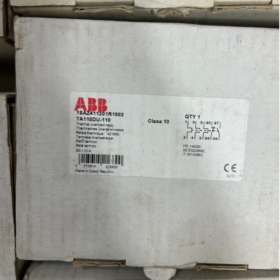
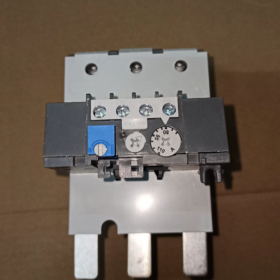
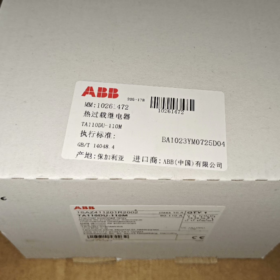
The TA110DU110 is a classic 3-pole thermal overload relay from ABB TA series, delivering integrated protection for three-phase asynchronous motors with a rated current range of 80~110A. Adopting the inverse-time tripping principle of bimetallic strips, this relay comes standard with phase-loss protection and automatic ambient temperature compensation, with a trip class of Class 10A. It can be directly plugged onto ABB A/AE/AF95~110 series contactors or mounted independently on DIN rails. Equipped with switchable manual/automatic reset modes and one normally open (NO) plus one normally closed (NC) auxiliary signal contact, it serves as a standard protective component for industrial motor control circuits. Widely applied to power loads such as fans, water pumps, compressors and conveyor lines, it effectively prevents winding burnout accidents of motors caused by overload, locked rotor and phase loss.
Full Model: `TA110DU110`
- TA: General series code for ABB thermal overload relays, representing the family of electrothermal protective relays
- 110: Frame current rating, indicating the maximum rated frame current of 110A for this product
- DU: Function type code, standing for standard specification featuring 3-pole protection, phase loss detection, ambient temperature compensation and direct mounting onto contactors
- 110: Upper limit of current setting, corresponding to an adjustable current range of 80A ~ 110A
Core Technical Specifications
| Parameter Category | Parameter Item | Detailed Specification |
| Main Circuit Characteristics | Rated Insulation Voltage Ui | 690V AC / 440V DC |
| UL/CSA Rated Operational Voltage | 600V AC | |
| Adjustable Current Range | Continuously adjustable from 80A to 110A | |
| Trip Class | Class 10A (standard motor protection class) | |
| Number of Poles | 3 poles, full 3-pole protection | |
| Phase Loss Protection | Standard built-in; accelerates tripping under three-phase unbalance | |
| Temperature Compensation | Supported; protection accuracy remains unaffected within -25℃ ~ +55℃ ambient temperature | |
| Auxiliary Contacts | Contact Configuration | 1 NO + 1 NC, electrically isolated |
| Conventional Thermal Current Ith | 5A | |
| Rated Contact Capacity | AC250V 3A; DC24V 5A | |
| Mechanical & Mounting | Mounting Method | Direct mounting on contactors / independent DIN rail mounting |
| Compatible Contactors | Series A95, A110, AE95, AE110, AF95, AF110 | |
| Wiring Method | Screw-clamp terminals | |
| Overall Weight | Approx. 0.76kg | |
| Reset Mode | Switchable manual/automatic reset; supports remote reset expansion | |
| Environment & Certifications | Operating Ambient Temperature | -25℃ ~ +55℃ |
| Storage Temperature | -40℃ ~ +70℃ | |
| Ingress Protection Rating | IP20 | |
| Compliance Certifications | CE, UL, CSA, CCC, GL (Germanischer Lloyd Marine Certification) | |
| Compliant Standards | IEC 60947-4-1, EN 60947-4-1 |
Cross Reference of Models within the Same Series
- Full Specifications of TA110DU Frame
| Full Model | Adjustable Current Range | Compatible Motor Power (380V) | Matching Contactors |
| TA110DU-65 | 50 ~ 65A | 30kW | A95/AE95/AF95 |
| TA110DU-80 | 60 ~ 80A | 37kW | A95/AE95/AF95 |
| TA110DU-90 | 66 ~ 90A | 45kW | A110/AE110/AF110 |
| TA110DU-110 | 80 ~ 110A | 55kW | A110/AE110/AF110 |
- Comparison of Adjacent Frame Series
| Series Model | Frame Rated Current | Maximum Adjustable Current | Applicable Scenarios |
| TA110DU | 110A | 110A | Medium & small power motors (30~55kW) |
| TA200DU | 200A | 200A | Medium & large power motors (75~110kW) |
| TA450DU | 450A | 450A | High-power heavy-duty motors (132~250kW) |
Typical Application Scenarios
- Standard Motor Starter Protection Circuit: Combined with ABB A/AF series contactors to form electromagnetic starters, connected in series to the main circuit of three-phase motors to realize protection against motor overload, locked rotor and phase loss. It is the standard protection solution for general power equipment including fans, water pumps, air compressors and machine tool spindles.
- MCC Motor Control Centers: Served as standard protection units for motor feeder circuits in drawer cabinets and fixed cabinets, integrated with contactors to realize integrated motor start-stop control and protection.
- Conveyor & Logistics Sorting Systems: Matched with roller motors and sorting drive motors, adapting to frequent start-stop and load fluctuation working conditions of production lines, and preventing motor aging and burnout caused by long-term overload.
- Central Air Conditioning & Refrigeration Units: Protect refrigeration power equipment such as compressors and cooling tower fans, suited to the refrigeration industry’s characteristics of severe load fluctuations and seasonal high-load operation.
- Support for OEM Complete Equipment: Widely matched with industrial machinery including packaging machinery, rubber & plastic machinery and metallurgical auxiliary equipment. As standardized motor protection components, it meets electrical safety specification requirements for equipment factory delivery.
Common Troubleshooting Matrix
| Fault Phenomenon | Root Cause Analysis | Step-by-Step Solutions |
| Relay falsely trips during normal motor operation | 1. Low current setting value, lower than the motor rated current | 1. Check the motor rated current and adjust the setting knob to the corresponding rated value |
| 2. Excessively high ambient temperature exceeding compensation range | 2. Improve cabinet heat dissipation and avoid direct sunlight or heat source radiation | |
| 3. Severe current deviation induced by three-phase voltage unbalance | 3. Measure three-phase currents to troubleshoot hidden risks of voltage unbalance or phase loss | |
| 4. Overlong motor startup time exceeding withstand limit of Class 10 trip class | 4. Replace with thermal overload relays of Class 20 or Class 30 for heavy-load startup applications | |
| Relay fails to trip under motor overload or locked rotor | 1. Excessively high current setting value, far higher than the motor rated current | 1. Recalibrate the setting value to strictly match the motor rated current |
| 2. Loose main circuit wiring terminals leading to excessive contact resistance | 2. Tighten main circuit terminals and troubleshoot overheating & oxidation issues | |
| 3. Stuck relay mechanical mechanism and failed tripping assembly | 3. Cut off power and manually test the flexibility of the tripping mechanism; replace the module if jamming occurs | |
| Protection does not activate upon phase loss fault | 1. Wrong three-phase incoming wiring with incomplete connection to relay main circuit | 1. Verify L1/L2/L3 three-phase wiring to ensure all phases are reliably connected |
| 2. Aging and failure of internal bimetallic components | 2. Artificially simulate phase loss to test protection function; replace the relay if function fails | |
| Abnormal or no output of auxiliary contact signals | 1. Auxiliary contact load exceeds rated capacity, resulting in contact burnout | 1. Confirm load current does not exceed contact rating; add intermediate relays for current amplification if necessary |
| 2. No reset after tripping, contacts remain in fault state | 2. Manually or automatically reset the relay after troubleshooting root fault causes | |
| 3. Poor contact due to contact oxidation | 3. Measure contact on-off resistance; replace the module if poor contact exists |
- Terminal Definition & Function Description
The TA110DU110 adopts industry-standard terminal numbering rules, divided into two parts: main power circuit and auxiliary control circuit. All terminals are front-mounted screw-clamp type with all wiring operations accessible from the front side.
- Main Circuit Terminals (Three-Phase Power Circuit)
| Terminal Mark | Terminal Type | Wiring Instructions |
| 1L1, 3L2, 5L3 | Incoming Terminals | Upper-side input, connected to output terminals of contactor main contacts, corresponding to three-phase power L1/L2/L3 |
| 2T1, 4T2, 6T3 | Outgoing Terminals | Lower-side output, directly connected to stator windings of three-phase asynchronous motors |
Notes: The three-phase main circuit has no polarity requirement, yet each phase must be connected in one-to-one correspondence without cross-phase misconnection. When directly mounted on contactors, the main circuit is automatically conducted via plug-in copper bars with no extra power wiring required.
- Auxiliary Circuit Terminals (Control & Signal Circuit)
| Terminal Mark | Contact Type | Function Description | Typical Wiring Purpose |
| 95 – 96 | Normally Closed (NC) | Conductive under normal operating conditions; opens upon tripping caused by overload/phase loss | Connected in series to contactor coil control circuit to cut off power supply to the contactor and stop the motor upon faults |
| 97 – 98 | Normally Open (NO) | Disconnected under normal operating conditions; closes upon tripping caused by overload/phase loss | Connected to sound-light alarm circuits or PLC digital input points for fault signal upload and alarm notification |
The auxiliary contacts are electrically isolated with no electrical connection to the main circuit and a conventional thermal current of 5A. Intermediate relays are recommended for series connection to expand capacity and prevent contact burnout when controlling high-power loads.
- Typical Wiring Schemes
- Direct Mounting Wiring on Contactor (Most Commonly Used)
This is the standard application method for TA110DU110. It is directly plugged onto the top of ABB A95/A110/AF95/AF110 series contactors. The main circuit is automatically connected through internal plug-in connectors, with only the control circuit requiring external wiring:
- Three-phase power passes through a circuit breaker and connects to contactor main incoming terminals L1/L2/L3
- After the thermal overload relay is directly mounted on the contactor, the main circuit is automatically conducted without extra power wiring
- One end of the control power supply passes through stop and start buttons and connects to contactor coil terminal A1
- The 95-96 NC contact of the thermal relay is connected in series to the live wire of the contactor coil circuit to realize automatic motor shutdown under overload
- The 97-98 NO contact of the thermal relay is paralleled with fault indicator lights or connected to PLC DI points for fault alarming
- Independent DIN Rail Mounting Wiring
Independent rail mounting is adopted for separate installation or matching with contactors of other brands:
- Contactor output terminals L1/L2/L3 are connected to thermal relay incoming terminals 1L1/3L2/5L3 via power cables
- Thermal relay outgoing terminals 2T1/4T2/6T3 connect to motor three-phase terminals
- The control circuit follows the same wiring logic as the direct mounting scheme, with the 95-96 NC contact wired in series into the contactor coil circuit
Wiring Precautions:
The cross-sectional area of main circuit cables shall match the 110A rated current; 25mm² copper cables are recommended
1~1.5mm² control cables are suggested for auxiliary control circuits
Reliable earthing is mandatory to guarantee personal and equipment safety
III. Parameter Comparison Table of Cross-Brand Equivalent Models
Below is a parameter comparison of mainstream thermal overload relays of the same current range from Siemens and Schneider Electric, for reference during alternative selection:
| Comparison Item | ABB | Schneider Electric | Siemens |
| Full Model | TA110DU110 | LRD3365C | 3RU5146-4MB1 |
| Adjustable Current Range | 80 ~ 110A | 80 ~ 104A | 80 ~ 100A |
| Frame Rated Current | 110A | 115A | 140A |
| Trip Class | Class 10A | Class 10 | Class 10 |
| Number of Poles | 3 poles | 3 poles | 3 poles |
| Auxiliary Contact Configuration | 1NO + 1NC (electrically isolated) | 1NO + 1NC (electrically isolated) | 1NO + 1NC (electrically isolated) |
| Phase Loss Protection | Standard built-in | Standard built-in | Standard built-in |
| Ambient Temperature Compensation | Supported (-25℃~+55℃) | Supported (-20℃~+60℃) | Supported (-20℃~+60℃) |
| Reset Mode | Switchable manual/automatic | Switchable manual/automatic | Switchable manual/automatic |
| Compatible Contactor Series | A95~A110, AF95~AF110 | LC1D95~LC1D115 | 3RT5045~3RT5046 |
| Mounting Method | Direct mounting on contactor / DIN rail | Direct mounting on contactor / DIN rail | Direct mounting on contactor / DIN rail |
| Compliance Certifications | CE, UL, CCC, GL | CE, UL, CCC | CE, UL, CCC |
NH42-63-318x560.png "CHINT PC-type automatic transfer switches (ATS)NH42-63/4SZ")