Contactor,circuit breaker,sensor,Encoder,PLC,Converter

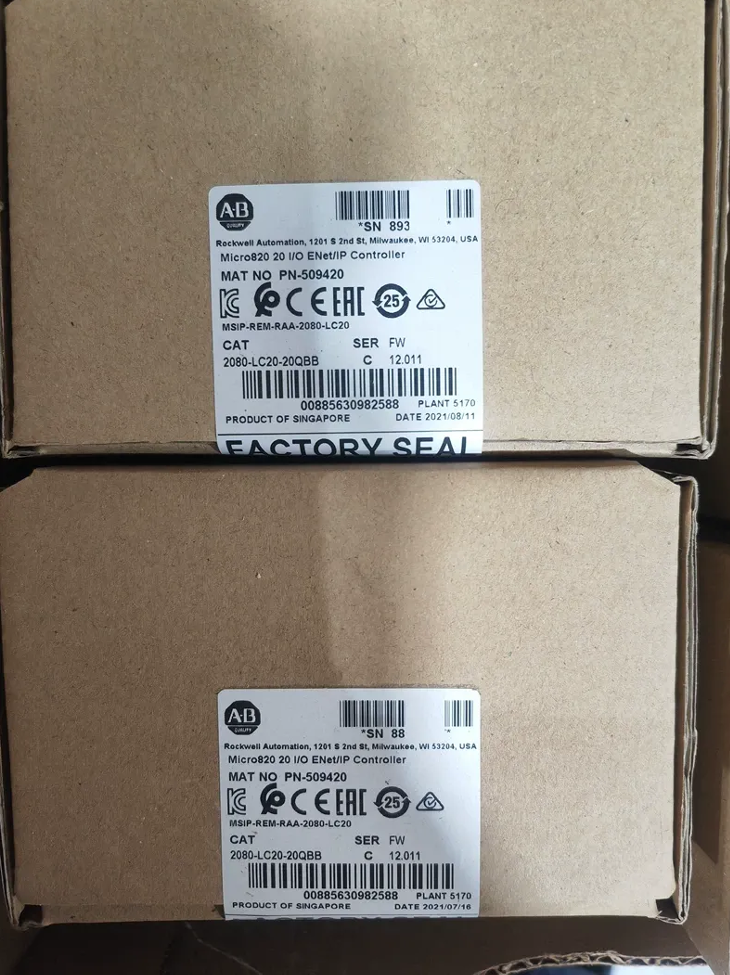

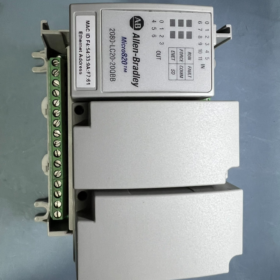
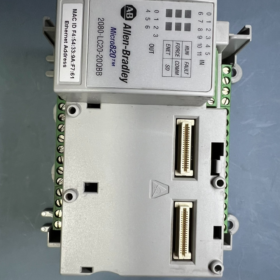
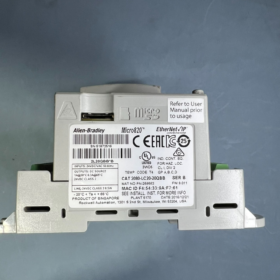
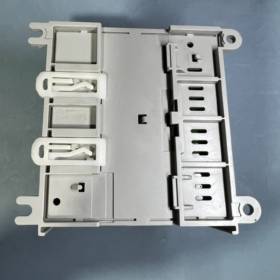
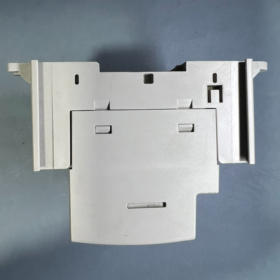
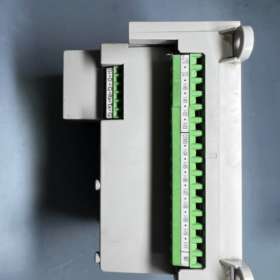
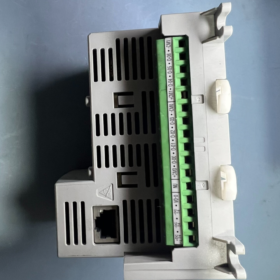
Catalog Code Breakdown
| Segment | Definition |
| 2080 | Family code for Micro800 series |
| LC20 | Micro820 CPU unit |
| 20 | Total native I/O count: 20 points |
| Q | Output type: Transistor output (NPN Sinking) |
| B | Power supply: 24VDC input |
| B | Input type: 24VDC digital input |
Native I/O Allocation (20 Points)
Inputs: 12-point DC24V Digital Inputs
Terminals I-00~I-11, sinking/sourcing compatible (configurable)
Outputs: 8-point DC24V NPN Transistor Outputs
Terminals O-00~O-07, NPN transistor type. AC loads cannot be driven directly.
⚠️ Distinction:
2080-LC20-20QBB = NPN transistor output
2080-LC20-20QBBR = Relay output version
Key Technical Specifications
- Power Supply: 24 VDC (operating range:18~30 VDC)
- Program Memory: 10K instructions
- Variable Memory: 10K bytes
- Communication Interfaces
USB (programming port)
Embedded RS485 (Modbus RTU Master/Slave)
- Expansion Capability
✅ Supports Micro800 plug-in modules (analog I/O, RTD/TC, high-speed counter, serial modules)
✅ Maximum 4 plug-in modules can be installed
- High-speed Functions
4-channel High-Speed Counter (HSC), max. 100kHz
4-channel Pulse Train Output (PTO), max. 100kHz for basic positioning control
- Environmental Ratings
Operating temperature: 0 ~ 55 ℃
Storage temperature: -40 ~ 85 ℃
Protection class: IP20, cabinet mounting only
Software Requirement
Programming Software: Connected Components Workbench (CCW)
Minimum supported version: CCW V8.0 and above
Typical Applications
Small conveying equipment, packaging machines, fan & pump control, custom automated tooling, HVAC control, basic stepper/servo positioning systems.
Selection Guidelines & Common Pitfalls
- NPN sinking transistor output: Load negative wire connects to PLC output terminal; AC loads cannot be driven directly. Use DC24V solenoid valves preferentially.
- No built-in Ethernet port! Ethernet communication requires additional Ethernet plug-in module (e.g. 2080-EWEB).
- Freewheeling diodes are recommended for inductive loads to avoid transistor breakdown caused by back EMF.
- Micro820 does not support remote I/O, only local plug-in expansion available.
Direct Replacements & Series Comparison
Same I/O count relay variant: 2080-LC20-20QBBR
Higher I/O capacity: Upgrade to Micro830 (2080-LC30 series)
Complete Reference for 2080-LC20-20QBB
(Terminal Wiring + Modbus RTU Configuration + PTO Program + Troubleshooting + HS Code)
- Hardware Terminal Definition & Wiring Guide
Model: Micro820 2080-LC20-20QBB
Power Supply: DC24V; DI:12-channel DC24V; DO:8-channel NPN Sinking Transistor Output
⚠️ Embedded serial port: Shared RS485/RS232 without galvanic isolation
1.1 Power Terminals (PLC Main Power)
| Terminal Label | Definition | Wiring Instruction |
| 0 | Positive power input | Connect to DC24V+ |
| 0 | Negative power input | Connect to DC24V 0V/GND |
1.2 Digital Input Terminals (12 DI: I-00 ~ I-11)
Common terminal: CM0
Sinking Wiring (Most Common): CM0 connected to DC24V+; NPN sensor output to I-xx; sensor negative to 0V
Sourcing Wiring: CM0 connected to 0V; PNP sensor output to I-xx; sensor positive to DC24V
I-00, I-01, I-02, I-03: Dedicated high-speed counter channels
DI Terminal List:
I-00, I-01, I-02, I-03, I-04, I-05, I-06, I-07, I-08, I-09, I-10, I-11
1.3 Digital Output Terminals (8 DO O-00 ~ O-07, NPN)
Common terminal: -CM0
✅ NPN Sinking characteristic: Terminal O-xx approximates 0V when energized
Standard Wiring Scheme:
+DC24V → Load positive terminal; Load negative terminal → O-xx; All -CM0 terminals tied to DC24V 0V
O-00, O-01: PTO pulse output channels (high-speed)
Freewheeling diode must be reverse-paralleled for inductive loads (solenoid valves)
DO Terminal List: O-00, O-01, O-02, O-03, O-04, O-05, O-06, O-07
1.4 Embedded RS485/RS232 Serial Terminal (6-pin terminal block)
| Pin | Signal | Function |
| 6 | SG | Signal Ground (common ground mandatory) |
| 7 | TX/R1OUT | RS485-B / RS232 TXD |
| 8 | RX/R2IN | RS485-A / RS232 RXD |
RS485 Wiring: Pin7(B) ↔ Device B terminal; Pin8(A) ↔ Device A terminal; Pin6 shared ground
❗ No galvanic isolation on this port. Install isolated repeater for long-distance communication.
- Step-by-step CCW Modbus RTU Configuration (Master/Slave Supported)
Software: Connected Components Workbench CCW V8.0 and above
Step1: Project Hardware Configuration
- Create new project → Select controller 2080-LC20-20QBB
- Double-click [Controller] on left pane to open configuration page → Locate [Serial Port]
- Driver selection: Modbus RTU
Step2: Communication Parameters (Recommended Defaults)
| Parameter | Recommended Value | Remarks |
| Baud rate | 19200 | Adjust to 9600/38400 as required; both sides must match |
| Data bits | 8 | Fixed |
| Stop bits | 1 | Fixed |
| Parity | None | No parity |
| Mode | RS485 | Match hardware wiring |
| Role | Slave / Master | Select based on system architecture |
| Slave Address | 1~247 | Valid only under Slave mode |
Step3: Register Mapping (Critical Section)
Modbus address mapping rule for Micro820
Coils (0x addresses): PLC BOOL variables
Discrete Inputs (1x addresses): Read-only BOOL status
Holding Registers (4x addresses): INT/DINT (Read & Write, most widely used)
Input Registers (3x addresses): Read-only INT values
Important Note: Micro800 series does not support automatic tag mapping for Modbus. Use function blocks for master read/write operations:
`MODBUS_READ` / `MODBUS_WRITE`
- PTO Pulse Positioning Control (O0/O1 Pulse Output for Stepper/Servo)
Hardware Channel Assignment
PTO0: Pulse Output → O-00; Direction signal recommended on O-02
PTO1: Pulse Output → O-01; Direction signal recommended on O-03
Max output frequency: 100kHz
Output type is NPN sinking. Servo drive pulse input setting must be low-level active / sinking input
CCW Configuration Workflow
- Controller Configuration → Enable [Pulse Output (PTO0)]
- Set maximum frequency: 100000 Hz; Acceleration/Deceleration time: 500ms
- Call motion function block `PTO_RUN` inside program
Structured Text Example: Relative Positioning
⚠️ Critical Limitation: Micro820 does not support electronic cam or multi-axis synchronization; only basic point-to-point positioning available.
- High-Speed Counter (HSC) Configuration (I0~I3)
4 independent HSC channels, support single-phase input & quadrature encoder with 4x multiplication
Common operation modes:
Mode0: Single-phase up-counting
Mode4: Quadrature encoder, 4x frequency multiplication mode
- Wiring & Selection Hard Rules (Risk Avoidance)
- 2080-LC20-20QBB = NPN sinking output. AC loads cannot be driven directly. Add intermediate relays for AC loads.
- Do not overload transistor outputs continuously: 0.3A per point maximum (ambient temperature 55℃)
- RS485 port non-isolated. Communication errors easily occur under multi-ground power supply systems; implement shared ground or galvanic isolation.
- No native Ethernet port. Install plug-in module 2080-EWEB if Ethernet connection is required.
- Maximum 4 plug-in modules supported. Remote I/O expansion is not available.
- Use shielded cables for pulse wiring; route away from power cables of contactors and inverters to reduce interference.
- HS Code Reference for Import & Export Customs Declaration
8537101100
Description: Programmable Logic Controller (PLC)
⚠️ Reference only. Confirm classification with local customs authority before formal customs clearance.
- Common Fault Troubleshooting Matrix
| Fault Phenomenon | Root Cause | Solution |
| No PTO pulse output | Pulse signal mismatch; Output common terminal not connected to 0V | Switch drive to sinking input; Verify -CM0 wiring |
| Intermittent Modbus communication | Missing signal ground; Excessive cable length; No terminating resistor | Connect SG pin on both ends; Add 120 terminating resistor |
| False triggering of digital inputs | Sensor cable interference; Incorrect CM0 wiring | Deploy shielded cable; Verify sinking/sourcing configuration |
| PLC restarts repeatedly after power-on | Insufficient DC24V power rating, excessive ripple | Replace power supply with minimum 3A capacity |
- Official Manual Reference
User Manual: 2080-UM005E-EN-E (Micro820 Controller User Manual)
Allen‑Bradley 2080-LC20-20QBB (Micro820) Programmable Controller Overview
- Product Positioning
2080-LC20-20QBB is an Allen‑Bradley Micro820 compact integrated PLC manufactured by Rockwell Automation. Designed for standalone OEM machinery and small complete automation systems. It replaces conventional control circuits built with massive intermediate relays. Equipped with integrated digital & analog I/O and multiple communication ports, DIN rail mountable. Target market: compact, low-cost standalone automation solutions.
Catalog Summary
2080: Micro800 series identifier
LC20: Micro820 controller platform
20: 20 native I/O points
Q: 24V DC sourcing (PNP) digital output
BB: Onboard 4 analog inputs +1 analog output, PTO pulse output, embedded Ethernet
- Native Hardware I/O Specifications
- Digital Inputs:12-point DC24V (configurable sinking/sourcing)
Signal acquisition: Photoelectric sensors, proximity switches, limit switches, start/stop pushbuttons, emergency stop, door interlock switches
- Digital Outputs:7-point DC24V PNP sourcing output
Drive small solenoid valves, indicator lamps, intermediate relays (e.g. MY2N-GS), contactor coils
- Integrated Analog Channels (Core Advantage)
4 analog inputs: 0~10V, 0~20mA, thermistor temperature acquisition supported
1 analog output: 0~10V / 0~20mA, used for inverter speed regulation and modulating valve control
- Motion Control Functions
Built-in 1 channel PTO/PWM pulse output, capable of driving stepper motor controllers for basic point positioning
- Expansion Capacity: 2 plug-in slots for high-speed counters, serial ports and additional I/O modules
- Core Functions
3.1 Discrete Logic Control (Basic Function)
Based on signals from sensors and operation buttons, execute programmed sequence, interlock, mutual lock and start-stop logic:
Sequential start/stop of conveyors, automatic cylinder cycling, automatic machine workflows, safety loop judgment and fault alarm output.
Can be paired with MY2N-GS intermediate relays to drive high-power loads indirectly.
3.2 Analog Process Control (Advantage of Onboard Analog Channels)
Collect temperature, pressure, liquid level and flow signals from transducers
Built-in PID function: Constant temperature control, constant pressure water supply, air volume regulation; Analog output to adjust inverter speed and proportional valves.
3.3 High-speed Signal Processing
High-speed counters read encoder pulses (speed & position measurement); PTO pulses implement basic stepper positioning.
3.4 Communication Networking
- EtherNet/IP Ethernet Port
Connect HMI touchscreens, SCADA host computers and other Rockwell PLCs for remote monitoring, parameter access and program upload/download.
- RS232/RS485 (Non-isolated Serial Port)
Modbus RTU Master/Slave interface to connect inverters, instruments and third-party sensors.
- USB Programming Port: Direct connection to PC for program download and online debugging.
3.5 Data Storage, Recipe & Log Management
Embedded RTC real-time clock: Timed tasks, timestamp for fault logging
MicroSD card slot: Store production recipes, runtime logs, fault records; support program backup & one-click restore.
3.6 HMI Expansion
Supports external remote text display 2080‑REMLCD, enabling parameter modification and alarm display without additional touchscreen panels.
- Typical Industries & Equipment
- Packaging Machinery: Small sealers, labelers, filling machines, miniature sorting conveyor systems
- HVAC & Water Treatment: Small pump stations, air handling units, constant temperature water tanks, chemical dosing systems
- Food Machinery & Central Kitchen Equipment: Washing lines, material conveyors, temperature-controlled ovens, smoke exhaust control systems
- Custom Automation: Assembly tooling, test benches, small transfer equipment
- Auxiliary control for machine tools, material conveying lines
- Laboratory equipment, small constant-temperature aging equipment
- Programming Software
Programming Software: Connected Components Workbench (CCW)
Supported languages: Ladder Diagram (LD), Function Block Diagram (FBD), Structured Text (ST), compliant with IEC61131‑3
- Application Boundaries
✅ Suitable for: Standalone machines with limited I/O, analog acquisition/PID demand, Ethernet networking requirement, cost-sensitive OEM equipment
❌ Not suitable for: Multi-axis servo synchronization, large-scale distributed production lines, massive remote I/O, high safety-level safety circuits (install dedicated safety relays such as G9SX for safety functions)
Supplement Remarks
- Terminology strictly follows Rockwell Automation official datasheet standards, suitable for export tender documents, equipment manuals and overseas product catalogs;
- Consistent industrial automation vocabulary matching international engineering conventions;
- If you need Russian translation or condensed datasheet version, I can process further.
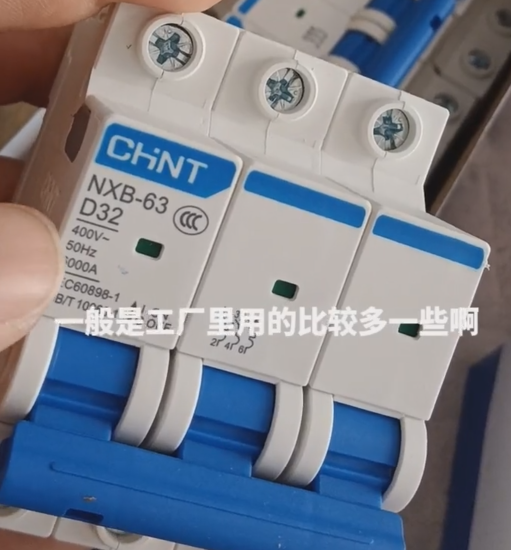
NH42-63-318x560.png "CHINT PC-type automatic transfer switches (ATS)NH42-63/4SZ")