Contactor,circuit breaker,sensor,Encoder,PLC,Converter


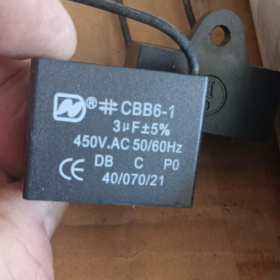
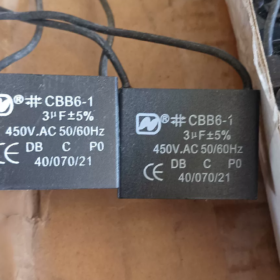
Model & Specification Explanation
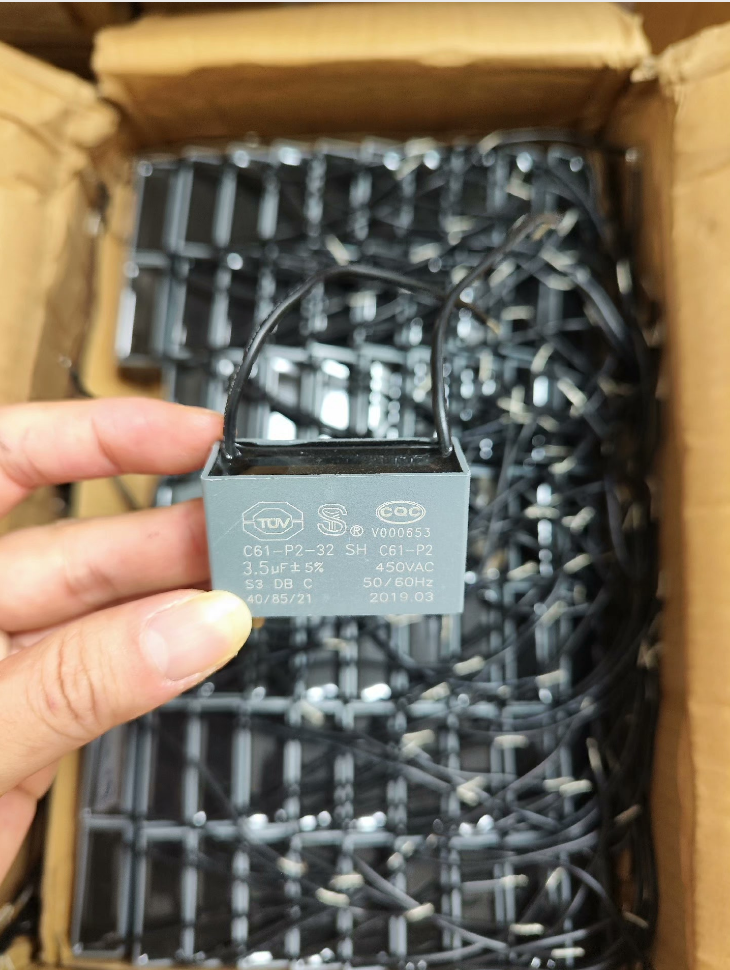
Definition of CBB61 Model
- CBB: Metallized polypropylene film capacitor (non-polar, low loss, self-healing and explosion-proof built-in)
- 61: Standard series of plastic-cased lead-out capacitors specially for starting/running single-phase AC motors
- 3μF: Nominal capacitance of 3 microfarads; mainstream tolerances in the industry: ±5% (Grade J) / ±10% (Grade K)
- Standard rated voltage: 450VAC (universal model for domestic 220V mains power), compatible with 50/60Hz power supply
- Core Electrical Specifications
| Item | Standard Specification |
| Nominal Capacitance | 3.0μF |
| Capacitance Tolerance | ±5% (Grade J) / ±10% (Grade K) |
| Rated AC Voltage | 450VAC (Replacement voltage shall not be lower than 400VAC) |
| Applicable Frequency | 50Hz / 60Hz |
| Dielectric Material | Metallized polypropylene film |
| Dissipation Factor tanδ | ≤0.002 (ultra-low heat generation, suitable for long-term continuous operation) |
| Operating Temperature | -40℃ ~ +70℃ (Climate Class 40/70/21) |
| Structure | Black flame-retardant plastic housing, epoxy resin sealing, double wire leads (non-polar) |
| Safety Features | Self-healing after overvoltage breakdown, explosion-proof pressure relief structure, compliant with UL94 V0 flame retardant standard |
| Service Life | Class B, 10,000 hours of continuous operation |
| Applicable Standards | GB/T 3667.1, IEC60252-1 |
III. Working Principle
A single-phase asynchronous motor cannot start on its own. This capacitor is connected in series with the motor auxiliary winding to generate a rotating magnetic field via phase shift and provide starting torque. During operation, it continuously maintains motor torque, improves power factor and reduces winding heat generation.
Fault manifestations without a functional capacitor: The motor hums after power-on, only rotates when manually pushed, runs at low speed with insufficient power, and shuts down frequently.
- Full Application Scenarios (3μF Matches Low-Power Fans)
- Household Ventilation Equipment (Most Widely Used)
Floor fans, desk fans, wall fans, ceiling fans, circulation fans
Main fans for kitchen range hoods, small ventilators, bathroom exhaust fans
Cross-flow fans of indoor air conditioners, small cooling fans, portable air conditioner fans
- Small Household Appliance Motors
Drainage motors and auxiliary dewatering fans of small washing machines
Centrifugal fans for dehumidifiers and air purifiers
Air supply motors for small humidifiers, space heaters and warm air blowers
- Small Industrial Single-Phase Equipment
Small cooling fans for machine tools, heat dissipation fans for electrical control cabinets
Small 220V clean water pumps, atomizing water pumps, miniature air compressors
Small heat dissipation fans for production lines, cooling fans for food processing equipment
- HVAC & Commercial Equipment
Small indoor fans of central air conditioners, small motors for air curtains
Heat dissipation fans for convenience store refrigerators and display freezers
- Mandatory Requirements for Model Selection & Replacement
- Capacitance must be matched: Only 3μF is acceptable; 2.5μF or 4μF cannot be used as substitutes
Smaller capacitance: Insufficient starting torque, low rotating speed, motor overheating and winding burnout
Larger capacitance: Excessive current leading to rapid burnout of motor coils
- Rated voltage ≥450VAC: Low-voltage models of 250V/330V are forbidden for replacement, as they tend to bulge and burst
- Must adopt CBB61 film capacitors; electrolytic capacitors are not allowed (electrolytic capacitors are polar and prone to liquid leakage under AC power)
- Lead length and mounting holes shall be matched as required; non-polar with no positive/negative wiring distinction
- Typical Fault Phenomena & Solutions
| Fault Phenomenon | Root Cause of Capacitor Failure | Solution |
| Fan hums after power-on and fails to rotate unless manually pushed | Capacitance degradation, capacitance drops below 2μF | Directly replace with CBB61 3μF/450V |
| Obviously reduced rotating speed and air volume | Capacitor aging and insufficient capacitance | Replace with a new capacitor |
| Circuit breaker trips or fuse blows within several seconds after power-on | Internal short-circuit breakdown of capacitor | Cut off power for replacement and inspect motor windings |
| Bulged housing, glue leakage, blackening and overheating | Long-term overheating or insufficient withstand voltage | Replace immediately and check whether the motor is stuck |
| Intermittent rotation and insufficient power | Poor internal contact of capacitor | Replace with a brand-new capacitor |
VII. Safety Key Points for Installation & Replacement
- Cut off power before operation! Short-circuit the two leads with a screwdriver for full discharge to prevent electric shock.
- The two leads are non-polar and can be connected to either end of the motor auxiliary winding arbitrarily.
- Fix the capacitor far away from heat-generating parts of the motor to avoid accelerated aging caused by high temperature.
- Wrap wiring terminals with insulating materials to prevent short-circuit and sparking.
- Do not squeeze or bend the capacitor housing to avoid sealing damage and moisture ingress.
VIII. Unsuitable Application Scenarios
- High-power compressors and air compressors (large-capacity CBB60 capacitors are required)
- DC motors and DC circuits of inverters (designed exclusively for AC, not for long-term DC operation)
- High-temperature enclosed equipment (custom high-temperature resistant models are required for environments above 75℃)
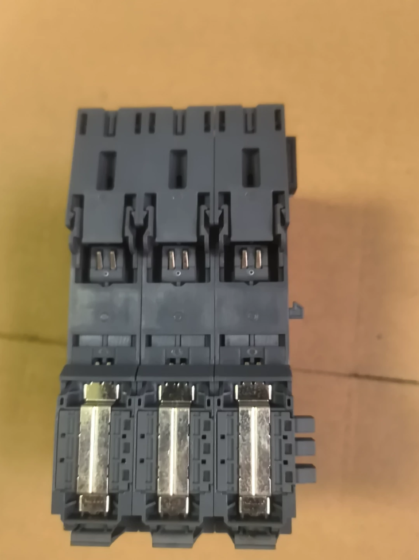
NH42-63-318x560.png "CHINT PC-type automatic transfer switches (ATS)NH42-63/4SZ")