Contactor,circuit breaker,sensor,Encoder,PLC,Converter

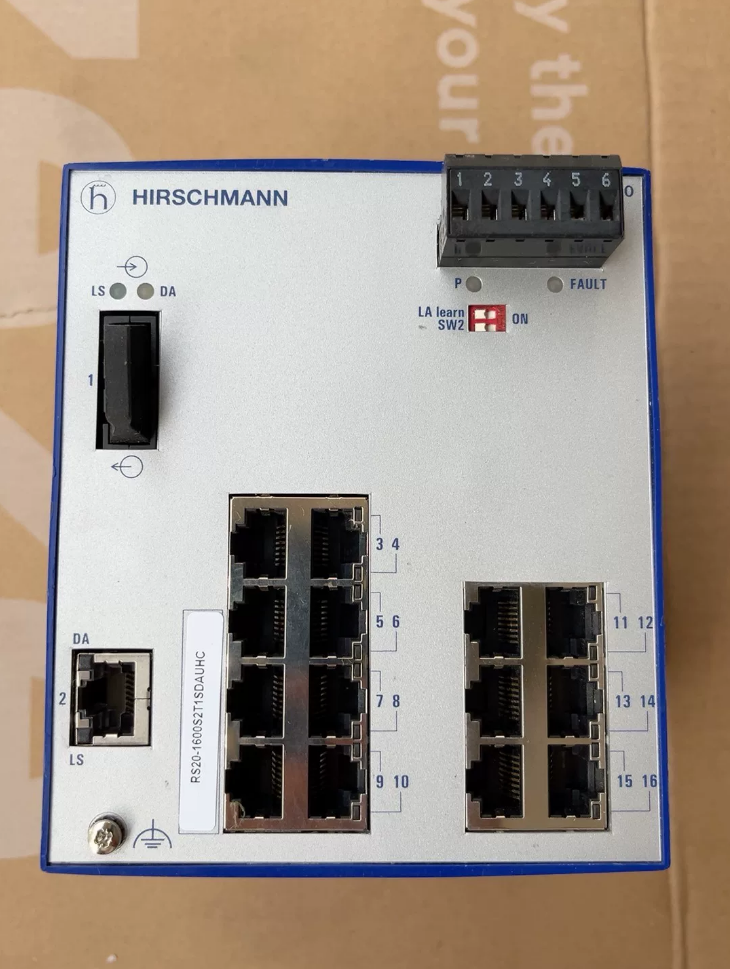

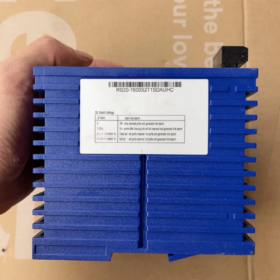
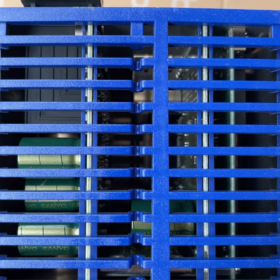
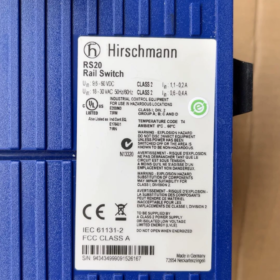
Model Segment Definition
| Model Segment | Meaning | Description |
| RS20 | Product series identifier | Hirschmann RS20 series compact open DIN-rail industrial Ethernet switch, fanless design, suitable for industrial automation environments |
| 1600 | Port quantity | 16 = total 16 ports; 00 = base model code |
| S2 | Uplink Port 1 type | S = Single-mode fiber (SM); 2 = SC interface, 100BASE-FX speed |
| T1 | Uplink Port 2 type | T = Twisted Pair (TP); 1 = RJ45 interface, 10/100BASE-TX speed |
| SDA | Port configuration | S = Standard port; D = 14 RJ45 data ports; A = Auto-negotiation / Auto MDI-X function |
| U | Software version | U = Unmanaged; plug-and-play, no configuration required |
| HC | Temperature grade & certification | H = Wide temperature range (-40~+70℃); C = Compliant with industrial standards IEC 61850-3, UL 508, ISA 12.12.01, etc. |
- Core Specification Table
Basic Parameters
| Item | Specification |
| Manufacturer | Belden Hirschmann |
| Part No. | RS20-1600S2T1SDAUHC (Order No.: 943 434-051) |
| Product Type | 16-port unmanaged industrial Ethernet switch |
| Switching Mode | Store-and-Forward |
| Mounting | Standard NS 35/7.5 DIN rail mounting |
| Dimensions | W130mm × H90mm × D60mm |
| Weight | Approx. 650g |
| Housing Material | Metal, IP20 protection class |
| Cooling | Fanless, natural heat dissipation |
Port Configuration
| Item | Specification |
| Total Ports | 16 |
| Data Ports | 14 × 10/100BASE-TX RJ45, support auto-negotiation / auto MDI-X |
| Uplink Port 1 | 1 × 100BASE-FX single-mode fiber SC port, transmission distance up to 15km |
| Uplink Port 2 | 1 × 10/100BASE-TX RJ45, support auto-negotiation / auto MDI-X |
| Port Features | Full-duplex / Half-duplex support, 802.3x flow control |
| Cable Type | Twisted pair: Cat.5e and above, max 100m; Single-mode fiber: 9/125μm |
Electrical Characteristics
| Item | Specification |
| Power Input | Wide voltage: 12-48VDC, 24VAC(±10%) |
| Power Interface | 1 × 6-pin pluggable terminal block, supports dual power redundancy |
| Power Consumption | Max 15W |
| Surge Protection | Compliant with IEC 61000-4-5, differential / common mode protection |
| EMC | EN 55032 Class A, EN 55035, EN 61000-6-2 |
Mechanical & Environmental Characteristics
| Item | Specification |
| Operating Temperature | -40~+70℃ (Wide temperature model) |
| Storage Temperature | -40~+85℃ |
| Humidity | 5~95%RH (Non-condensing) |
| Vibration Resistance | 5-150Hz, 1g (IEC 60068-2-6) |
| Shock Resistance | 15g (11ms) (IEC 60068-2-27) |
| Certifications | CE, cUL508, ISA 12.12.01, Class 1 Div 2, IEC 61850-3 |
- Accessory List
Standard Accessories
- RS20-1600S2T1SDAUHC switch main unit
- Pre-installed DIN rail mounting clips
- Pre-installed 6-pin power terminal block
- User manual (hard copy / electronic version)
- Product certification documents
Optional Accessories
| Accessory Name | Model | Function Description |
| Redundant Power Module | RPS-24DC | Provides dual redundant power input to improve system reliability |
| Fiber Patch Cord | SC-SC Single-mode 9/125μm | Fiber connection for Uplink Port 1 |
| Power Cable | 12-48VDC | Matches switch power input |
| Marker Strip | RS20-MARK | Port labeling for easy maintenance and troubleshooting |
| Dust Cover | RS20-DUST | Protects unused RJ45 and SC ports |
| Mounting Bracket | RS20-BRACKET | Wall / panel mounting instead of DIN rail |
- Competitor & Cross-Brand Comparison
Same Series Comparison (Hirschmann RS20 Series)
| Model | Port Configuration | Uplink Ports | Software Version | Temperature Grade | Application Scenario |
| RS20-1600S2T1SDAUHC | 14×RJ45+1×SM SC+1×RJ45 | Single-mode SC + RJ45 | Unmanaged (U) | Wide -40~+70℃ | Long-distance fiber uplink, harsh industrial environments |
| RS20-1600M2M2SDAUHC | 14×RJ45+2×MM SC | Dual Multi-mode SC | Unmanaged (U) | Wide -40~+70℃ | Short-distance fiber uplink, building automation |
| RS20-1600T1T1SDAUHC | 14×RJ45+2×RJ45 | Dual RJ45 | Unmanaged (U) | Wide -40~+70℃ | Pure copper cable connection, simple network topology |
| RS20-1600S2S2SDAEHC | 14×RJ45+2×SM SC | Dual Single-mode SC | Basic Managed (E) | Wide -40~+70℃ | Basic network management required, long-distance fiber |
Cross-Brand Comparison
| Brand & Model | Port Configuration | Uplink Ports | Software Version | Temperature Range | Features | Price Level |
| Hirschmann RS20-1600S2T1SDAUHC | 14×RJ45+1×SM SC+1×RJ45 | Single-mode SC + RJ45 | Unmanaged | -40~+70℃ | Wide temp, fanless, complete industrial certifications | Mid-to-high |
| Phoenix Contact FL SWITCH SF 16TX/1SM | 15×RJ45+1×SM SC | Single-mode SC | Unmanaged | -40~+70℃ | Redundant power, reliable Phoenix quality | Mid-to-high |
| MOXA EDS-2016-1M-S-SC | 15×RJ45+1×SM SC | Single-mode SC | Unmanaged | -40~+75℃ | Extended wide temp, IP30 protection | Mid-range |
| Schneider Electric TCSESM0163F2CU | 14×RJ45+2×SM SC | Dual Single-mode SC | Unmanaged | -25~+70℃ | Seamless integration with Schneider PLC | Mid-range |
| Advantech EKI-2526SI | 16×RJ45 (2 SFP slots) | Expandable fiber | Unmanaged | -40~+75℃ | Flexible SFP configuration, cost-effective | Mid-range |
- Selection Guidelines & Alternative Solutions
Key Selection Considerations
- Port Type: Select uplink port type (single/multi-mode fiber, RJ45) according to network topology; single-mode for long distance (>2km), multi-mode for short distance (<2km).
- Software Function: Unmanaged (U) for simple plug-and-play scenarios; Managed (E/P) for complex networks requiring VLAN, QoS, ring redundancy.
- Temperature Range: Wide-temperature model (H) for outdoor, high-temperature workshop and harsh environments; standard model for general indoor industrial sites.
- Power Requirement: Confirm whether dual power redundancy is needed to enhance system reliability.
- Certification: Select products compliant with IEC 61850-3, UL 508, ISA 12.12.01 based on regional and industry standards.
Recommended Alternative Models
| Application Scenario | Recommended Model | Reason for Replacement |
| Short-distance fiber uplink (<2km) | RS20-1600M2M2SDAUHC | Lower cost multi-mode fiber, suitable for intra-factory and building connection |
| Pure copper cable, no fiber required | RS20-1600T1T1SDAUHC | Dual RJ45 uplink for simple network topology and cost saving |
| Basic network management required | RS20-1600S2T1SDAEHC | Supports VLAN, QoS, HIPER-Ring ring redundancy (recovery time <300ms) |
| Budget-sensitive, cost performance priority | MOXA EDS-2016-1M-S-SC | Similar functions, more affordable price and wider temperature range |
| Existing Phoenix Contact system | Phoenix Contact FL SWITCH SF 16TX/1SM | High system compatibility and shared accessories |
Technical Advantages Summary
Fanless Design: Higher reliability, lower maintenance cost, suitable for dusty environments.
Wide Temperature Range: -40~+70℃ operating temperature, adaptable to harsh industrial conditions.
Plug-and-Play: Unmanaged design, no configuration needed, fast deployment.
Complete Industrial Certifications: Compliant with IEC 61850-3, UL 508, ISA 12.12.01, ideal for power, rail transit and other industries.
Compact Size: 130mm width saves cabinet space and supports high-density installation.
How to Select Hirschmann Industrial Ethernet Switches According to Actual Requirements
Below is a standardized 7-step selection process applicable to engineering projects, together with series positioning, industry matching and common selection pitfalls.
Step 1: Confirm Mounting Method
Determine the product series directly:
- DIN Rail Mount (Most control cabinets & automation production lines)
Choose: RS20 / RS30 / RS40 compact series
- 19-inch Rack Mount (Central control room & power distribution core cabinet)
Choose: MACH100 / MACH4000 rack-mounted series
- Outdoor Wall Mount / Cabinet-Free (Outdoor base station, tunnel, pumping station)
Choose: OCTOPUS IP65/IP67 waterproof series
- Panel Embedded Mount (Built-in equipment)
Choose: EAGLE / dedicated panel type
Step 2: Confirm Port Quantity, Port Type & Speed
Total Port Quantity
Count PLC, HMI, instrument and camera quantities on site, reserve 20% redundancy.
Common: 4-port / 8-port / 16-port / 24-port.
Port Type (Core Selection Point)
RJ45 Copper Port: Indoor short distance ≤100m, standard network cable
Fiber Port: Long distance & strong anti-interference
Multi-mode (MM): ≤2km, intra-factory & building interconnection, low cost
Single-mode (SM): ≥5~15km, cross-plant road, power remote transmission, outdoor
SFP Slot: Hot-pluggable Gigabit/100M fiber module, flexible expansion; recommended for mid-to-high-end projects.
Speed
Ordinary PLC, instrument & monitoring: 10/100M Fast Ethernet is sufficient
Machine vision, big data, multi-camera & core aggregation: Full Gigabit
Step 3: Select Management Mode
Three grades based on network complexity:
- Unmanaged
Features: Plug-and-play, zero configuration
Application: Single device, simple production line, no network partition or ring redundancy
Suffix: U
- Managed Lite
Supports VLAN, QoS, port rate limiting, basic ring network
Application: Multi-workshop partition, simple isolation & basic redundancy
- Full Managed
Supports HIPER-Ring, MRP, RSTP, IGMP multicast, network security, port mirroring, fault alarm
Application: Power, rail transit, smart factory, ring topology, high reliability non-stop network
Step 4: Select Operating Temperature Grade
- Standard Temperature: 0℃~+60℃
Application: Air-conditioned central control room, constant temperature cabinet
- Wide Temperature: -40℃ ~ +70℃
Application: High-temperature workshop, outdoor, non-air-conditioned cabinet, cold northern & hot southern environments
Industrial sites are recommended to choose wide-temperature models for higher fault tolerance.
Step 5: Power Specification & Redundancy
- Voltage: Industrial standard 24VDC, some support 12~48VDC wide voltage
- Dual Power Redundancy: Mandatory for key production sections, power and rail transit; avoids network outage from single power failure
- Protection: Reverse polarity protection & surge immunity; prioritize industrial EMC protection for harsh power environments
Step 6: Network Redundancy & Special Application Requirements
- Ring Network Self-healing (Network remains online when one cable breaks)
Must choose managed switches supporting HIPER-Ring / MRP / RSTP
- Network segmentation & device isolation → Require VLAN
- Multiple cameras & streaming media → Require IGMP multicast
- Industrial security & unauthorized access prevention → Require port security & MAC binding
Step 7: Protection Class & Industry Certification
- Protection Class
Cabinet installation: Standard IP20
Outdoor, dusty & humid site: IP65/IP67 OCTOPUS series
- Industry-Specific Certification
Power industry: Mandatory IEC 61850-3
Rail transit: EN 50155
Marine & offshore: Ship classification certification
Explosion-proof chemical industry: Explosion-proof grade certification
Hirschmann Main Series Positioning
| Series | Positioning | Application Scenario |
| RS20 | Entry-level compact | Small production line, ordinary control cabinet, mostly unmanaged, conventional budget |
| RS30 | Mid-range mainstream | Gigabit SFP, basic management, small & medium factory ring network, cost-effective |
| RS40 | High-end industrial | Full Gigabit, full-featured management, power/rail transit/high-end smart factory |
| MACH100/4000 | Rack-mounted core | 19-inch cabinet machine room, plant-level core aggregation switch |
| OCTOPUS | Outdoor waterproof | Outdoor, tunnel, pumping station, cabinet-free on-site installation |
Industry Recommended Selection
- General Automation Production Line / Workshop
8/16-port RS20 wide-temperature unmanaged — cost-effective and sufficient
- Multi-workshop Ring Network / Smart Factory
RS30 Gigabit SFP managed with ring network support
- Power Substation / PV & Wind Power
RS40 wide-temperature + IEC61850 certification + dual power redundancy
- Rail Transit / Tunnel Outdoor
OCTOPUS IP67 waterproof + wide temperature + rail transit certification
- Central Control Room Core Aggregation
MACH rack-mounted full Gigabit
Common Selection Pitfalls
- Do not blindly choose full Gigabit; 100M is enough for ordinary PLC and wastes budget.
- Avoid standard temperature models for industrial sites; cabinet overheating easily occurs in summer.
- Use single-mode fiber ports for long-distance cross-plant connection; do not use network cables for long-distance laying.
- Ring topology must use managed switches; unmanaged switches cannot implement ring redundancy.
- Key equipment must adopt dual power redundancy to prevent entire network paralysis from single power failure.
NH42-63-318x560.png "CHINT PC-type automatic transfer switches (ATS)NH42-63/4SZ")