Контактор,автоматический выключатель,датчик,Кодер,ПЛК,Конвертер


Основная информация
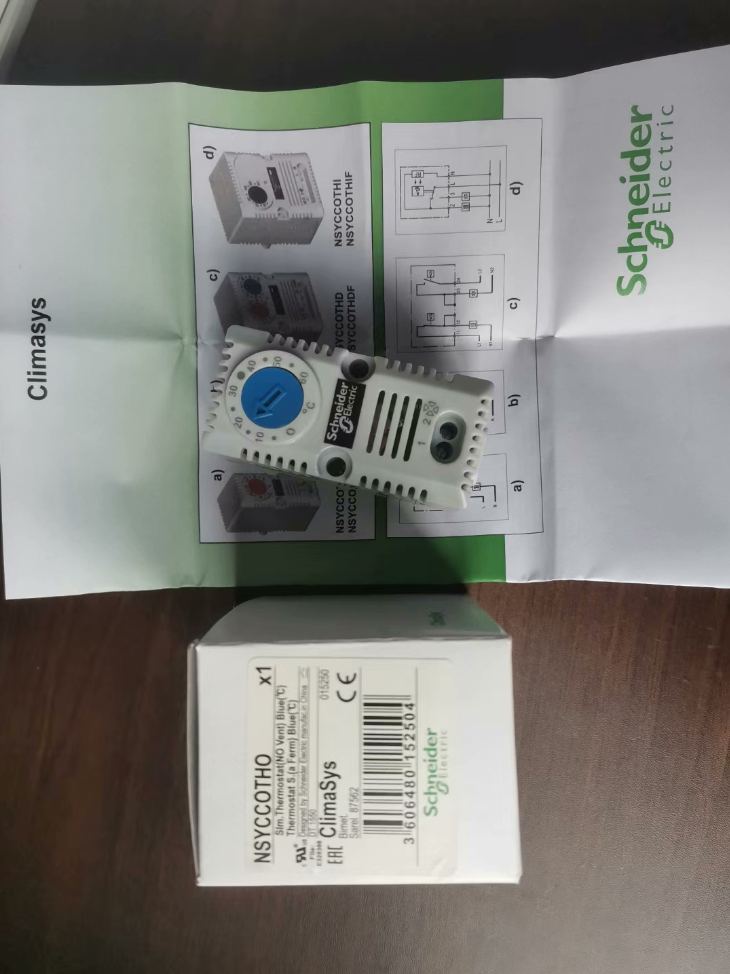
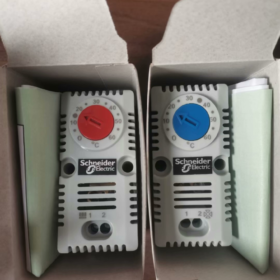
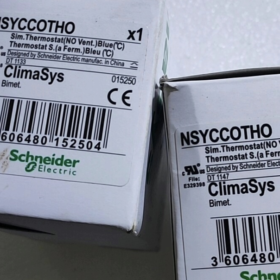
Полное имя: ClimaSys CC Mechanical Enclosure Thermostat (Single-circuit, Нормально открытый НЕТ)
Ряд: ClimaSys CC Enclosure Climate Control Components
Приложение: Activate cooling fans inside electrical enclosures at high temperatures; contacts close once temperature reaches setpoint to start ventilation fans.
Разбивка кода модели
NSY: Prefix for Spacial enclosure climate accessories
СС: ClimaSys CC mechanical thermostat series
ОТ: Термостат
ЧАС: Обогрев / Cooling Thermostatic Switch
О: NO = Normally Open Normally Open Contact (Blue Knob, Cooling Control)
Cross-reference within the same series
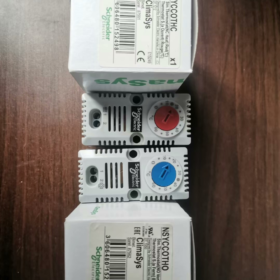
NSYCCOTHO: 1NO Normally Open → Control cooling fans (blue dial)
NSYCCOTHC: 1NC Normally Closed → Control enclosure heaters (red dial, low-temperature heating activation)
NSYCCOTHD: Dual thermostat 1NO+1NC, controls heating and cooling simultaneously
- Основные электрические характеристики
| Элемент | Параметр |
| Temperature Sensing Principle | Bimetallic mechanical type (no electronic components) |
| Adjustable Temperature Range | 0 ~ +60 °С |
| Конфигурация контактов | 1 set Normally Open (НЕТ) |
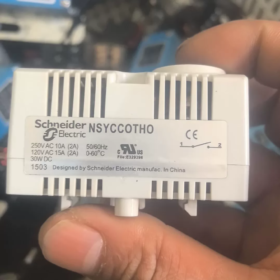
| Switching Capacity | 10А / 250ВАК (резистивная нагрузка) |
| 2А / 250ВАК (индуктивная нагрузка) | |
| Механический срок службы | ≥100 000 циклов |
| Рабочая температура окружающей среды | -20 °С ~ +80 °С |
| Защита от проникновения | IP20 (for internal enclosure mounting only) |
| Материал корпуса | Flame-retardant PC, UL94 V0 |
| Terminal Wire Size | 2.5 мм², Терминалы 1, 2 |
| Габаритные размеры | 68(ЧАС) × 33(Вт) × 44(Д) мм |
| Способ монтажа | 35мм Монтаж на DIN-рейку / backplate screw mounting |
| Масса | Приблизительно. 40г |
- Операционная логика
✅ NSYCCOTHO (Нормально открытый НЕТ)
Temperature > Setpoint → Contacts close → Cooling fan starts
Temperature < Setpoint → Contacts open → Fan stops
Typical setting: 35°C ~ 40°C for enclosure fan activation.
- Инструкции по подключению
Нижние клеммы 1 и 2: passive switch contacts, no separate power supply required. Wire in series within the fan control circuit.
Примечание: This unit serves only as a switching signal. Do not drive high-power fans directly. An external contactor is recommended for heavy loads.
- Типичные сценарии применения
PLC control cabinets, variable frequency drive cabinets, UPS enclosures, outdoor electrical boxes
Automatic overheat cooling control for cabinet interiors
Подстанции, автоматизированные производственные линии, HVAC electrical cabinets
- Selection Pitfalls to Avoid
- Do not mix up OTHO / OTHC
OTHO (blue dial): NO contact → Cooling fan control
OTHC (red dial): NC contact → Anti-condensation heater control
- Mechanical thermostats feature inherent hysteresis (4~6°C) and offer lower precision than electronic thermostats. Select electronic NSYCCOTHxx series for high-precision requirements.
- Suitable for indoor enclosure installation only. Outdoor direct exposure is prohibited (IP20 rating).
- If load current exceeds 10A, an auxiliary relay or contactor must be added.
- Alternative Upgrade
For simultaneous heating and cooling control: upgrade directly to NSYCCOTHD (dual dial, 1НЕТ + 1Северная Каролина).
Operating Principle of Schneider NSYCCOTHO Mechanical Thermostat
- Core Sensing Element: Биметаллическая полоса
Fundamental Principle
Two thin metal strips with vastly different coefficients of thermal expansion are pressure-welded together to form a bimetallic composite strip.
Metal A: High thermal expansion coefficient; Metal B: Low thermal expansion coefficient
Rising ambient temperature → Unequal thermal elongation causes the bimetallic strip to bend toward the metal with lower expansion;
Falling ambient temperature → Reverse deformation occurs.
The NSYCCOTHO relies on bimetallic strip deformation to directly actuate mechanical contacts. Нет источника питания, circuit boards or sensor chips required, classified as a passive mechanical switch.
- Internal Structural Components
- Temperature-sensing bimetallic strip (directly measures cabinet air temperature)
- Adjustment screw + calibrated knob (external blue dial for threshold setting)
- Moving contact and fixed contact (НЕТ контактов, Терминалы 1, 2)
- Mechanical spring assembly (provides contact pressure to ensure reliable connection)
- Complete Actuation Sequence (Focus on NSYCCOTHO Normally Open Version)
Model Feature: НЕТ контакта, designed for cooling fan control
- Cabinet Temperature < Set Temperature
Limited bending of the bimetallic strip; mechanical assembly remains released → Contacts open
Fan circuit de-energized, fan inactive.
- Cabinet Temperature rises ≥ Set Temperature (Actuation Point)
Continuous thermal bending of the bimetallic strip generates thrust to overcome spring preload, pushing contacts closed
→ Terminals 1 и 2 руководить, cooling fan circuit energized to start exhaust ventilation.
- Cabinet Temperature decreases
The bimetallic strip gradually rebounds as temperature drops;
⚠️ Critical Feature: Inherent hysteresis (4 ~ 6°C)
Пример: Setpoint = 40°C for fan startup
≥40°C → Contacts close, fan turns ON
Fan will NOT stop at 39°C; contacts typically open at 34~36°C
Purpose of hysteresis: Prevent rapid cycling, contact chatter and arcing caused by minor temperature fluctuations. This characteristic is intrinsic to mechanical thermostats and cannot be eliminated.
- Электрические характеристики
- Passive Contacts
The thermostat requires no dedicated operating power; it functions purely as a temperature-controlled mechanical switch. Circuit power is supplied externally (230ВАК, 24В, и т. д.).
- Рейтинг контактов: 10A/250VAC resistive load; derated to 2A/250VAC for inductive loads.
- Principle Comparison with NSYCCOTHC (Normally Closed Heater Thermostat)
NSYCCOTHO (Blue Dial, НЕТ): Closes at high temperature → Fan cooling control
Temperature ↑ → Circuit conducts; Temperature ↓ → Circuit opens
NSYCCOTHC (Red Dial, Северная Каролина): Conducts at low temperature → Anti-condensation cabinet heater control
Temperature ↓ → Circuit conducts; Temperature ↑ → Circuit opens
Both share identical bimetallic sensing elements; only the internal contact assembly orientation differs.
- Преимущества & Ограничения (Derived from Operating Principle)
✅ Преимущества
Passive, no auxiliary power; stable performance in harsh cabinet environments
Simple construction, vibration-resistant, широкий диапазон рабочих температур
DIN rail mounting with straightforward wiring
❌ Ограничения (determined by bimetallic technology)
Moderate accuracy with fixed hysteresis; precise constant temperature control is unachievable
Mechanical fatigue after repeated cycling; service life shorter than electronic thermostats
No remote signal feedback and no communication capability
- Schematic Application Circuit Principle
AC Power → Terminal 1 → Internal NO contact of thermostat → Terminal 2 → Cabinet cooling fan → Neutral line
Contacts close when temperature threshold is reached to complete the circuit and drive the fan.
For high load current: Use thermostat contacts to energize an auxiliary relay coil; the relay main contacts drive the fan to protect thermostat contacts from arc erosion.
Temperature Adjustment Operating Guide for Schneider NSYCCOTHO
- Visual Identification
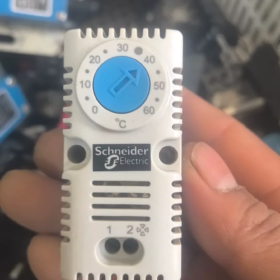
Equipped with blue adjustment knob, temperature scale range: 0°С ~ 60°С
Терминалы: 1, 2 (NO contacts for cooling fan control)
Монтаж: DIN rail installation inside control cabinet
Important Precondition: This mechanical bimetallic thermostat has fixed inherent hysteresis of 4~6°C, which cannot be eliminated.
Пример: Setpoint 40°C for fan startup; fan will shut down approximately between 34~36°C.
- Standard Adjustment Procedures
- Safety Precaution
Power off before adjustment where possible. If live commissioning is required, avoid touching live terminals to prevent short circuits.
- Locate the front adjustment knob
The knob center features a flathead screwdriver slot; temperature markings are printed around the outer dial.
- Recommended Tool
Small flathead screwdriver. Do not pry the knob forcibly with sharp objects.
- Adjustment Rules
Clockwise rotation → Higher set temperature
Counter-clockwise rotation → Lower set temperature
- Calibration Reference
A white indicator line on the knob aligns with the outer scale to define the target activation temperature.
Practical Reference (General Electrical Cabinet Settings)
Standard VFD / PLC cabinet: Align indicator line to 35°C~40°C
Значение: Cabinet temperature ≥ setpoint → Contacts close, fan activates for cooling.
- Two Commissioning Methods
Метод 1: Static Preset (Выключить питание)
Rotate knob directly to target temperature; the thermostat operates per threshold after power-up.
Метод 2: Live On-site Precision Commissioning
- Place a thermometer inside the cabinet to measure internal air temperature;
- Rotate knob slowly and observe fan ON/OFF status;
- Record fan start temperature (actuation point = dial scale value);
- Wait for temperature drop and record fan stop temperature (to verify hysteresis).
⚠️ Key Note: The printed value on the dial = fan activation temperature when contacts close, NOT the fan stop temperature!
- Recommended Setpoints for Common Scenarios
| Сценарий применения | Recommended Set Temperature | Описание |
| General low-voltage electrical cabinet | 35℃~40℃ | Well-ventilated environment |
| VFD cabinets / high heat-generating enclosures | 30℃~35℃ | Early cooling for high heat dissipation |
| Outdoor cabinets / high summer ambient temperature | 38℃~42℃ | Avoid continuous fan operation |
- Critical Notes & Common Mistakes
- ❌ Never apply excessive force to turn the knob
Internal thread actuator can strip under heavy force, causing permanent thermostat failure.
- ❌ Do not mount adjacent to heat-generating components
The thermostat measures cabinet ambient air temperature. Mounting close to inverters, resistors or heat sources leads to distorted temperature readings.
- ✅ Optimal mounting position: Mid-cabinet within circulating airflow, away from heaters and air outlets.
- If the fan cycles frequently: Increase set temperature appropriately. Frequent cycling occurs when ambient temperature hovers near the threshold. The only permanent solution is upgrading to an electronic thermostat, as hysteresis cannot be reduced on mechanical models.
- No locking mechanism required after adjustment. For high-vibration sites, apply a small amount of thread locker (avoid dripping into the rotary shaft gap).
- Диагностика неисправностей (No Response after Adjustment)
- Rotate fully to minimum scale (0°С): Contacts should close, fan runs continuously;
- Rotate fully to maximum scale (60°С): Contacts should open at ambient temperature, fan stops;
- If above tests fail: Internal bimetallic mechanism damaged; thermostat requires replacement.
NH42-63-318x560.png "Автоматические переключатели резерва типа PC CHINT (АТС)НХ42-63/4СЗ")