Schütz,Leistungsschalter,Sensor,Encoder,SPS,Konverter





(Thermal Flow Switch)
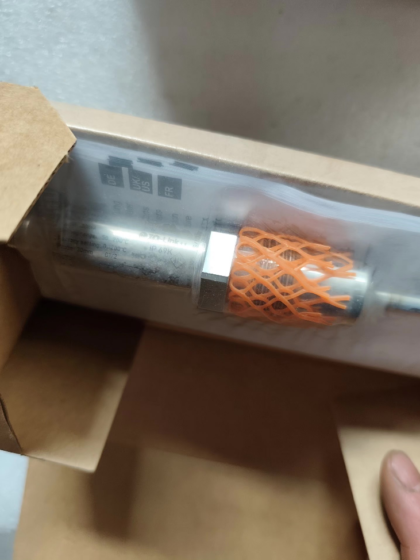
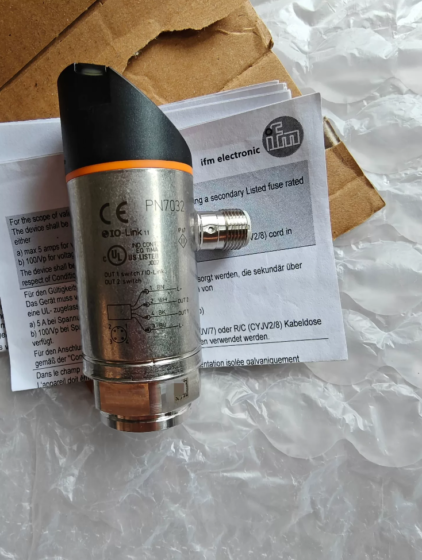
Modell: SIR11ABBFPKG/US-100-IPF
IFM hygienic thermal flow monitor operating on the thermal calorimetric principle, designed for liquid/gas flow velocity monitoring and dry-run protection, specially for hygienic pipelines in food & beverage and pharmaceutical industries.
✅ Key Features
- Hygienic Design: Wetted parts in 1.4435 (316L) Edelstahl, Ra<0.4μm. Supports CIP cleaning and SIP high-temperature sterilization up to 140°C for short duration, compliant with EHEDG. G1 Aseptoflex Vario aseptic thread interface, compatible with various hygienic adapters.
- Anzeige & Betrieb: 10-segment tri-color LED bar graph for real-time flow velocity and switchpoint indication. Single-button calibration with parameter lockout to prevent unintended modification.
- Elektrisch: PNP single switching output, NO/NC software-selectable. Supply DC 19~36V; M12 A-coded connector; short-circuit and reverse polarity protection.
- Schutz vor Eindringen: IP67 / IP69K, suitable for high-pressure washdown.
- Measurable Media: Liquids and gases.
📋 Wichtige technische Spezifikationen
| Artikel | Parameter |
| Probe length | 55 mm, probe diameter 7.7 mm |
| Flow velocity setting range | Flüssig: 3~300 cm/s (optimal range 3~100 cm/s) |
| Gas: 200~3000 cm/s (optimal range 200~800 cm/s) | |
| Mittlere Temperatur | -25~95℃; short-time SIP peak up to 140℃ |
| Max. Arbeitsdruck | 30 Bar |
| Umgebungstemperatur | -25~60℃ |
| Ansprechzeit | 1~10 s |
| Wiederholbarkeit | 1~5 cm/s (Wasser, 25℃, 5~100cm/s) |
| Hysterese | 2~5 cm/s (factory calibrated for water) |
| Gewicht | 440 G |
| Gehäusematerial | Körper:1.4404(316L)+PC/PBT-GF20; Robben: FKM/EPDM |
🛠️ Principle & Kalibrierung
Thermal principle: The probe integrates heating and temperature-sensing elements. Heat is carried away by flowing media, and flow velocity variation is converted into electric signals.
Supports two-point calibration: zero-flow calibration (stationary medium) + full-flow calibration
Werkseinstellung: calibrated for water, switchpoint at LED7 (70~79 cm/s), NO output.
Notiz: Recalibration is mandatory when changing media (water → oil / Druckluft), otherwise switchpoint drift will occur.
🧪 Typical Application Scenarios
Essen & beverage production lines: Trockenlaufschutz der Pumpe, pipeline no-flow alarm
Pharmaceutical purified water and CIP cleaning loop flow monitoring
Compressed air pipeline gas flow monitoring
Heat exchanger and cooling circuit no-flow protection
⚠️ Installation Guidelines
- Hygienic installation requirement: self-draining mounting to avoid dead legs; no dead zones on sealing surfaces; drain port facing downward for vertical installation.
- Probe must be fully immersed in medium; keep away from turbulence induced by elbows, valves and reducers (≥5×pipe diameter straight pipe upstream).
- Media with high solid content or high viscosity tend to foul the probe rod and cause signal drift; regular tip cleaning is required.
- Not suitable for heavy pulsating or surge flow conditions.
🔁 Alternative Selection Reference
Same IFM series:
SI6600: short probe, general hygienic type
SI6700: medium-length probe
SI6800: 55 mm probe, hygienic SIP version (the model here)
Inländische Alternativen: hygienic thermal flow switch with G1 thread, 316L wetted parts, IP69K, PNP-Ausgang. Key selection checkpoints: probe length, surface roughness, SIP temperature resistance.
📌 Common Troubleshooting
- Flow exists but no signal: probe fouling; invalid calibration; large medium temperature variation.
- Frequent false alarms: severe pipeline pulsation, small hysteresis setting; turbulent flow at installation point; probe not fully immersed.
- Full red LED flashing: calibration failure, check medium condition.
IFM SI6800 Field Application Cases
SI6800 features EHEDG hygienic rating, CIP/SIP capability, polished 1.4435 wetted parts and IP69K washdown rating. It is mainly used for minimum flow monitoring and no-flow protection (thermal principle, no moving parts). Below are field engineering cases sorted by industry.
Fall 1: Pharmaceutical Purified Water & CIP Cleaning Loops (Am häufigsten)
Arbeitszustand: Purified water distribution network and CIP detergent pipelines in pharmaceutical workshops. Medien: ambient purified water, 85℃ acid/alkaline detergent, short-time SIP sterilization at 135℃.
Objectives:
- Monitor circulation pump dry-run protection; trigger PLC interlock to stop pump on no-flow to prevent dry-running damage.
- Verify flow during CIP cleaning to confirm the cleaning loop is operational.
- Alarm: trigger audible & visual alarm when flow drops below threshold and record batch data.
Auswahlbegründung:
Tolerates transient high SIP temperature; wetted surface Ra<0.4μm with no dead legs, meeting GMP hygienic requirements.
IP69K for direct high-pressure washdown; G1 Aseptoflex Vario aseptic thread adapts to hygienic welding adapters.
Setup Tips: Two-point calibration (static zero-flow + operating flow); switchpoint set at 10~20 cm/s; EPDM seal recommended.
Fall 2: Brewery & Beverage Production Line (Mashing & Filling CIP)
Arbeitszustand: Cooling water loop for mash tun, CIP cleaning pipeline for juice production. Medien: gekühltes Wasser, alkaline detergent, low-solids fruit juice.
Objectives:
No-flow protection for cooling water circulation to maintain mash tun cooling performance.
CIP validation: confirm detergent flow in pipeline to satisfy required cleaning duration, serving as one of batch release conditions.
Einschränkungen: Not recommended for high-pulp, high-fiber viscous media; fouling on probe rod easily causes signal drift.
Engineerig Tips: Install on straight pipe with ≥5D straight section upstream; CIP can flush probe periodically to reduce fouling.
Fall 3: Cooling Water Circuit for Bioreactor
Arbeitszustand: Jacket cooling water for fermenter (deionized water with small amount of ethylene glycol), 24h continuous operation.
Objectives: Cooling water loss protection. Shut down fermenter heating immediately once cooling flow is lost to avoid microbial inactivation from overheating.
Vorteile: Thermal probe with no impeller, not jammed by minor impurities in water; much lower maintenance than target-type flow switches.
Notiz: Recalibration is mandatory for ethylene glycol media; factory water calibration cannot be reused.
Fall 4: Hygienic Compressed Air Aseptic Pipeline (Gas Monitoring)
Arbeitszustand: Filtered clean compressed air for aseptic workshops in pharmaceutical & food plants.
Objectives: Monitor minimum gas flow of process purge air, detect air supply interruption or pre-filter clogging; detect minor leakage.
Parameter Setup: Switch to gas mode, threshold ≥200 cm/s; add proper time delay to suppress false alarms caused by gas pulsation.
Notiz: Gas measurement responds slower than liquid; adjust delay parameters.
Fall 5: Dairy Industry (Milk & Yogurt Pre-treatment Pipeline)
Arbeitszustand: Raw milk transfer pipeline before pasteurization, CIP circulation. Medien: 4~12℃ raw milk; 85℃ acid/alkaline detergent during CIP, batch production with daily CIP.
Objectives: Pump dry-run protection and CIP loop flow confirmation.
Risk Note: Milk protein tends to adhere to probe rod at elevated temperature. Full probe tip coverage during CIP is mandatory, otherwise false flow alarms will occur.
Fall 6: Cooling Loop of Small Hygienic Heat Exchanger
Arbeitszustand: Cooling water monitoring for food-grade plate heat exchanger.
Objectives: Cooling water loss protection to prevent material coking on plates due to overheating and avoid production downtime and equipment repair.
Comparative Advantage: Electromagnetic flowmeter is costly for small hygienic pipelines. SI6800 is insertion-mounted, cost-effective for simple flow switch alarm without volumetric totalization.
Allgemeine Auswahl & Installation Summary for Field Implementation
- Geeignete Anwendungen: Only require flow presence / minimum flow alarm, no need for precise volume totalization; pipelines requiring CIP/SIP sterilization.
- Ungeeignete Anwendungen: High viscosity, high solid content, abrasive media; heavy pulsating surge flow; applications requiring high-precision flow measurement.
- Installation: Probe fully immersed in medium; stay away from turbulence generated by elbows, valves and reducers; self-draining installation preferred to avoid liquid pooling dead legs.
- Kalibrierung: Recalibrate when changing media (water→ethylene glycol/compressed air); recheck calibration after large temperature swings.
Gleicher Serienvergleich (For Alternative Proposal)
SI6600: short probe for small-bore hygienic pipelines
SI6700: medium-length probe
SI6800: 55 mm long probe, for larger pipe sizes and SIP sterilization pipelines
IFM SI6800 Food & Beverage Field Application Cases
SI6800 is an EHEDG-certified hygienic thermal flow monitor supporting CIP cleaning and short-time SIP sterilization up to 140℃, with polished 1.4435 wetted parts and IP69K high-pressure washdown capability. It functions as a no-flow / minimum flow switch, not for flow totalization. Below are typical field cases in food & bverage plants.
Fall 1: Dairy (Raw Milk / Yogurt) Pre-treatment Pipeline — Pump Dry-Run Protection
Arbeitszustand: Raw milk transfer pipeline before pasteurization. Medien: 4~12℃ raw milk; 85℃ acid/alkaline detergent during CIP. Batch production with daily CIP.
Process Objectives
- Monitor minimum flow in feed pump pipeline. Trigger PLC interlock to stop pump on no-flow, to prevent pump dry-grinding damage and material overheating coking.
- CIP circulation validation: confirm continuous detergent flow as one of batch release conditions for CIP.
Auswahlbegründung
Dead-leg-free hygienic design compliant with 3A/EHEDG, compatible with acid/alkaline CIP detergents used in dairy plants including Ecolab chemicals.
No impeller or moving parts, not jammed by milk protein or minor milk fat.
IP69K rated for direct high-pressure washdown in workshop.
Tipps zur Inbetriebnahme
Switchpoint setting: 10~15 cm/s; two-point calibration (static zero-flow + rated operating flow).
Risiko: Milk protein adheres to probe rod at high temperature. CIP must fully cover probe tip, recalibrate periodically to avoid drift and false alarms.
Fall 2: Craft Brewery — Mash Cooling Loop + CIP Validation
Arbeitszustand: Cooling water loop for mash tun; CIP circulation for wort pipeline. Medien: cold water, 80℃ alkaline detergent.
Process Objectives
- No-flow protection for cooling water during mashing: loss of cooling water causes uncontrolled wort temperature and impacts fermentation flavor. Alarm is triggered and heating cut off when flow drops below threshold.
- CIP sequence validation: confirm circulation of cleaning liquid to avoid false cleaning in empty pipes and ensure traceable batch cleaning records for compliance.
Auswahlpunkte
SI6800 long probe (55 mm) fits DN50~DN80 hygienic pipes, ensuring probe insertion into central flow stream.
Supports short-time SIP sterilization and directly compatible with mash system sterilization.
Einschränkungen: Not recommended for main wort pipelines with high spent grain and high solids due to fouling risk. Prefer installation on clean cooling water and CIP return lines.
Fall 3: Juice / Plant-Based Beverage Line (Apple Juice, Oat Drink) CIP Return Monitoring
Arbeitszustand: CIP return pipeline for concentrated juice and oat beverage production. Medien: rinse water, high-temperature acid/alkaline detergent.
Process Objectives: Automated batch judgment for CIP, confirm cleaning liquid circulation meets flow and duration requirements, generate traceable cleaning records for factory internal audit and customer inspection.
Engineering Tips
Installation: ≥5D straight pipe upstream, self-draining mounting to avoid dead legs (EHEDG mandatory requirement).
Seal selection: EPDM seal compatible with food-grade acid & alkaline cleaners.
Kalibrierung: Calibrate with cleaning water instead of juice media.
Fall 4: Aseptic Filling Workshop for Bottled Beverages — Aseptic Compressed Air Pipeline Monitoring
Arbeitszustand: Process purge air and bottle pre-purge clean compressed air pipeline in aseptic filling.
Process Objectives: Monitor minimum purge gas flow to detect air supply interruption or pre-filter clogging; trigger no-air alarm to prevent contamination of aseptic environment.
Parameter Setup: Switch to gas mode, threshold ≥200 cm/s; add proper time delay to suppress false alarms induced by gas pulsation.
Fall 5: Plate Heat Exchanger Cooling Loop (Shared for Beverage & Dairy)
Arbeitszustand: Cooling water monitoring for food-grade plate heat exchanger.
Process Objectives: Cooling water loss protection to prevent high-temperature material coking on heat exchanger plates, production shutdown and equipment maintenance.
Comparative Advantage: Electromagnetic flowmeters are expensive for small hygienic pipelines. SI6800 adopts insertion mounting and is cost-effective for simple flow switch alarm without volumetric metering.
✅ General Application Guidelines for Food & Getränkeindustrie
✔ Suitable Scenarios for SI6800
CIP/SIP hygienic pipelines requiring only no-flow / minimum flow alarm, no flow totalization required.
Medien: Wasser, cleaning detergent, low-solids beverages, clean compressed air.
Workshop requires high-pressure washdown (IP69K) and EHEDG/3A hygienic certification.
❌ Nicht empfohlene Szenarien
High-pulp, high-fiber, high-viscosity media such as jam and chocolate slurry; heavy fouling on probe rod easily causes signal drift.
Heavy pulsating or surge flow.
Applications requiring precise volumetric flow measurement (select SMF hygienic electromagnetic flowmeter instead).
Common On-site Faults (Frequent in Food Plants)
- Probe fouling by milk protein / juice sugar → false flow alarm: strengthen CIP flushing, periodically remove and polish probe.
- Calibration drift: recalibrate after large medium temperature variation or detergent replacement.
- Installation dead legs: liquid pooling and microbial growth if not self-draining, failing hygienic audit.
NH42-63-318x560.png "Automatische Transferschalter vom Typ CHINT PC (ATS)NH42-63/4SZ")