contactor,cortacircuitos,inversor solar,medidor electrico,baterias solares

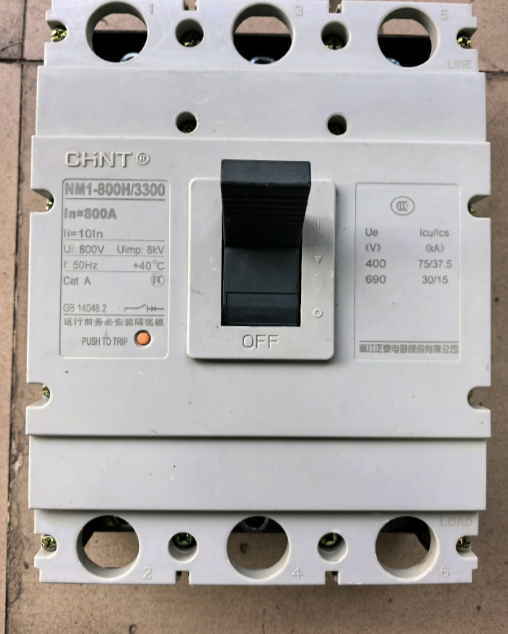

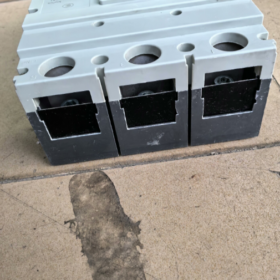
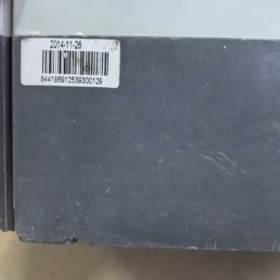
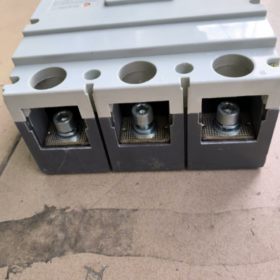
Chint NM1-800H/3300-800A es un conector tripolar, 800A disyuntor de caja moldeada (MCCB) de la serie NM1, con poder de corte grado H y disparo termomagnético. Está diseñado para protección contra sobrecargas y cortocircuitos de líneas de distribución de energía., y adecuado para líneas troncales de distribución de energía industriales y comerciales grandes.
| Código | Significado |
| NM1 | Disyuntor de caja moldeada serie Chint NM1 |
| 800 | Corriente del marco 800A |
| h | Grado de alto poder de ruptura (Grado H, normalmente 50 kA a 400 V CA) |
| 3300 | 3 polos, tripper combinado (disparo termomagnético), sin accesorios |
| 800A | Corriente nominal 800A |
Parámetros principales
| Parámetro | Valor |
| Tensión de funcionamiento nominal | CA 690V, 50Hz |
| Tensión nominal de aislamiento | 800V |
| Corriente nominal | 800A |
| Capacidad de ruptura | Grado H: 50el (400V y) |
| Número de polo | 3PAG |
| Tipo de disparador | termomagnético (sobrecarga de retraso prolongado + protección instantánea contra cortocircuitos) |
| Método de montaje | tipo fijo, montaje vertical/horizontal disponible |
| Método de cableado | Cableado frontal (cableado trasero y tipo enchufable opcional) |
| Método de operación | Operación de manija directa |
| Estándar ejecutivo | ES 14048.2, CEI 60947-2, Certificación CCC |
Escenarios de aplicación
Protección contra sobrecargas y cortocircuitos para troncales de distribución de energía industrial y circuitos de energía en grandes talleres..
Protección para troncales principales de distribución de energía en edificios comerciales. (centros comerciales, edificios de oficinas).
Protección para grandes circuitos de motores con arranques poco frecuentes.
Puntos clave de instalación y operación
- La instalación deberá cumplir con las especificaciones.; Tanto el montaje vertical como el horizontal son aceptables., con fijación segura y buena disipación del calor garantizada.
- Verifique las especificaciones de los terminales de cableado antes de realizar el cableado para que coincidan los cables/barras colectoras para una corriente de 800 A..
- Inspeccione periódicamente la precisión de la acción del disparador para evitar el impacto de la temperatura ambiente en el rendimiento de la protección..
Referencia de reemplazo entre marcas
Schneider: NSX 800N/3P 800A (Verificar capacidad de frenado y curva de disparo.).
TEJIDO: Tmax T6N 800/3P 800A (Preste atención a las dimensiones de montaje y la compatibilidad de accesorios.).
La principal diferencia entre Chint NM1-800H/3300-800A y NM1-800H/3200-800A radica en el tipo de disparador y la función de protección.; otros parámetros básicos (marco actual, capacidad de ruptura, número de polo, etc.) son completamente consistentes.
- Diferencia central: Significado de “3300” y “3200” en el modelo
| Parte del modelo | Significado digital | Función de protección |
| 3300 | 1primer dígito 3 = 3 polos; 2segundo dígito 3 = disparador combinado (disparo termomagnético); últimos dos dígitos 00 = sin accesorios | Protección contra sobrecarga y retardo prolongado + protección instantánea contra cortocircuitos |
| 3200 | 1primer dígito 3 = 3 polos; 2segundo dígito 2 = disparador magnético (solo disparo magnético); últimos dos dígitos 00 = sin accesorios | Sólo protección instantánea contra cortocircuitos, sin protección contra sobrecarga |
Esta es la diferencia fundamental entre los dos disyuntores., que determina directamente sus escenarios de aplicación y capacidades de protección..
- Tabla completa de comparación de parámetros
| Parámetro | NM1-800H/3300-800A | NM1-800H/3200-800A | Observaciones |
| Tipo de disparador | Disparo combinado termomagnético | disparo magnético | Diferencia central |
| Protección contra sobrecarga | Disponible (retraso prolongado) | Indisponible | El 3300 El modelo logra protección contra retardo de sobrecarga mediante la flexión térmica de tiras bimetálicas. |
| Protección contra cortocircuitos | Disponible (instantáneo) | Disponible (instantáneo) | Ambos realizan disparos instantáneos por cortocircuito a través de bobinas electromagnéticas. |
| Marco actual | 800A | 800A | Coherente |
| Corriente nominal | 800A | 800A | Coherente |
| Capacidad de ruptura | Grado H (50kA@400V CA) | Grado H (50kA@400V CA) | Coherente |
| Número de polo | 3PAG | 3PAG | Coherente |
| Tensión nominal | CA 690V, 50Hz | CA 690V, 50Hz | Coherente |
| Tensión nominal de aislamiento | 800V | 800V | Coherente |
| Método de montaje | tipo fijo (vertical/horizontal) | tipo fijo (vertical/horizontal) | Coherente |
| Método de cableado | Cableado frontal (cableado trasero, tipo enchufable opcional) | Cableado frontal (cableado trasero, tipo enchufable opcional) | Coherente |
| Estándar ejecutivo | ES 14048.2, CEI 60947-2 | ES 14048.2, CEI 60947-2 | Coherente |
III. Diferencias de escenarios de aplicación
| Modelo | Escenarios aplicables | Escenarios inaplicables |
| 3300 | • Troncales de distribución de energía industrial/comercial (Requiere protección tanto contra sobrecarga como contra cortocircuitos.) | • Ocasiones especiales que requieren sólo protección contra cortocircuitos |
| • Grandes circuitos de motores (arranque poco frecuente) | • Circuitos dedicados para equipos contra incendios (3300 El modelo con disparo en derivación generalmente se requiere para equipos contra incendios.) | |
| • Sistemas híbridos de distribución de energía e iluminación general. | ||
| 3200 | • Se utiliza como interruptor de aislamiento (necesita protección contra cortocircuitos pero no protección contra sobrecargas) | • Se utiliza solo como protección de líneas de distribución de energía. (La falta de protección contra sobrecargas causará sobrecalentamiento y daños en la línea.) |
| • Ocasiones combinadas con otros dispositivos de protección contra sobrecargas (p.ej., relés de sobrecarga térmica) | • Protección directa para motores (incapaz de evitar que el motor se queme debido a una sobrecarga) | |
| • Protección especial contra cortocircuitos para equipos industriales específicos |
- Sugerencias de selección
- Priorizar el 3300 modelo: La mayoría de los escenarios de distribución de energía requieren protección tanto contra sobrecarga como contra cortocircuitos.; el 3300 El modelo proporciona una protección más completa para evitar el sobrecalentamiento de la línea., Daños en el equipo y otros problemas causados por sobrecarga..
- Seleccione el 3200 modelo sólo bajo condiciones específicas: Cuando el sistema ya está equipado con otros dispositivos de protección contra sobrecargas (p.ej., relés de sobrecarga térmica, alarmas de sobrecarga), el 3200 El modelo se puede utilizar como disyuntor de protección contra cortocircuitos dedicado para reducir costos..
- Nota: El 3200 El modelo no se puede utilizar solo para líneas de distribución de energía que requieren protección contra sobrecargas debido a la falta de protección contra sobrecargas., De lo contrario, se pueden producir riesgos potenciales para la seguridad..
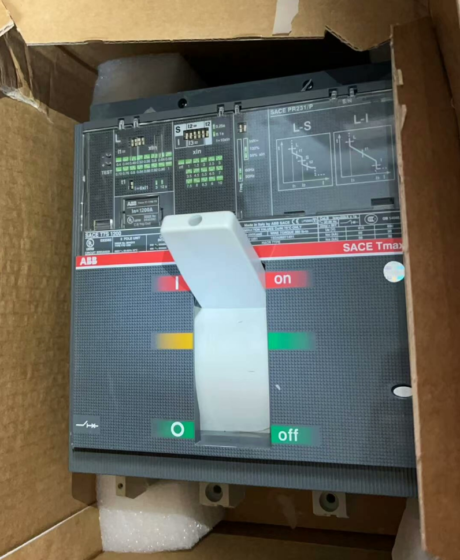
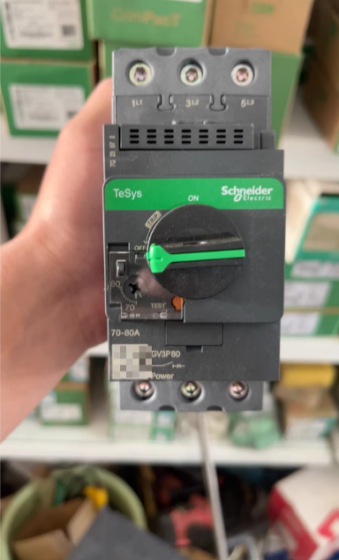
NH42-63-318x560.png "Interruptores de transferencia automática tipo PC CHINT (ATS)NH42-63/4SZ")