コンタクタ,サーキットブレーカー,センサー,エンコーダ,PLC,コンバータ

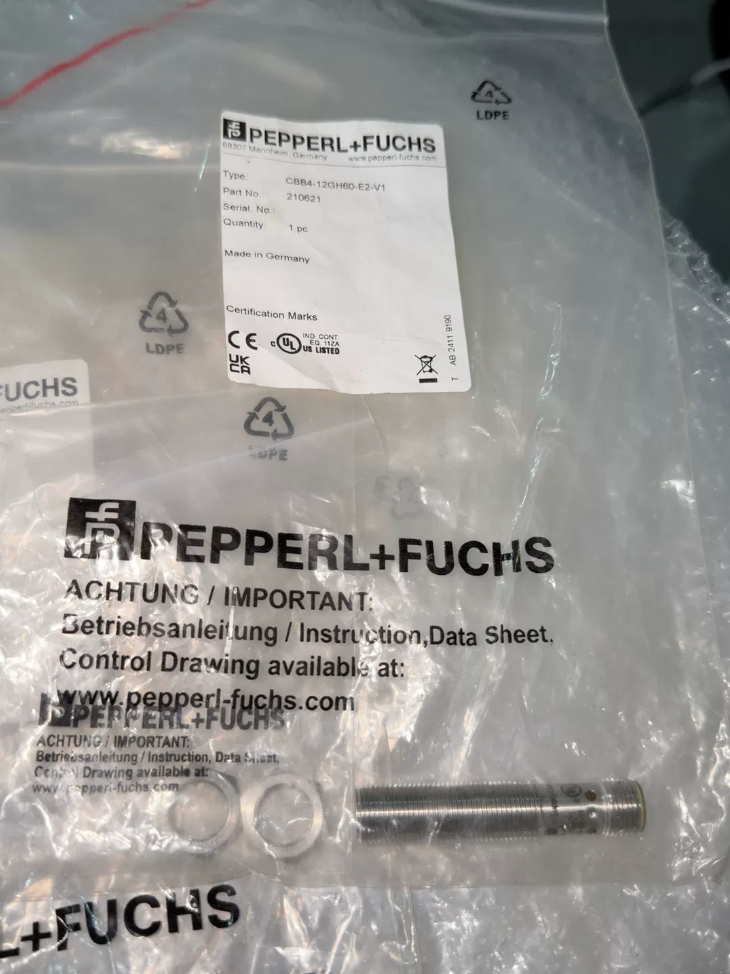

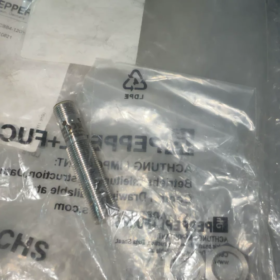
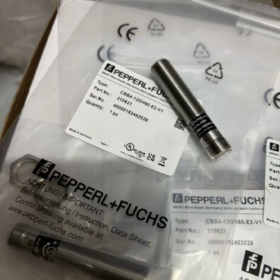
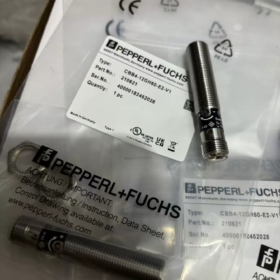
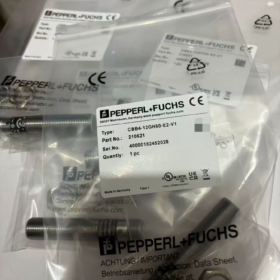
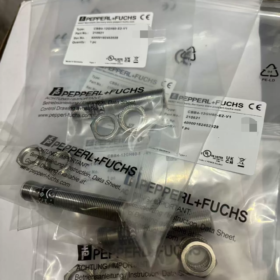
注文番号: 210621 Capacitive 近接センサー, M12 flush-mount, 316L stainless-steel, food-grade corrosion-resistant housing
型式コードの説明
| コード | 説明 |
| CBB | Capacitive sensor, stainless‑steel housing, flush‑mount type |
| 4 | Nominal sensing distance: 4 mm |
| 12 | M12×1 thread |
| GH60 | 1.4404(316L) stainless‑steel, overall length 59.8 mm, built‑in sensitivity potentiometer |
| E2 | PNP ノーマルオープン (いいえ) 出力 |
| V1 | M12‑pin connector output |
コアの電気仕様
| アイテム | パラメータ |
| 検出距離 | Nominal Sn=4 mm; Assured working range Sa=0…2.88 mm, adjustable via potentiometer |
| 取付タイプ | Flush‑mount (shielded type) |
| 出力 | 3‑wire DC PNP NO (通常開) |
| 電源電圧 | 10‑36 VDC |
| マックス. 負荷電流 | 100 ミリアンペア |
| No‑load current | ≤12 mA |
| 電圧降下 | ≤2.5 V |
| スイッチング周波数 | 50 Hz |
| 保護 | Reverse‑polarity protection, pulsed short‑circuit protection |
| インジケータ | Yellow LED status indicator |
機械式 & 環境データ
ハウジング: 1.4404/AISI316L stainless steel, sensing face in PEEK, suitable for food-processing and corrosive-media environments
繋がり: M12-4-pin male connector (mating cable such as V1-G4 required)
保護等級: IP65
動作温度: -25℃~+70℃
寸法: M12 cylindrical, overall length 59.8 mm
認証: CE, UL/cULus, EN60947-5-2
M12-4-pin Pin Assignment (Sensor-side male connector)
| ピン | 信号 |
| 1 | 茶色: DC+ 10‑36V |
| 2 | 白: Not used |
| 3 | 青: 0V/GND |
| 4 | 黒: PNP output signal |
注記: This 4-pin connector uses only pins 1, 3 and 4; pin 2 is unused. Use standard 4-core M12 cable.
代表的な用途
Level detection for water, 油, slurries; powder / pellet bin level monitoring
Presence detection for non-metallic materials (plastics, ガラス, 紙)
Food-beverage and pharmaceutical equipment, wash-down corrosion-resistant environments
包装機械, workpiece-in-position detection
Series Replacement Reference
- CBB4-12GH60-E0-V1: Same housing, NPN normally-open output; all other parameters identical
- Domestic alternative selection criteria: M12 flush-mount capacitive sensor, 4 mm nominal sensing, PNP-NO, 10-36 VDC, M12-4-pin, 316L housing, with sensitivity adjustment potentiometer.
試運転メモ
- Adjust the built-in potentiometer: clockwise increases sensitivity; counter-clockwise decreases sensitivity.
- Flush-mount installation; metal mounting sleeves shall not protrude beyond the sensing face.
- Capacitive sensors are sensitive to ambient humidity and pipe-wall material. Always calibrate the potentiometer with the actual target medium; do not rely solely on metal-target nominal values.
Pepperl+Fuchs CBB4-12GH60-E2-V1 Practical Application Cases
Key features: M12 flush-mount capacitive sensor, 316L stainless-steel + PEEK sensing face, adjustable-sensitivity potentiometer, PNP出力, M12-4-pin connector, IP65. Suited for food-industry wash-down and mild-corrosion environments; detects liquids, powders, plastics, glass and other non-metallic targets.
Case 1|Food & 飲料: Tank / Pipe Level Detection (High-humidity wash-down environment)
シナリオ: 飲料, sauce and dairy production lines. Side-wall mounting on small plastic / stainless-steel storage tanks for conductive-liquid high/low-level alarm; tank wall thickness ≤2.5 mm.
取り付け: Thread-in flush-mount on tank outer wall; no intrusion into process medium to avoid product contamination.
試運転: Adjust potentiometer to ignore tank-wall influence and trigger only by liquid.
関数: Switch signal sent to PLC for pump start-stop, low-level alarm and dry-run prevention.
アプリケーションの利点: 316L housing withstands CIP cleaning and cleaning-agent corrosion; PEEK sensing face resists material build-up; IP65 rated against spray-wash.
注意: For viscous sauces avoid over-high sensitivity, as material build-up will cause false triggering.
Case 2|Pharmaceutical Equipment: Powder-filling Bin Level Monitoring
シナリオ: Small bins for pharmaceutical powders and excipients; low-level shortage alarm for dusty electrostatic-prone powders.
取り付け: M12 threaded flush-mount on bin side-wall.
ターゲット: Pharmaceutical powders, granular excipients.
関数: When level drops below sensor position, PNP output de-energizes to trigger material-refill reminder.
利点: Insensitive to dust accumulation; stainless-steel housing resists disinfectant spray; potentiometer adapts to powders of differing dielectric constants.
Case 3|Packaging Machinery: プラスチック / Glass Container Presence Check
シナリオ: Conveyor-line detection of PET bottles and glass bottles for filling lines. Replaces photoelectric sensors to eliminate false-detection caused by transparent-bottle light reflection.
Targets: PET bottles, glass bottles, plastic caps.
取り付け: 1-2 mm gap between sensor and target; flush-mount installation.
論理: Bottle present → sensor switches ON → trigger filling actuator; no bottle → filling inhibited.
制限: 50 Hz switching frequency, suitable for medium-low-speed lines; not for ultra-high-speed production.
Case 4|Light-Chemical Industry: Level Monitoring for Mildly-Corrosive-Media Tanks
シナリオ: Small dosing-system tanks holding diluted cleaners and mild acid-alkali additives for high/low-level point monitoring.
1.4404(316L) + PEEK construction withstands splashes and vapors from mild acids and alkalis.
Non-intrusive outer-wall sensing; medium does not touch the sensor body to reduce corrosion risk.
注記: Not suitable for concentrated strong acids / strong alkalis; dedicated heavy-duty corrosion-resistant sensors required for those media.
Case 5|Rubber-Plastics / Injection-Molding: Hopper Pellet-Level Detection
シナリオ: Auxiliary-material hoppers for injection-molding and extrusion machines; pellet-shortage alarm for feeder trigger.
ターゲット: PP, PE plastic pellets.
動作条件: ほこり, static electricity from pellet friction.
Commissioning tip: Increase sensitivity appropriately for loosely-packed pellets; keep metal brackets clear to avoid interference.
Case 6|Feed-Processing Industry: Bin Point-Level Detection for Granular Feed
シナリオ: Small-bin point-level monitoring for grain and feed pellets in dusty feed-production environments.
利点: Tolerant to dust coverage; low-cost point-switch alternative to continuous level transmitters.
制限: Provides discrete point-switch signal only, no continuous height-level output.
Case 7|Conveyor-line: Non-metallic-workpiece Presence Confirmation
シナリオ: Conveyor-line detection of plastic parts, ゴム部品, cardboard; inductive sensors cannot detect non-metallic targets.
PNP output connects directly to PLC digital input.
Compact M12 threaded form-factor for space-constrained machinery.
General Installation & 試運転メモ (Common-field-failure points for this model)
- Flush-mount requirement is mandatory: Sensor thread end face shall be coplanar with metal mounting surface. Protrusion will cause erratic sensing-distance drift.
- Actual sensing range for non-metallic targets is substantially less than the nominal 4 mm. Always calibrate potentiometer on-site with real-world material. Do not design mechanical layout based purely on nominal 4 mm value.
- For liquids and viscous media, material build-up and foam cause false switching. Perform commissioning while simulating real-world build-up conditions before locking potentiometer setting.
- M12-4-pin connector: pin 2 unused. Terminate pins 1(brown, +), 3(青, GND), 4(黒, 信号) のみ.
- Switching frequency limited to 50 Hz. Not applicable for high-speed counting applications. Intended for workpiece-present and point-level-detection tasks only.
Pepperl+Fuchs CBB4-12GH60-E2-V1 Installation Specification
This is a flush-mount (シールドされた) M12-thread capacitive proximity sensor. Non-flush protruding installation is prohibited.
ハウジング: 1.4404(316L) stainless-steel; sensing face PEEK; supplied with M12 lock nut; rear-end M12-4-pin male connector.
- Basic Installation Methods
1.1 Threaded-hole metal-panel mounting (最も一般的な, for tanks / equipment walls)
- Hole preparation: M12×1 threaded hole. For plain bore: Ø12.2-12.5 mm; clamp-fix using two M12 lock nuts front-and-rear.
- Critical requirement: PEEK sensing face must sit perfectly flush with metal mounting surface. No protrusion; recess depth shall not exceed 0.5 mm.
✅ Correct: Sensing face coplanar with metal wall surface
❌ Incorrect: Sensor head protruding outward; excessive inward recess (>0.5 mm)
- Torque specification: Use OEM stainless-steel M12 lock nut; tightening torque 0.8-1.2 N·m. Over-torquing will damage threads and housing.
- Mount orientation: Horizontal or vertical are permitted. For level-measurement applications, orient sensing face toward tank interior.
Datasheet-specified installation clearances
A=0 mm: Side-wall metal may lie flush against sensor thread
B=0 mm: Front-face metal flush to sensing face
C=15 mm: Rear-connector end: minimum clearance ≥15 mm from metal obstructions
F=15 mm: Lateral direction: minimum clearance ≥15 mm from adjacent metal objects
1.2 Outer-wall mounting on non-metallic vessels (プラスチック / glass tanks, external level-sensing)
Mount sensor externally on tank outer wall, do not thread into tank interior. Sensing face sits flat against tank outer surface.
Recommended tank-wall thickness ≤2 mm; materials PE/PP/PET/glass.
Secure via bracket / nuts; maintain zero-gap contact between sensing face and tank wall.
Reduce sensitivity via potentiometer to compensate for tank-wall dielectric effect.
1.3 Bracket-clamp mounting
Use M12-sensor bracket; ensure sensing face is perpendicular (90°) to target.
Maintain ≥15 mm clearance between bracket metal and sensor thread barrel. Do not fully enclose sensor head with metal, as this will shield the capacitive sensing field and disable the sensor.
- Multi-sensor side-by-side installation (anti-crosstalk)
For multiple CBB4-12GH60-E2-V1 sensors mounted adjacent: center-to-center spacing ≥15 mm (datasheet mandatory C/F=15 mm).
Insufficient spacing causes mutual interference and random false-switching. If spacing cannot be increased, adopt staggered offset mounting.
- Sensing-distance & target-related installation rules
- Assured working range Sa=0~2.88 mm. Design mechanical layout with safety margin at ≤2.0 mm. Do not use nominal Sn=4 mm for mechanical design.
- For liquid / powder / pellet targets: orient sensing face squarely toward material. Direct contact between material and PEEK sensing face is permitted (IP65).
- No metal obstructions in front of sensing face; metal severely attenuates capacitive sensing field.
- Connector-cable installation
- Rear-end M12-4-pin male connector; mate with M12-4-core female straight / angled cable (例えば. V1-G4).
- Avoid mechanical tension on connector; implement cable strain-relief bend loop to prevent pulling-force damage.
- Route sensor cables separately from motor / inverter power cables to reduce electromagnetic interference.
- Post-installation commissioning procedure
- Complete mechanical locking; verify flush-mount condition of sensing face.
- Apply 10-36 VDC supply; allow 2-3 min warm-up.
- Adjust potentiometer under actual operating conditions (including build-up, foam, ほこり).
- Simulate target-present / target-absent conditions; verify yellow-LED indication matches expected status, then secure potentiometer setting.
- Common installation-induced faults (field-failure root-causes)
- Sensor head protruding past metal surface: detects surrounding metal, latches permanently ON.
- Excessive inward recess: drastically reduced sensing range, frequent missed detections.
- Metal obstructions within <15 mm behind connector end-cap: sensing-field interference, unstable signal drift.
- Excessive tightening torque: cracked stainless-steel housing / thread damage.
- Multiple sensors mounted too close: mutual crosstalk, random false-switching.
Pepperl+Fuchs CBB4-12GH60-E2-V1 Sensing Distance (Official datasheet values)
- Nominal sensing distance Sn: 4 mm
Specified using a grounded-metal standard test target. The digit 4 in the model number represents this parameter. Reference value only; non-metallic targets will not achieve 4 mm.
- Assured reliable working range Sa: 0 … 2.88 mm
Valid under correct flush-mount installation conditions. For mechanical design purposes apply safety margin of ≤2.0 mm. Do not design hardware against Sn=4 mm.
⚠️ Critical capacitive-sensor notes
Sn=4 mm is measured with a grounded-metal test target. For plastics, powders, liquids, glass and other non-metallic targets, actual trigger distance reduces significantly, determined by target dielectric constant.
Built-in potentiometer provides continuous sensing-distance adjustment. Always commission using real-process material on-site. Do not rely purely on nominal 4 mm rating.
This is a shielded flush-mount type. Improper installation (protruding / recessed) directly degrades or eliminates sensing performance.
Practical-application reference trigger distances
水 / conductive liquid: 約. 2.5-2.8 mm
PP / PE plastic pellets: typically 1-2 mm
External-wall level-sensing through 1-2 mm thin plastic tank wall: effective sensing gap near zero; compensation via potentiometer required.


NH42-63-318x560.png "CHINT PC型自動切替スイッチ (ATS)NH42-63/4SZ")