Contactor,circuit breaker,sensor,Encoder,PLC,Converter

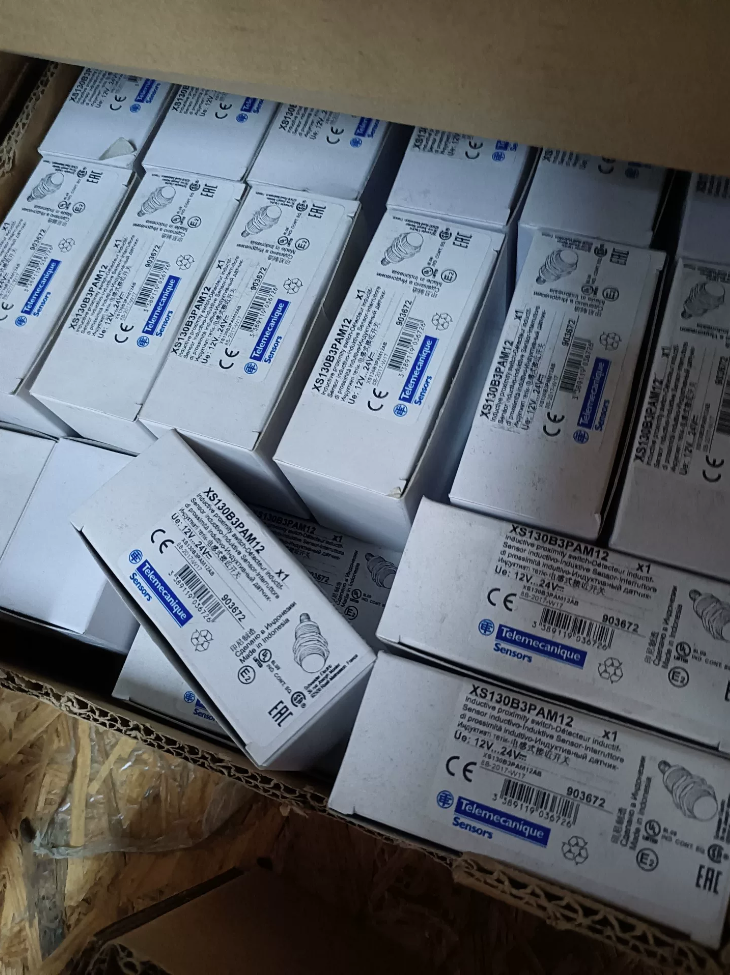

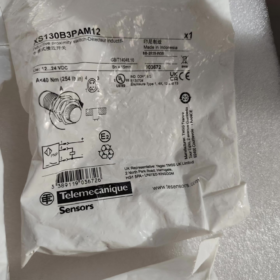
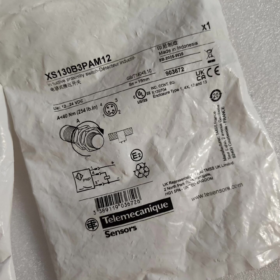
OsiSense XS1 series M30 cylindrical inductive proximity sensor (often misspelled as Telemek)
✅ Model Code Interpretation
XS1 30 B3 P A M12
XS1: Basic general-purpose inductive proximity switch series
30: M30 thread outer diameter
B3: Flush mounting, Sn=15mm
P: PNP output
A: Normally Open (NO)
M12: M12 4-pin male connector
📋 Main Technical Specifications
| Item | Specification |
| Type | Inductive proximity sensor |
| Rated sensing distance Sn | 15 mm (flush mounting) |
| Power supply | DC 12…24 V, permissible range 10~36VDC, reverse polarity protection |
| Output | 3-wire PNP Normally Open (NO) |
| Max. load current | ≤200mA, overload & short-circuit protection |
| Housing | Nickel-plated brass; sensing face PPS plastic |
| Thread | M30×1.5, overall length L=55mm |
| Connection | M12 4Pin male plug |
| Ingress protection | IP65 / IP67 |
| Operating temperature | -25℃ ~ +70℃ |
| Switching frequency | ≤500Hz |
| Indicator | Yellow LED for output status indication |
| Net weight | 130g |
🛠️ Installation & Application
Flush mounting: Can be fully embedded into metal bracket without reduction of sensing distance, good mechanical impact resistance
⚙️ Wiring Definition (M12 4-pin)
- Brown: DC+
- Black: PNP signal output
- Blue: DC 0V
- Spare / Not used
🔁 Series Alternatives / Options
XS130B3NAM12: Same dimension, NPN Normally Open, M12 plug
XS130B3PBM12: PNP Normally Closed (NC)
XS130B3PAL2: PNP Normally Open, 2m fixed cable version
📌 Troubleshooting Guide
- No signal: Check power supply and pin oxidation; ensure metal target is perpendicular to sensing face and distance ≤15mm
- False triggering: Excessively thick metal mounting bracket; strong electromagnetic interference nearby
- Flashing indicator: Load current exceeds 200mA or short-circuit protection activated
📎 Customs HS Code Reference
85437099 (Other industrial sensors, declare as inductive proximity switch for customs clearance)
Telemecanique Brand Background
XS130B3PAM12 belongs to Telemecanique Sensors
- Brand History
- 1924: Founded in Nanterre near Paris, France, originally named Manufacture d’Appareillage Electrique; officially renamed Télémécanique Electrique in 1928. Initially focused on contactors, limit switches and control components, being a veteran European industrial automation brand.
- 1965: Developed the first generation inductive proximity switch, the technical origin of XS series, establishing its leading position in industrial non-contact metal detection.
- 1988: Acquired by Schneider Electric. Afterwards it served as a major automation brand under Schneider, with sensor product line named OsiSense (XS/XT/XU series). XS130B3PAM12 is part of the original OsiSense XS inductive proximity switch family.
- 2023: Schneider divested the Telemecanique Sensors sensor business to YAGEO Group. The brand name Telemecanique Sensors remains independently operated with trademark licensing. Part numbers, specifications, drawings and certifications remain unchanged, so the XS series coding rules are identical to the Schneider-era versions.
✅ Key point: Telemecanique Sensors now belongs to YAGEO instead of Schneider. The brand name and XS part numbers are still in use. Old documents may still mark it as Schneider Telemecanique.
- Brand Positioning & Product Portfolio
Telemecanique Sensors: Specialized in industrial detection sensors, slogan: Simply easy.
Core product lines: Inductive proximity switches (XS series including XS130B3PAM12), capacitive sensors XT, photoelectric sensors XU, limit switches, RFID, pressure sensors, etc.
Product features: High anti-interference capability, wide temperature range, robust brass housing, UL/CE/CSA/CCC certifications. Suitable for heavy-duty automation scenarios such as machine tools, packaging, material handling and automotive production lines.
XS series (original OsiSense XS): Classic inductive proximity switch portfolio, full coverage of M8/M12/M18/M30 sizes, flush/non-flush, PNP/NPN, cable/M12 connector variants. XS130B3PAM12 is a representative M30 flush type.
- Quality & Market Position
Origin: France; R&D center remains in Angoulême, France; manufacturing sites located in France, Batam (Indonesia), etc.
Industry recognition: Veteran European sensor benchmark with large installed base in OEM machinery, construction machinery, production line limit and counting applications.
Certification: CE, UL, CSA, RoHS, REACH available. COC, RoHS and REACH declarations can be provided for XS130B3PAM12, friendly for export customs.
- Name Notes
Official Chinese name: 特勒美科, market aliases: 特乐美克、特力美肯; English: Telemecanique.
Application Fields of XS130B3PAM12 (Telemecanique)
Product positioning: M30 flush inductive proximity switch, metal-only detection, 15mm sensing distance, IP67, nickel-plated brass housing, PNP NO with M12 connector. Vibration, oil and dust resistant, suitable for OEM machinery, position confirmation, counting and limit interlock.
- Machine Tools & Metal Working
CNC lathes, machining centers: Tool turret position detection, chuck clamping confirmation, workpiece presence detection, travel limit
Stamping / bending machines: Mold position confirmation, slider position feedback, metal blank presence detection
Advantages: Flush mounting allows embedding into metal panels, impact resistant, withstand cutting fluid and metal dust
- Material Handling & Logistics Automation
Belt conveyors, roller lines, pallet handling: Metal pallet detection, workpiece counting, station position signal, jam monitoring
AGV & mobile carts: Body metal limit, collision trigger, station positioning, lifting platform position feedback
Automated warehouse, stacker cranes: Metal tag detection for storage location, lifting limit interlock
- Packaging Machinery
Carton packaging, filling, case sealers: Metal cap / metal component detection, fixture confirmation, indexing station validation
Food packaging lines: Washdown-rated versions are optional. This model IP67 suits general dust & oil environments (IP69K type recommended for high-pressure washing)
- Automotive Manufacturing & Component Lines
Body welding & assembly lines: Tooling fixture positioning, metal workpiece presence, slide position, welding station interlock
Component assembly equipment: Engine / chassis part position detection to prevent dry run without workpiece
- Lifting & Mobile Construction Machinery
Electric hoists, scissor lifts, on-board construction machinery: Lifting tool position, travel limit, safety position feedback
Elevators & escalators: Metal component position monitoring, metal marker detection for steps / handrails
- Robotics & Automated Assembly
Robots, assembly workstations: Clamping confirmation, metal workpiece presence, rotary table positioning, home position signal
Special automated machines: Indexing plate position, missing metal part detection in material hoppers
- Rail Transit
Vehicle door mechanism, braking system, pantograph mechanism: Metal component position feedback, travel detection. Wide temperature range -25~+70℃ fits on-board conditions
- Heavy Industry, Metallurgy & Building Material Equipment
Metallurgy auxiliary machines, cement plants, mining conveyors: Metal material / mechanism position detection; suitable for heavy dust and high vibration environments
Note: Not applicable for high-temperature sintering or molten metal applications; high-temperature dedicated sensors required.
✅ Summary of Typical Detection Functions
- Presence / absence detection of metal workpieces
- Position confirmation, home position and travel limit of mechanical structures
- Rotational speed / counting for rotating mechanism (≤500Hz)
- Equipment interlock protection to prevent malfunction
⚠️ Key Selection Limitations
- Metal detection only: Cannot detect plastic, paper or wood; sensing distance of aluminum, copper and other non-ferrous metals will be attenuated
- Flush mounting advantage: Can be mounted flush inside metal holder without loss of rated sensing distance and better impact resistance. Not suitable as safety switch for PLd or higher safety level, only for ordinary automation position signals
- M12 plug enables quick disassembly & assembly, suitable for OEM machinery export with CE/UL certifications.
Detection Accuracy of XS130B3PAM12 Telemecanique
Important note: This is a digital switching inductive proximity sensor, not a ranging sensor. It outputs only two states: triggered / not triggered, no continuous distance value. Below are all accuracy-related parameters from the original datasheet.
- Rated Sensing Distance Sn
Sn = 15 mm (flush mounting, standard test target: ferritic steel with standard target dimension)
Effective operating distance Sr range: 8 ~ 15 mm
Definition: Reliable triggering of sensor with standard steel target within 8–15mm; sensing distance varies with metal material (significantly reduced for aluminum and copper).
- Hysteresis (Differential travel) [Core Accuracy Parameter]
Hysteresis: 1% ~ 15% of effective operating distance Sr
Calculation for Sn=15mm: hysteresis approx 0.15 ~ 2.25 mm
Definition: Difference between the trigger distance when metal approaches and the reset distance when metal retreats. Hysteresis prevents signal jitter caused by vibration; trade-off is millimeter-level deviation between approach and reset positions, not suitable for micron-level positioning.
- Repeatability
No separate repeatability value specified in original datasheet. Field test of same XS series M30 flush model: positional repeatability around ±0.1mm under constant temperature, standard steel target and vibration-free conditions
Note: This repeatability only describes small dispersion of trigger point for approach in one direction. Due to hysteresis between approach and retreat, it cannot be treated as absolute distance accuracy.
- Temperature Drift
Operating temperature: -25℃ ~ +70℃
Sensing distance drift over full temperature range approx ±10% Sn (±1.5mm). Larger temperature change leads to bigger trigger point shift.
- Response Time
Response time: 0.6 ms; release time: 1.4 ms
Max. switching frequency: 500Hz, applicable for high-speed counting.
- Key Selection Remarks (for tender / proposal documents)
- It performs switch point detection rather than continuous distance measurement, no analog distance output, only judges whether metal reaches trigger position;
- Applied only for presence / absence, position and limit detection. Analog inductive sensor is required if continuous high-precision displacement measurement is needed;
- Target material has significant impact. Standard reference is mild steel. Trigger distance must be verified on-site for aluminum, copper or stainless steel;
- Mounting condition, surrounding metal and vibration will alter actual trigger position. Installation margin must be reserved for high-precision positioning.
✅ Tender-ready Abstract (Direct Copy)
The XS130B3PAM12 is a digital inductive proximity sensor with rated sensing distance of 15mm (flush mounting) and effective operating distance from 8 to 15 mm. Differential hysteresis is 1~15%Sr. Under constant temperature, vibration-free condition with standard steel target, positional repeatability can reach ±0.1mm. Sensing distance drifts with temperature and target metal material. It is designed for metal workpiece presence, limit and counting switching signal detection, not for continuous displacement measurement.


NH42-63-318x560.png "CHINT PC-type automatic transfer switches (ATS)NH42-63/4SZ")