contactor,cortacircuitos,sensor,Codificador,SOCIEDAD ANÓNIMA,Convertidor

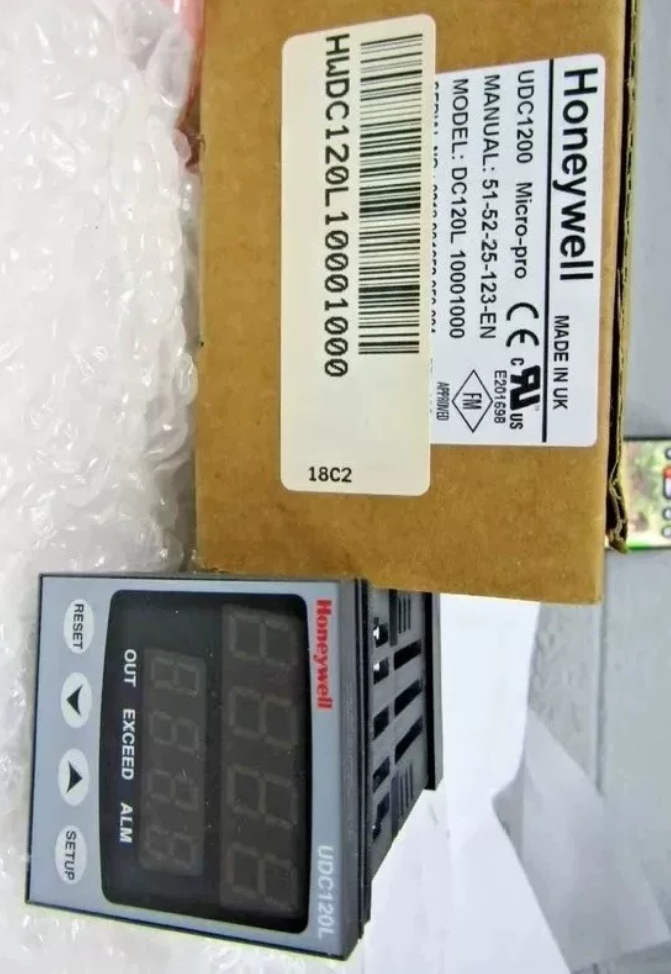

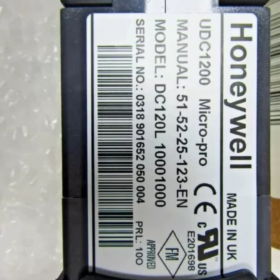
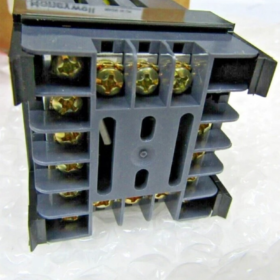
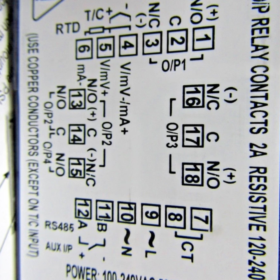
Nombre completo: mielwell UDC120L10001000, a UDC1200 Micro-Pro 1/16 DE Limit Controller. It is not a conventional PID temperature controller. It is designed for safety over-limit protection with latching alarm function.
- Decodificación de código modelo: DC120L 10001000
DC120L: UDC1200 series Limit Controller (differentiated from DC1201/1202 conventional PID controllers)
1: Main Output 1, SPDT Relay
0: No auxiliary output
0: Sin comunicación
1: Universal Power Supply 90–264VAC (50/60Hz)
0: No second output
0: No optional extras
0: No additional alarm
- Especificaciones principales
| Artículo | Parámetro |
| Dimensión general | 48×48×110 mm (1/16 DE) |
| Panel Cutout | 45×45 mm |
| Fuente de alimentación | 90~264V AC, 50/60Hz, Power Consumption ≤4W |
| Aporte | Universal Input: Thermocouple K/J/R/S/B/E/N/T; RTD Pt100; 4-20mA linear signal |
| Exactitud | 0.1% of full scale ±1 LSD |
| Main Output | SPDT Relay, Contact Rating 3A@240VAC |
| Sampling Period | 250EM |
| Mostrar | Dual 4-digit LED, simultaneous PV/SP display + status LED |
| Peso | máx.. 210gramo |
| Certificaciones | CE, RoHS |
- Funciones clave (Main Differences Between Limit Controller & Normal PID Controller)
- Over-limit Latching Protection: When the measured value exceeds the set limit value, the relay actuates and latches. Manual reset is required for recovery. Applied for over-temperature safety cut-off of ovens, furnaces and heat treatment equipment (safety temperature limiter).
- Universal sensor input supporting thermocouples, RTDs and analog signals.
- Sensor break detection: TC/RTD break triggers alarm output.
- Password-protected parameters to prevent unauthorized modification of limit values on site.
- No PID automatic regulation. Only upper / lower limit safety protection (cannot be used for continuous temperature regulation).
- Escenarios de aplicación típicos
Over-temperature safety protection loops for industrial ovens, heat treatment furnaces, aging test chambers, environmental chambers, boiler auxiliaries, plastic extruders and food baking equipment. Often used together with conventional PID temperature controllers (PID controller handles regulation; DC120L serves as independent safety temperature limiting).
- Instalación & Pautas de cableado
- Panel snap-in mounting, max panel thickness 6mm; keep heat dissipation gaps front and rear.
- Relay contacts are dry contacts with external load power supply. Do NOT connect high voltage to instrument internal terminals.
- Route sensor cables separately away from power cables to reduce interference.
- Unlock via password before commissioning to modify temperature limits. Manual key reset is required after latch activation.
- Alternativa / Optional Models
- Misma serie: Other DC120L suffix versions (DC120L10011000 with RS485 communication)
- Alternativas domésticas: Yudian AI series limit controllers, Hongrun NHR-1100 (funciones similares, latch logic needs verification)
- Legacy Honeywell replacement: DC1000 series limit type (gradually phased out)
- Solución de problemas comunes
Sensor error displayed: Check TC/RTD polarity, wire breakage and cold junction compensation.
No latch after over-limit: Confirm function mode is set to Limit latch mode instead of ordinary alarm mode.
Relay fails to actuate: Verify contact load rating, terminal wiring and instrument power supply.
Parameters cannot be modified: Instrument password locked, enter unlock password.
- Referencia del código HS (For Foreign Trade)
9032890090 Other automatic regulating or controlling instruments and apparatus
Tabla comparativa: Honeywell DC120L (UDC120L10001000) vs UDC1202 PID Temperature Controller
| Artículo de comparación | DC120L (Limit Controller) | UDC1202 (PID Process Controller) |
| Posicionamiento central | Safety over-limit protection instrument (independent safety temperature limiting) | Process temperature automatic regulation instrument (main temperature control) |
| Control Algorithm | No PID algorithm, only limit logic; Over-limit Latch function | PID/PD/On-off / Three-position stepping valve control; Auto-tune supported |
| Latch Function | ✅ Standard: Relay latches after over-limit actuation, manual reset mandatory for release (safety cut-off) | ❌ Ordinary alarm without latch; output recovers automatically once temperature drops |
| Función de salida | Output for safety cut-off only, no continuous regulation | Main output for continuous temperature control: Relé / RSS / 4-20mA analog output |
| Dimensión general | 48×48mm, 1/16 DE, panel cutout 45×45mm | 48×48mm, 1/16 DE, panel cutout 45×45mm (fully interchangeable for panel mounting) |
| Universal Input | ✅ Thermocouple, Pt100, 4-20mA linear signal | ✅ Thermocouple, Pt100, 4-20mA linear signal |
| Fuente de alimentación | 90~264VAC wide range | 90~264VAC wide range |
| Exactitud | 0.1% of full scale ±1 LSD | 0.1% of full scale ±1 LSD |
| Uso típico | Over-temperature safety protection for ovens, heat treatment furnaces and test chambers, independent safety loop (safety redundancy) | Closed-loop regulation of normal process temperature to maintain setpoint |
| Combination Application | Used with PID controller: UDC1202 for main temperature control, DC120L as secondary independent safety protection | Sole unit for automatic temperature control; not responsible for safety temperature limiting |
| Manual / Auto Mode | No manual/auto control mode, only limit value setting | Automatic PID regulation, manual output, manual/auto switch available |
| Alarm Types | Only over-limit safety latch alarm | Upper limit, límite inferior, desviación, band alarms and more configurable alarm types |
| Communication Option | RS485 Modbus optional (this DC120L10001000 unit has no communication) | RS485 Modbus optional |
| Puntos clave de selección | Applications requiring independent temperature limit loop and latching trip per safety specifications | Conventional temperature control scenarios requiring automatic constant temperature closed-loop regulation |
| Observaciones importantes | Cannot replace PID controller for temperature regulation, safety protection only | Cannot replace safety limit instrument; non-latching alarm fails safety requirements for some equipment |
Selection Recommendation Summary
- Equipment requiring safety redundancy, hard over-temperature cut-off and fault latching: Dual-instrument scheme: UDC1202 (main temperature control) + DC120L (independent temperature limit) (widely used for heat treatment, ovens and aging chambers)
- Only conventional constant temperature control required with no mandatory safety latch requirement: Select UDC1202 directly
- Only over-temperature protection required without automatic temperature control: Select DC120L alone
Honeywell DC120L10001000 (UDC120L Limit Controller) Technical Document
Product Full Name: Honeywell UDC1200 Micro-Pro DC120L Limit Controller
Document Type: Ficha de datos / Technical Specification Manual (English Engineering Version)
Applicable Model: DC120L10001000 (Salida de relé, No Communication, 90~264VAC Power Supply)
Posicionamiento del producto: Independent safety limit instrument, no PID regulation, over-limit latching trip, applied for equipment over-temperature safety protection
- Model Code Definition DC120L 1 0 0 1 0 0 0
| Segmento de código | Descripción | Configuration of This Model |
| DC120L | UDC1200 series Limit Controller | Limit type, no PID algorithm |
| 1primer dígito 1 | Main Output Type | 1=SPDT Relay Output |
| 2segundo dígito 0 | Salida auxiliar | 0=No auxiliary output |
| 3tercer dígito 0 | Communication Option | 0=No RS485 Modbus communication |
| 4º dígito 1 | Power Supply Specification | 1=Universal AC 90~264VAC, 50/60Hz |
| 5º dígito 0 | Second Output | 0=No second output |
| 6º dígito 0 | Optional Function | 0=No optional extras |
| 7º dígito 0 | Alarm Option | 0=No additional alarm output |
- Eléctrico & Especificaciones mecánicas
| Artículo | Valor | Observaciones |
| Dimensión general | 48mm × 48mm × 110mm | 1/16 DIN panel mount |
| Panel Cutout | 45mm × 45mm | Max panel thickness 6mm |
| Fuente de alimentación | 90~264V AC, 50/60Hz | Wide-range universal AC supply |
| Consumo de energía | ≤4W | Bajo consumo de energía |
| Peso | ≤210g | |
| Sampling Period | 250EM (4 veces por segundo) | |
| Precisión de medición | 0.1% of full scale ±1 LSD | Cold junction compensation ±1℃ for thermocouples |
| Impedancia de entrada | >10MΩ (TC/RTD); 5Oh (4-20mamá) | |
| Main Output | SPDT Relay, 3A@240VAC | Dry passive contacts |
| Certificaciones | CE, RoHS | Industrial certifications |
| Sensor Break Detection | TC / IDT / 4-20mA break diagnosis supported | Breakage triggers limit action |
Universal Input Types (Supported Sensors)
Par termoeléctrico: k, j, R, S, B, mi, norte, t
IDT: Pt100 (DIN43760 0.00385)
Linear Analog: 4~20mA, 0~20mA, 0~10V, 1~5V
- Core Function Description
- Limit Latch Protection【Core Feature】
When measured PV exceeds setpoint SP, relay actuates and latches in trip state. No automatic recovery upon temperature drop; manual key reset required. Meets hard cut-off safety requirements for ovens and heat treatment furnaces.
Configurable for high limit or low limit mode.
- Sensor Break Diagnosis
Breakage of thermocouple, RTD or 4-20mA signal triggers limit output action to prevent runaway caused by sensor failure.
- Parameter Password Lock
Parameter menu protected by password to prevent unauthorized modification of safety limit values. Password unlock required to edit SP, input type and latch mode.
- Dual 4-digit LED Display
Upper screen: PV real-time measured value; Lower screen: SP set limit value. Status LED indicates output/alarm/latch status.
- No PID Automatic Control
This instrument has no PID regulation function and cannot act as primary temperature controller. It serves only for independent safety over-limit protection, forming dual-loop safety temperature control system when paired with UDC1202 PID controller.
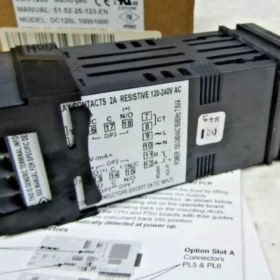
- Definición de cableado de terminales (DC120L Basic Version)
Nota importante: Relay contacts are passive dry contacts. Do NOT connect load power supply to instrument internal power terminals.
- l, norte: Instrument power supply, 90~264VAC
- Sensor input terminals: Par termoeléctrico / Pt100 / 4-20mamá
- Main output relay: COM común, NO normalmente abierto, NC normalmente cerrado
Typical wiring: Use NC normally closed contact. Contact closes under normal temperature; opens upon over-temperature latch to cut heating circuit.
Wiring Recommendation: Use shielded twisted pair for sensor cables, routed separately from power cables to reduce interference.
- Especificaciones de instalación
- Panel snap mounting, max panel thickness 6mm; reserve heat dissipation gap for side-by-side multi-unit installation.
- Temperatura ambiente de funcionamiento: 0~50 ℃; ambient humidity: 20~80%RH, no condensation and corrosive gas.
- Keep away from high-power contactors, frequency converters and strong electromagnetic interference sources.
- Earthing: Instrument chassis grounding; single-end grounding for shield layer.
- Operación & Configuration Overview
6.1 Enter Parameter Menu
Press 【UP】+【SETUP】 simultaneously, ingrese la contraseña (common password:10/20) to unlock and enter configuration mode.
6.2 Key Configurable Parameters
Input type code (sensor model selection)
Full scale upper/lower range
Limit SP (safety protection threshold)
Limit mode: high limit latch / low limit latch
Latch enable/disable
Action logic for sensor break
Password setting & parameter locking
6.3 Latch Reset
After over-limit latch trip, perform manual reset via keys on operator interface to restore relay contacts to normal state.
- Escenarios de aplicación típicos
Independent over-temperature safety protection loops for industrial ovens, hot air furnaces, heat treatment furnaces, aging test chambers, environmental chambers, plastic extruders and food baking equipment.
Standard scheme: UDC1202 (PID main temperature control) + DC120L (independent temperature limit protection) dual-instrument redundant control complying with equipment safety standards.
- Tabla de diagnóstico de fallas
| Fenómeno de falla | Dirección de solución de problemas |
| Sensor error displayed | Check sensor wiring polarity and breakage; verify input code matches sensor; comprobar la conexión a tierra del blindaje |
| No latch after over-limit | Confirm Latch function enabled in parameters; confirm limit mode instead of ordinary alarm mode |
| Relay fails to actuate | Check contact load rating; verify COM/NO/NC relay wiring; confirm instrument power supply |
| Parameters cannot be modified | Instrument password locked, input unlock password; confirm not in read-only mode |
| Reading drift | Separe los cables de los sensores de los cables de alimentación.; check grounding; verify cold junction compensation for TC |
- Alternative Model Information
Same Honeywell series: DC120L10011000 (version with RS485 communication)
Alternativas domésticas: Yudian AI series limit controllers, Hongrun NHR-1100 (latch logic requires verification)
Reemplazo heredado: DC1000 series limit controller (interrumpido)
- HS Code for Foreign Trade
Código HS: 9032890090 Other automatic regulating or controlling instruments and apparatus
- Notas de seguridad
- This instrument is a safety limit protection device, cannot be used alone for process temperature control.
- External contactor is recommended for safety circuit. Relay contact capacity is limited and cannot directly drive high-power heating loads.
- Periodic over-temperature test on safety circuit is required to verify latch trip function.
- Disconnect power before instrument disassembly and wiring, comply with local electrical safety regulations.
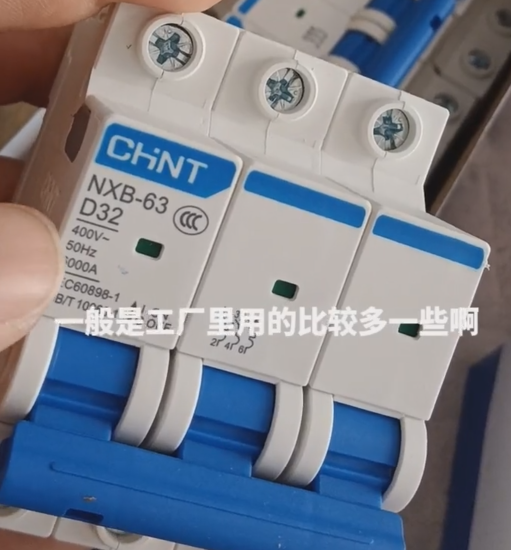
NH42-63-318x560.png "Interruptores de transferencia automática tipo PC CHINT (ATS)NH42-63/4SZ")