Contacteur,disjoncteur,capteur,Encodeur,API,Convertisseur

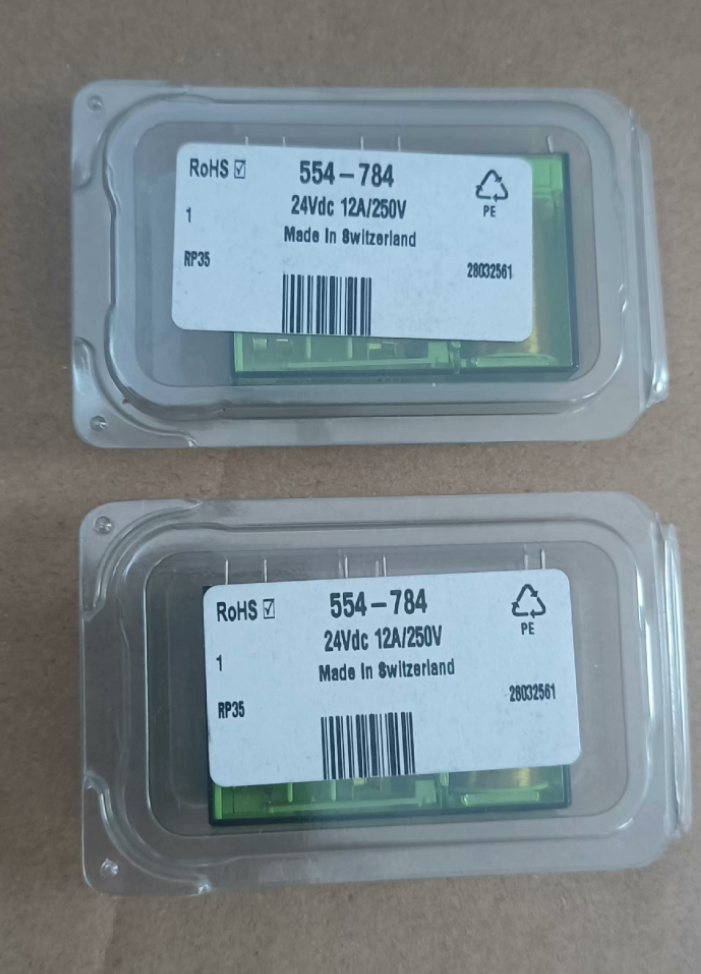

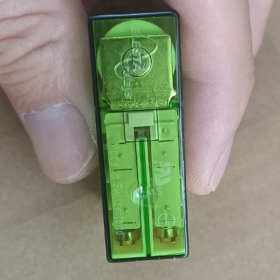
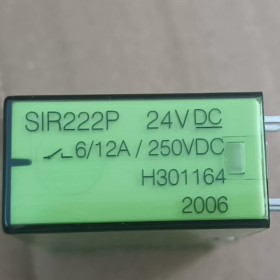
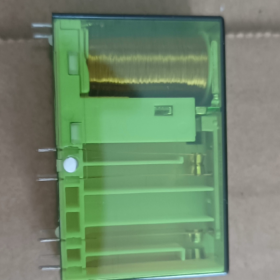
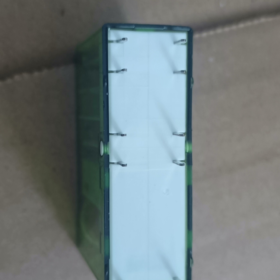
ELESTA (Swiss safety relay brand under Champignon) SIR4 Power high-current PCB-mount relais de sécurité
- SIR: SIR4 series safety relay with forcibly guided contacts
- 222: Configuration des contacts: 2 Normalement ouvert (NON) + 2 Normalement fermé (Caroline du Nord) (dual-pole double-throw safety structure)
- P.: High-current version rated for 12A load (standard SIR222 is 10A)
Standard stock coil specifications:
SIR222P 24VDC (grand public, part number H301164, coil resistance 760Ω)
SIR222P 12VDC (part number H301192)
Custom coil voltages available: 5/6/18/48/110VCC
Core Safety Certifications
Conforme à la CEI 61810-3 Type A Forcibly Guided Contacts and EN50205 machinery safety standards. Applicable to machine tool and automated safety circuits to meet safety contact fault monitoring requirements.
- Dimensions mécaniques & Montage
Taille globale: 46.4(L) × 16(W) × 30.7(H) mm
Montage: Through-hole PCB soldering (14-pin footprint)
Poids: Environ. 32g
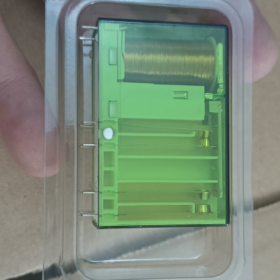
Logement: Transparent green dustproof flame-retardant PC, allows visual inspection of coil and contact status
Standard through-hole pin pitch for PCB mounting; compatible with dedicated PCB sockets
- Coil Electrical Parameters (CC)
| Article | Valeur du paramètre |
| Nominal pull-in coil power | 0.75W |
| Holding power consumption | 0.23W (low-power latching, low heat generation) |
| 24VDC coil resistance | 760Ω ±10% |
| Pull-in voltage range | 70%~110 % de la tension nominale (DC 16.8~26.4V) |
| Tension de chute | ≤10% Un |
| Tension de tenue diélectrique (coil to contacts) | 2500V AC for 1 minute |
| Coil protection | Diode de roue libre intégrée (prevents reverse breakdown of DC coils) |
- Core Contact Electrical Ratings (2NO+2NC Safety Forced Linkage)
4.1 Capacité de charge (High-Current Advantage of SIR222P)
Continuous rated current: 12UN / 250ACC (AC1 resistive load)
Peak inrush current: Max.. 60UN (20MS, suitable for inductive startup of motors and contactors)
Switching voltage range: AC 5~480V / DC 5~250V
Capacité de commutation nominale: 3000Virginie
Minimum reliable switching load: 5mA / 5V (no sticking for weak signal circuits)
Matériel de contact: AgSnO2 silver tin oxide, résistant à l'arc et anti-soudure
4.2 Core Feature of Forcibly Guided Safety Design (Distinction from Standard Relays)
Forced mechanical linkage: NO and NC contacts within the same channel can never conduct simultaneously
Monitoring logic: Safety circuits can detect NC feedback signals to judge contact welding faults
Dielectric withstand voltage between contacts: 4000ACC; open contact withstand voltage: 1500ACC
Contact creepage distance: ≥10mm between coil and output contacts; ≥8mm between two output contact banks for enhanced isolation protection
4.3 Service Life Ratings
Durée de vie mécanique: 10 million operations under no-load conditions
Durée de vie électrique (12A/250VAC resistive): 250,000 opérations
Factory contact resistance: ≤100 mΩ (tested at 6V/100mA)
- 14-Pin Pinout Definition (Standard Top Silkscreen Layout)
Goupilles de bobine (Drive Side)
13(+), 14(-): DC coil positive and negative terminals with built-in diode. Connecter 14 to 0V and 13 to DC24V.
Two Independent Safety Contact Banks (1NO+1NC per bank with forced linkage)
Canal 1 (First Contact Bank)
1: COM1 commun | 2: NC normalement fermé | 3: NON Normalement Ouvert
Canal 2 (Second Contact Bank)
4: COM2 commun | 5: NC normalement fermé | 6: NON Normalement Ouvert
Pins 7~12 are unoccupied locating pins with no electrical connections.
- Environmental Operating Parameters
Température de fonctionnement: -40℃ ~ +70℃
Température de stockage: -40℃ ~ +85℃
Humidité: 5%~95% RH non-condensing
Vibration / Résistance aux chocs: IEC60068 industrial equipment grade, suitable for machine tool and production line control cabinets
- Scénarios d'application typiques (Dedicated for Safety Circuits)
- Dual-channel monitoring for machine safety door and emergency stop circuits (NC contacts detect welding faults)
- Safe cut-off circuits for inverter and servo enable signals
- Output expansion for safety light curtains and safety mats on automated production lines
- Safety control circuits for rail transit, medical equipment and lifts
- High-current output expansion for PLCs (direct drive of contactors and solenoid valves up to 12A)
- Equipment fault diagnosis feedback (self-inspection of contact adhesion via NC contacts)
- Cross-Series Model Selection Comparison Table
| Modèle | Configuration des contacts | Courant continu | Puissance de la bobine | Scénario d'application |
| SIR222P | 2NON+2NC | 12UN | 0.75W | High-current safety circuits, contactor driving (primary recommended model) |
| SIR222 | 2NON+2NC | 10UN | 0.6W | Medium/low-current signal safety circuits |
| SIR312P | 3NON+1NC | 12UN | 0.75W | Multi-output single-channel monitoring |
| SIM222 | 2NON+2NC | 8UN | 1W | Compact low-load safety relay |
- Matrice de dépannage
| Phénomène de défaut | Cause première | Solution |
| Coil energized but NO contacts fail to close | 1. Reversed coil polarity; 2. Tension d'alimentation inférieure 70% tension nominale; 3. Bobine brûlée | Swap pins 13 et 14; Measure DC supply voltage; Remplacer le relais |
| NO contacts stick closed after power-off, NC contacts cannot close (critical safety failure) | Load current exceeds 12A; repeated heavy arcing welds contacts | Reduce load or add intermediate relay; Install brand-new SIR222P |
| Both NC and NO contacts conduct during safety inspection | Damaged forcibly guided mechanical structure; relay cannot be repaired | Replace immediately; prohibit further use in safety circuits |
| Severe contact voltage drop and overheating | Poor PCB soldering; long-term near full 12A load | Re-solder PCB pins; Parallel additional contacts for current sharing |
| Coil shows no pull-in action at all | Open circuit at pins 13/14; No power supply output | Inspect power circuit and PCB solder joints for open connections |
- Mandatory Installation & Interdictions d'utilisation
- NC contact safety monitoring must not be omitted: Safety devices must read NC feedback signals; otherwise anti-welding protection is lost.
- Long-term resistive load shall not exceed 12A; inductive loads are recommended to be derated to 8A.
- DC coils must not be energized with reversed polarity for extended periods (built-in diode only provides one-time transient protection; sustained reverse voltage burns the coil).
- Prohibit full-load continuous operation above 70℃ in sealed cabinets; sufficient heat dissipation space must be reserved.
- Do not parallel contacts of different relays for current expansion; single-channel load cannot exceed rated current of one contact.
- Only PCB soldering mounting is allowed; avoid violent bending or repeated plugging/unplugging of pins.
- Liste de colisage standard
1 × SIR222P relay unit
- Original manufacturer safety datasheet, TÜV/CE safety certification documents
- Standard package quantity: 15 pièces par boîte
Application Manual for ELESTA SIR222P Forcibly Guided Safety Relay
Document Version: V1.0|Applicable Models: SIR222P-24VDC (grand public), SIR222P-12VDC
Marque: ELESTA (Suisse)|Safety Standards: CEI 61810-3 Type A Forcibly Guided Contacts, EN50205, ISO13849-compliant safety circuit design
Table des matières
- Présentation du produit & Explication du code modèle
- Spécifications électriques complètes
- Pinout Definition & Standard Wiring Specifications
- 4 Standard Industrial Wiring Schemes (Including Safety Circuits)
- PCB Mounting, Soldering & Mechanical Installation Standards
- Load Selection & Derating Guidelines
- Core Rules for Safety Circuit Design (Requirements for Forcibly Guided Contacts)
- Power-On Commissioning & Functional Test Procedures
- Matrice de dépannage
- Mandatory Installation & Interdictions d'utilisation
- Comparaison de modèles alternatifs entre séries
- Conditionnement & Documents de certification
- Présentation du produit & Explication du code modèle
1.1 Model Code SIR222P
SIR: SIR4 Power series PCB-mounted forcibly guided safety relay
222: Contact structure: 2NON + 2Caroline du Nord, two independent banks of 1NO+1NC forced-linkage contacts
P.: High-current version with 12A AC1 continuous rating per contact (standard SIR222 is only 10A)
1.2 Core Safety Features (Distinction from Ordinary Relays)
- Forcibly Guided Mechanical Structure: NO and NC contacts within one channel can never conduct simultaneously. If contacts weld shut, the paired opposite contacts remain open to enable fault diagnosis.
- Coil-to-contact dielectric withstand voltage: 2500ACC; inter-contact isolation: 4000ACC. Creepage distances meet safety isolation criteria.
- AgSnO2 silver tin oxide contacts with thin gold plating, anti-arcing and anti-welding, compatible with both high-current loads and weak signal detection.
- Built-in coil freewheeling diode (dedicated for DC coils to prevent reverse voltage breakdown).
1.3 Applicable Safety Performance Levels
Suitable for PLd / Cat.3, SIL2 safety cut-off circuits. Dual-channel redundant design achieves Cat.4 / PLe.
- Spécifications électriques complètes
2.1 Paramètres de la bobine (CC)
| Article | SIR222P-24VDC | SIR222P-12VDC |
| Nominal pull-in power | 0.75W | 0.75W |
| Holding power consumption | 0.23W | 0.23W |
| DC coil resistance | 760Ω±10% | 190Ω±10% |
| Pull-in voltage range | 70%~110% Un (16.8~26,4 VCC) | 8.4~13.2VDC |
| Tension de chute | ≤10% Un | ≤10% Un |
| Coil reverse protection | Diode de roue libre intégrée (Pin13+, Pin14-) | Diode de roue libre intégrée |
| Coil dielectric withstand voltage | 2500V AC for 1min | 2500V AC for 1min |
2.2 Contact Load Ratings (Per 1NO/1NC Channel)
- AC1 resistive: 12UN / 250ACC, max switching capacity 3000VA
- AC15 inductive (contacteurs / électrovannes): 8UN / 250ACC (derating mandatory)
- DC13 inductive: 5UN / 24VCC
- Peak surge current: 60UN (short-duration 20ms)
- Minimum reliable switching load: 5mA / 5V (no poor contact for PLC weak feedback signals)
- Matériel de contact: AgSnO2 with 0.2~0.4μm gold plating
- Factory contact resistance: ≤100 mΩ (6V/100mA test condition)
2.3 Service Life Ratings
Durée de vie mécanique (pas de charge): 10 millions d'opérations
Durée de vie électrique (12A/250VAC resistive): 250,000 opérations
Durée de vie électrique (8A inductive load): 100,000 opérations
2.4 Environnemental & Paramètres mécaniques
Dimensions hors tout: 46.4(L)×16(W)×30.7(H)mm, 14-pin through-hole PCB mount
Poids: 32g
Température de fonctionnement: -40℃ ~ +70℃ (enhanced heat dissipation required for full load at 70℃)
Température de stockage: -40℃ ~ +85℃
Humidité: 5%~95% RH non-condensing
Résistance aux vibrations: 10~55Hz, 1.5mm amplitude for 2 hours on each of three axes
Logement: Transparent green flame-retardant PC for visual contact inspection
- Pinout Definition (Top Silkscreen View, Standard PCB Footprint)
3.1 Coil Drive Pins
13: Coil positive DC+
14: Coil negative DC(cathode of built-in diode; sustained reverse connection prohibited)
3.2 Two Independent Forcibly Guided Contact Banks (COM+NC+NO per bank)
Canal 1 (First Safety Contact Bank)
1: COM1 commun
2: NC1 Normally Closed (forced linkage feedback contact)
3: NO1 Normally Open (main power output)
Canal 2 (Second Safety Contact Bank)
4: COM2 commun
5: NC2 Normally Closed (forced linkage feedback contact)
6: NO2 Normally Open (main power output)
3.3 Unoccupied Pins
Épingles 7,8,9,10,11,12: Locating reinforcement only, no electrical connection, wiring forbidden.
3.4 Forced Linkage Logic (Core Safety Principle)
Bobine hors tension (open state): Pins 2-NC1 and 5-NC2 conduct; Pins 3-NO1 and 6-NO2 open
Bobine alimentée (pulled-in state): Pins 2-NC1 and 5-NC2 open; Pins 3-NO1 and 6-NO2 conduct
Fault judgment rule: If NC contacts remain closed after coil energization → NO contacts welded shut; safety circuit triggers fault and equipment shutdown.
- Four Standard Industrial Wiring Schemes
Schème 1: Dual-Channel Safety Cut-Off Circuit (Arrêt d'urgence / Porte de sécurité, Le plus courant)
Description de la fonction
Two independent NO contacts cut servo/inverter enable signals; two NC contacts connect to PLC for contact welding fault monitoring, complying with ISO13849 Cat.3 safety requirements.
Étapes de câblage
- Coil drive: PLC 24V+ output → Pin13; 0V → Pin14
- Power output circuit (two independent cut-off paths, parallel connection prohibited)
Canal 1: 24VAC/DC supply → COM1(Broche1); NON1(Broche3) → Servo Enable Coil 1
Canal 2: 24VAC/DC supply → COM2(Broche4); NO2(Pin6) → Servo Enable Coil 2
- Fault feedback monitoring (NC contacts wired to PLC digital input)
NC1(Broche2) and NC2(Pin5) shorted together and connected to PLC PNP input; PLC logic: NC contacts must open when relay pulls in. Continuous conduction indicates contact welding and locks out equipment startup.
Mandatory Safety Rule
Two output loads must be independent. Parallel connection of NO1 and NO2 for current expansion destroys dual-channel redundant safety design.
Schème 2: PLC High-Current Output Expansion (Électrovanne / Contactor Drive)
Champ d'application
PLC single-point output current ≤0.5A, insufficient for direct drive of 10A solenoid valves; SIR222P expands contact current capacity.
- Bobine: PLC output drives Pins13/14 (24VCC)
- Main circuit AC220V live wire → COM1(Broche1), COM2(Broche4)
- NON1(Broche3) and NO2(Pin6) parallel to solenoid coil (parallel allowed for resistive loads, not recommended for inductive loads)
- NC contacts unused or wired to alarm indicator light (light illuminates when relay de-energized)
Schème 3: Equipment Self-Diagnosis Circuit (Safety Light Curtain Output Expansion)
- Dual-channel NC signals from safety light curtain wired in series to drive relay coil Pins13/14
- Two NO contacts cut main contactor power supply; two NC contacts feed real-time contact status to PLC
- Logique: Curtain blocked → coil de-energized → NO contacts open and machine stops; If NC contacts stay closed with unobstructed curtain, relay contact damage is detected and alarm interlock activates.
Schème 4: Mixed Weak Signal & High-Current Circuit (Contact Channel Isolation)
- Channel1 NO contacts: Drive high-current AC220V contactors
- Channel2 NC contacts: Feed 5V weak feedback signal to MCU IO ports (gold-plated contacts guarantee stable low-current contact performance)
Interdiction: Do not share one contact bank for both high-current inductive loads and 5V weak signals; arcing contaminates contact surfaces and causes intermittent weak signal faults.
- PCB Mounting & Soldering Standards
5.1 PCB Pad Design Requirements
Pin hole diameter: 1.3mm, pad diameter ≥2.2mm
Standard pin pitch layout compatible with all 14-pin relays
Wider copper traces for COM/NO/NC high-current pins; copper thickness ≥35μm, trace width ≥5mm for 12A loads
5.2 Soldering Process Specifications
- Wave soldering peak temperature ≤260℃, contact duration ≤4s; hand iron temperature ≤350℃, single pin soldering time ≤3s
- Prolonged high-temperature heating of pins is forbidden, as it melts internal contact plastic supports
- Solder joints must be fully filled without cold solder or bridging between adjacent pins
- Clean flux residue after soldering to prevent leakage and creepage currents
5.3 Exigences de dissipation thermique
Continuous full 12A operation: Increase PCB copper trace heat dissipation area; cabinet ambient temperature ≤60℃
Ambient temperature of 70℃: Load must be derated to ≤8A
- Load Selection & Derating Standards
| Type de charge | Rated Permitted Current | Mandatory Derating Explanation |
| AC250V resistive (heating lamps, résistances) | 12UN | No derating required for long-term stable operation |
| AC250V inductive (contacteurs, électrovannes) | 8UN | Inductive kickback arcs occur at power-off; obligatoire 1/3 déclassement |
| DC24V inductive (electromagnetic clutches) | 5UN | Poor DC arc extinction performance; significant derating required |
| Weak signal 5~24V (Retour d'information de l'automate) | ≤0.5A | Only use gold-plated NC contacts; do not share channel with high-current loads |
Recommended Arc Suppression Measures
Fit absorption components across inductive load coils:
AC loads: RC absorption circuit (0.1μF capacitor in series with 100Ω resistor)
DC loads: Freewheeling diode wired in reverse parallel across coil terminals
- Mandatory Core Rules for Safety Circuit Design (Violation Invalidates Safety Certifications)
- NC contact monitoring cannot be omitted
All safety cut-off circuits (arrêt d'urgence, safety doors, rideaux lumineux) must route both NC contact banks to the upper controller (API) for welding diagnosis. Circuits without monitoring fail to meet IEC61810-3 safety requirements.
- Dual-channel outputs must not be paralleled
Two NO contacts provide redundant safety cut-off; each must drive an independent load. Parallel connection eliminates fault isolation capability.
- Single-channel cut-off is prohibited for safety applications
Using only one NO contact to cut power while leaving the other unused downgrades safety classification directly to Cat.1 and fails machine safety acceptance tests.
- Do not series multiple safety relay contacts for current expansion
Multi-stage series connection increases contact failure probability and reduces safety level.
- Coil power supply must share the same source as the safety circuit. Separate power supplies cause asynchronous logic operation.
- Power-On Commissioning & Functional Test Procedures
8.1 Static Pre-Power Test (Multimeter Required)
- Coil de-energized state: Measure continuity between 1-2 et 4-5; open circuit between 1-3 et 4-6
- Measure coil resistance at Pins13/14 (760Ω for 24VDC model) to rule out short/open circuits
- Verify no continuity between unoccupied pins and coil/contact terminals
8.2 Energized Pull-In Test
- Apply rated DC24V to Pin13(+) and Pin14(-)
- Multimeter verification: Open circuit between 1-2 et 4-5; continuity between 1-3 et 4-6
- Cut coil supply voltage; contacts reset rapidly to original state
8.3 Safety Fault Simulation Test (Mandatory for Acceptance)
Manually simulate NO contact welding by shorting Pins1 and 3. With coil energized, NC1 (Broche2) remains conductive. PLC detects persistent NC closure and triggers fault alarm to validate the forcibly guided mechanical design.
- Matrice de dépannage
| Phénomène de défaut | Cause première | Standard Resolution |
| Bobine alimentée, NO contacts fail to close | 1. Reversed Pin13/14 polarity; 2. Supply below 70% Et; 3. Bobinage ouvert | Swap coil terminals, measure supply voltage, replace relay |
| NO contacts stick closed after power-off, NC cannot close | Load exceeds 12A; no absorption circuit for inductive loads leading to arc welding | Install RC/diode absorption, derate load, replace relay |
| Coil pulls in but NC contacts remain closed (critical safety failure) | Damaged forcibly guided mechanical linkage, seized contacts | Discard and replace immediately; ban use in safety circuits |
| Surchauffe des contacts, voltage drop >1V | Poor PCB soldering, continuous 12A full load at high temperature, insufficient copper trace width | Re-solder joints, enlarge PCB heat dissipation traces, derate operating load |
| Intermittent PLC weak signal feedback | NC contacts previously carrying high-current loads with carbonized arc deposits on contact surfaces | Remplacer le relais; separate high-current and weak signal channels |
| No coil pull-in action, zero voltage detected | Open circuit at Pins13/14, fusible d'alimentation grillé | Inspect PCB solder pads and 24V supply circuit |
| Leakage short between adjacent pins | Residual flux condensation, cabinet internal condensation | Clean PCB surface, improve cabinet dehumidification and ventilation |
- Absolute Installation & Interdictions d'utilisation
- Omission of NC contact welding monitoring on safety cut-off circuits voids safety certification validity.
- Continuous resistive loads exceeding 12A or inductive loads exceeding 8A burn contact sets.
- Long-term reverse energization of DC coils destroys the built-in freewheeling diode.
- Do not run continuous full 12A loads above 70℃ in sealed cabinets.
- Do not share one contact bank for both high-current inductive loads and 5V weak signal circuits.
- Parallel connection of two NO contacts for current expansion is forbidden in safety circuit applications.
- Prolonged full-load operation at ambient temperature above 70℃ is prohibited.
- Violent pin bending, repeated plugging/unplugging, and extended high-temperature soldering are forbidden.
- Do not deploy in circuits above AC480V, exceeding contact voltage withstand ratings.
- Cross-Series Alternative Selection Comparison
| Modèle | Configuration des contacts | Per-Contact Rated Current | Puissance de la bobine | Différence d'application |
| SIR222P | 2NON+2NC | 12A AC1 | 0.75W | High-current safety cut-off, direct contactor drive (primary model) |
| SIR222 | 2NON+2NC | 10A AC1 | 0.6W | Medium/low-current signal safety circuits, low power consumption demand |
| SIR312P | 3NON+1NC | 12A AC1 | 0.75W | Multi-channel power output with single fault monitoring path |
| SIM222 | 2NON+2NC | 8A AC1 | 1W | Compact low-load PCB control boards |
- Conditionnement & Documents de certification
12.1 Liste de colisage standard
1 × SIR222P-24VDC safety relay
- Original manufacturer datasheet
- Copies of CE and TÜV safety certification
- Standard carton quantity: 15 pièces par boîte
12.2 Certifications de conformité
CE Industrial Equipment Certification
TÜV IEC 61810-3 Type A Forcibly Guided Contact Certification
EN50205 Machinery Safety Standard Compliance
RoHS Lead-Free Environmental Compliance Certification


NH42-63-318x560.png "Commutateurs de transfert automatiques de type PC CHINT (ATS)NH42-63/4SZ")