Contacteur,disjoncteur,capteur,Encodeur,API,Convertisseur



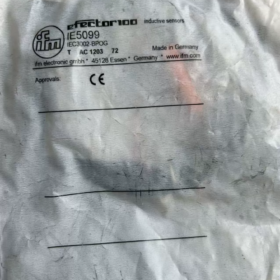
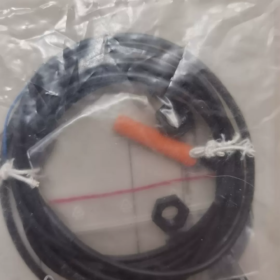
Répartition du code modèle
IE5099 = IEC3002-BPOG
(IE5099 est le numéro de pièce de commande; IEC3002-BPOG signifie le modèle de spécification de série)
- CEI: Série de proximité inductive capteurs avec filetage plastique M8 IFM
- 3002: Distance de détection nominale Sn = 2 mm
- B: 3-type de fil CC
- P.: Sortie PNP
- Ô: Normalement ouvert (NON)
- G: Câble droit en PVC (2m comme longueur d'usine standard; 6variante m disponible en IE5100)
- Spécifications matérielles de base
2.1 Dimensions mécaniques
Spécification du fil: M8 × 1,0, Boîtier en plastique PBT
Longueur totale: 35 mm, Conception à montage non encastré
Accessoires standards: 2 morceaux d'écrous de blocage M8
Câble: 3Gaine PVC ×0,14 mm², longueur standard 2 m
Poids net: 43.1 g
Classe de protection: IP67 (étanche à l'eau et à la poussière, permet un lavage à court terme)
2.2 Paramètres électriques (Normes officielles d'usine IFM)
| Article | Valeur du paramètre |
| Tension d'alimentation | C.C 10 ~ 36 V (compatible avec les systèmes industriels standard DC24V) |
| Consommation de courant à vide | <15mA (à 24 V état de fonctionnement) |
| Type de sortie | 3-fil DC PNP normalement ouvert (NON) |
| Max.. Courant de charge | 200 mA (peut piloter directement les entrées PLC et les bobines de relais) |
| Chute de tension de sortie | ≤2,5 V |
| Fréquence de commutation | 800 Hz (adapté au comptage à grande vitesse et au positionnement des convoyeurs) |
| Fonctions de protection | Protection contre l'inversion de polarité, protection contre les courts-circuits, protection contre les surcharges |
| Distance de détection nominale Sn | 2 mm |
| Plage de fonctionnement stable | 0~1,6mm (zone de détection fiable) |
| Tolérance réelle Sr | 2 ±10% mm |
| Plage d'hystérésis | 1%~15 % de la distance nominale (conception anti-gigue) |
| Décalage du point de commutation | ±10 % Sr |
2.3 Facteurs de correction matérielle (Atténuation de la distance de détection)
Acier doux St37: 1.0 (étalon de référence)
Acier inoxydable: 0.7
Laiton: 0.4
Aluminium: 0.3
Cuivre: 0.2
2.4 Conditions environnementales de fonctionnement
Température de fonctionnement: -25℃ ~ +85℃
Température de stockage: -25℃ ~ +90℃
Normes CEM: DANS 60947-5-2, EN55011 Classe B
- Définition standard du câblage à 3 fils (Code couleur uniforme mondial)
| Couleur du fil | Définition | Instructions de câblage |
| BN Brun | Alimentation DC+ Positive | Se connecte au rail positif 24 V et au terminal commun 24 V du module PLC. |
| Bleu BU | CC- Alimentation négative | Connectez-vous à 0V / mise à la terre |
| BK Noir | Sortie de signal PNP | Se connecter au terminal d'entrée numérique PLC (actif élevé) |
Logique de câblage PNP
Aucune cible métallique à proximité: Fil de signal noir = 0 V, aucun signal d'entrée vers l'automate
Le métal entre dans la zone de détection: Fil de signal noir ≈ 24 V, L'automate reçoit le signal de déclenchement
- Spécifications de montage (Exigences obligatoires pour une installation non affleurante)
- Dégagement de montage (Prévenir les interférences mutuelles)
Deux capteurs montés côte à côte sur le même axe: Entraxe ≥12 mm
Montage latéral adjacent: Écart ≥8 mm
- Contrôle de distance de détection
Maintenez l'écart entre la cible métallique et la face de détection entre 0 et 1,6 mm.. Une perte de signal se produira si la distance dépasse 1.6 mm.
- Couple de serrage
Couple de serrage pour écrous M8: 0.8~1,2 N·m. Ne pas trop serrer pour éviter de casser les fils en plastique.
- Règles de séparation des câbles
Maintenir un dégagement minimum de 30 cm entre les câbles des capteurs et les câbles d'alimentation des onduleurs / contacteurs. Acheminez les fils perpendiculairement lors du croisement pour réduire les interférences.
- Protection des câbles
Évitez la flexion et l'écrasement à long terme; réserver un 5 cm tampon de mou au niveau des joints de câbles.
- Scénarios d'application
- Détection de présence de pièces sur les lignes d'assemblage, comptage sur convoyeur, positionnement d'indexation à grande vitesse (800 Fonctionnement haute fréquence Hz)
- Détection de présence de métal sur machines-outils automatisées, retour de position du piston du cylindre
- Machines d'emballage, tri logistique, matériel comptant sur l'équipement de transport
- Compatible avec les entrées numériques des automates de série complète: Omron CJ/CP/NJ, Siemens S7, Mitsubishi FX/Q
- Comparaison de modèles alternatifs entre séries
| Modèle | Distance de détection | Type de sortie | Longueur du câble | Différence |
| IE5099 IEC3002-BPOG | 2 mm | PNP NON | 2 m | Modèle standard à usage général |
| IE5100 IEC3002-BPOG/6M | 2 mm | PNP NON | 6 m | Câble long pour câblage longue distance |
| IE5098 IEC3002-BPKG | 2 mm | PNP NC normalement fermé | 2 m | Pour les applications nécessitant un signal NC |
| IE5089 IEC3002-BNOG | 2 mm | NPN NON | 2 m | Remplacement des systèmes d'entrée PLC de type NPN |
- Matrice de dépannage
| Phénomène de défaut | Cause première | Solution |
| LED jaune éteinte et aucun signal émis lorsque la cible métallique s'approche | 1. Fils d'alimentation inversés marron/bleu; 2. Tension d'alimentation inférieure 10 V; 3. Câble cassé | Vérifier la polarité du câblage, mesurer l'alimentation DC24V, inspecter les segments de câble pour déceler des ruptures |
| La LED jaune reste allumée même sans cible métallique | 1. Espace de montage trop court; 2. Interférence provenant des supports métalliques environnants; 3. Panne du transistor de sortie interne | Élargir le dégagement de montage, enlever les obstructions métalliques environnantes, remplacer le capteur |
| Vacillant, signal intermittent | 1. Le câble passe à proximité de sources de forte puissance provoquant des interférences; 2. La vitesse de déplacement cible dépasse 800 Hz; 3. Écrous desserrés entraînant une dérive de distance | Monter un noyau de ferrite sur le câble pour le blindage, réduire la vitesse de déplacement, resserrer et sécuriser les écrous |
| Aucun signal d'entrée PLC mais la LED jaune du capteur fonctionne normalement | 1. Connexion du fil de signal noir lâche; 2. Polarité incompatible de la borne commune d'entrée de l'automate; 3. Courant de charge dépassé 200 mA | Serrez les bornes du fil noir, confirmer la borne commune 24 V pour les modules PNP, ajouter un relais intermédiaire pour l'expansion de la charge |
| Aucun voyant LED sur le capteur | Circuit ouvert dans la boucle d'alimentation, fusible d'alimentation grillé | Inspecter le câblage du disjoncteur DC24V et du bornier |
- Installation stricte & Interdictions d'utilisation
- Ne pas intégrer à fleur dans les supports métalliques. Ce modèle est conçu exclusivement pour un montage non encastré. Embedding will drastically shorten sensing distance or cause complete failure.
- Do not exceed total load current of 200 mA; otherwise the output transistor will burn out.
- Do not immerse cable in oil, strong acid or alkali for long periods; PVC cables are not resistant to highly corrosive media.
- Do not connect directly to AC220V mains; only DC 10~36V power supply is supported.
- Do not bundle multiple sensor cables with power cables for long-distance parallel routing in the same trunking.
- Liste de colisage standard
- 1 × IE5099 sensor main unit (with 2m 3-core PVC cable)
- 2 × M8 plastic locking nuts
- Original manufacturer operation manual, CE certification documents
Full Specification of Switching Frequency for IFM IE5099 (CEI3002-BPOG)
- Official Rated Parameter
Standard Switching Frequency: 800 Hz (rated value under DC operation)
Définition: The sensor can complete a maximum of 800 cycles de commutation complets par seconde: le métal entre dans la zone de détection → sortie ON; zone de détection des feuilles métalliques → sortie OFF.
Conversion du cycle de réponse
Cycle de commutation complet unique = 1 ÷ 800 = 1.25 MS
Le capteur présente un temps de réponse total ultra-rapide, y compris une détection interne et une bascule de sortie, idéal pour les applications de détection dynamique à grande vitesse.
- Paramètres dynamiques clés de support (Critique pour un fonctionnement stable à haute fréquence)
- Hystérèse: 1%~15% Sr
Sr = 2 mm (distance de détection nominale), plage d'hystérésis: 0.02~0,3mm
Fonction: Élimine les déclenchements fréquents de faux signaux causés par les vibrations mécaniques et les petites gigues, équilibrant la réponse à grande vitesse et les performances anti-interférences.
- Zone de détection efficace et stable: 0~1,6mm
La sensibilité de détection chute fortement au-delà 1.6 mm, conduisant à des pertes d'impulsions fréquentes dans des conditions de travail à haute fréquence.
- Capacité de conduite de sortie
Max.. courant de charge 200 mA. Can be wired directly to PLC high-speed input terminals without intermediate relay expansion for high-speed counting.
- Calculation of Equipment Linear Speed at 800 Hz (On-site Selection Reference)
Exemple: Metal baffles evenly arranged on conveyor, each baffle 1 mm thick with 1 mm gap between adjacent pieces
Total width of one metal piece plus gap = 2 mm
Max.. number of workpieces passing per second = 800
Linear speed = 800 × 2 mm = 1600 mm/s = 1.6 MS
Meets requirements for conveyor belts, indexing plates, high-speed stamping positioning and encoder synchronous counting;
Higher linear speeds are achievable with thinner workpieces and smaller gaps.
- High-Frequency Operation Limitations & Précautions
- Sensing Distance Attenuation by Metal Material Reduces Max. Stable Switching Frequency
Mild Steel: Correction factor 1.0, stable full-speed operation at 800 Hz
Acier inoxydable (0.7), Laiton (0.4), Aluminium (0.3), Cuivre (0.2): Effective sensing distance decreases, ce qui entraîne une fréquence de commutation stable réelle inférieure. Réduisez le jeu de montage en conséquence.
- Les interférences de câblage dégradent la fréquence effective
Acheminement parallèle des câbles de capteurs avec inverseur / Les câbles d'alimentation des contacteurs sans mise à la terre du blindage introduisent un bruit haute fréquence, provoquant une perte d'impulsion et un scintillement du signal.
Contre-mesure: Maintenir un espace ≥ 30 cm entre les câbles de signal et d'alimentation, croiser les fils perpendiculairement, mettre en œuvre une mise à la terre du blindage en un seul point à l'intérieur des armoires de commande.
- Une charge excessive est interdite
Commutation fréquente à grande vitesse avec un courant de charge approchant le 200 La limite supérieure en mA provoque un échauffement de la sortie et une fréquence de commutation maximale réduite. Complet 800 Les performances Hz peuvent être maintenues lors de la commande d'entrées API à faible courant (<10 mA).
- Restrictions réglementaires de montage
Ce capteur est un type non affleurant à filetage en plastique M8. L'intégration dans des bases métalliques affaiblit les champs magnétiques et altère gravement la réponse haute fréquence. La distance centrale entre deux capteurs côte à côte doit être ≥12 mm pour éviter la diaphonie du champ magnétique et la perte d'impulsion..
- Comparaison horizontale entre séries (Référence pour la sélection haute fréquence)
| Modèle | Fréquence de commutation | Type de logement | Différence d'application |
| IE5099 IEC3002-BPOG | 800 Hz | Câble droit à filetage plastique M8 | Lignes d'assemblage générales moyennes-hautes cadences, détection de la position du cylindre |
| IFB3002-BPKG (M12 en métal) | 1400 Hz | Type de connecteur à filetage métallique | Indexation ultra-rapide, comptage à grande vitesse |
| IEK3002-BBPOG | 1000 Hz | Filetage métallique M8 | Vitesse équilibrée et résistance aux chocs mécaniques |
- Scénarios typiques d'application haute fréquence
- Comptage de pièces à grande vitesse pour l'emballage & bandes transporteuses logistiques
- Retour de position à grande vitesse pour les tables d'indexation rotatives et les cames
- Confirmation rapide de la position des équipements d'emboutissage et des manipulateurs robotisés
- Acquisition d'impulsions pour modules compteurs rapides PLC (CJ1W-CT021, Entrées haute vitesse Siemens 224XP)
- Diagnostic de panne à haute fréquence (Fréquence de commutation insuffisante / Perte de pouls)
| Phénomène | Cause première | Solution |
| Comptage normal à basse vitesse, perte de pouls à grande vitesse | 1. Écart de montage au-dessus 1.6 mm; 2. Atténuation sévère des cibles en aluminium/cuivre; 3. Interférence de câble | Réduire l’écart de détection; remplacer les cibles par de l'acier; câblage de signal et d'alimentation séparé |
| LED jaune clignotante et sortie instable sous 800 Fonctionnement en Hz | Courant de charge approchant 200 mA limite supérieure | Installer un relais intermédiaire en série pour réduire la charge de sortie du capteur |
| Interférence mutuelle entre plusieurs capteurs exécutant une détection haute fréquence sur une seule piste | Entraxe de montage inférieur à 12 mm | Augmenter l'espacement central des capteurs côte à côte |


NH42-63-318x560.png "Commutateurs de transfert automatiques de type PC CHINT (ATS)NH42-63/4SZ")