접촉기,회로 차단기,감지기,인코더,PLC,변환기

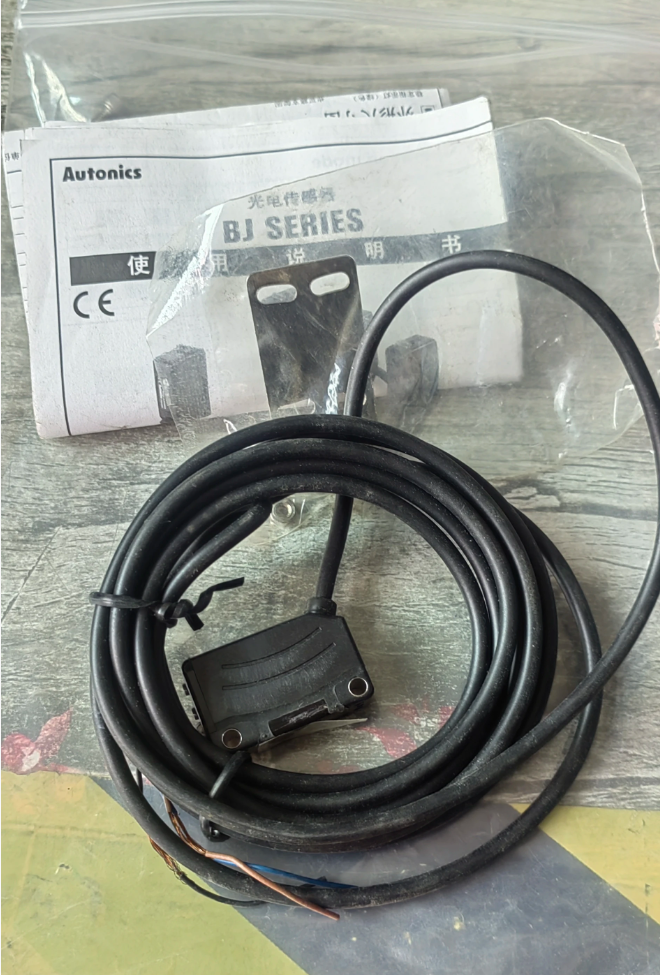

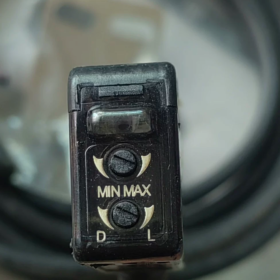
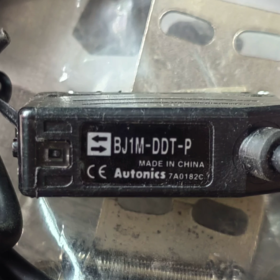
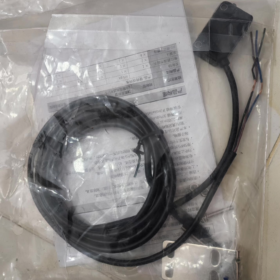
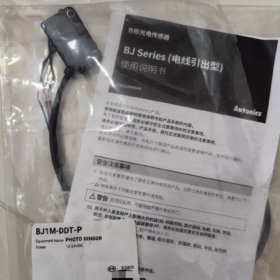
BJ-series diffuse-reflection 광전 센서, PNP 출력, cable-out type
모델 코드 설명
| 암호 | 설명 |
| BJ | BJ‑series compact photoelectric sensor |
| 1중 | 정격감지거리: 1 m |
| DDT | Diffuse‑reflection type; Light‑ON / Dark‑ON switchable |
| 피 | PNP open‑collector output |
| No suffix ‑C | Cable output; ‑C denotes M8 connector version (BJ1M‑DDT‑C‑P) |
주요사양
| 목 | 매개변수 |
| 감지방식 | Diffuse reflection (반사경이 필요하지 않습니다) |
| 감지거리 | 0‑1 m (standard white paper 300×300 mm) |
| 광원 | 적외선 LED, 850 nm |
| 응답 시간 | ≤1 ms |
| 전원공급장치 | 12‑24 VDC ±10%, ripple ≤10% |
| 산출 | PNP open‑collector, 최대. load 100 mA |
| 작동 모드 | Light‑ON / Dark‑ON via built‑in slide switch |
| 감광도 | Adjustable via potentiometer |
| 케이블 | 3-핵심, Φ3.5 mm, standard length 2 m |
| 유입 방지 | IP65 |
| 작동 온도 | -25℃~+55℃ |
| Hysteresis | 20 % of maximum sensing distance |
| 보호 | Reverse‑polarity, 단락 & 과전류 보호; mutual‑interference resistance |
| 치수 | W20 × H32 × D10.6 mm |
| 무게 | 대략. 45 g |
| 부속품 | 장착 브래킷, M3 bolts & nuts |
배선 (3-wire System)
갈색: DC12-24V Positive
파란색: 0V Negative
검은색: PNP Signal Output
메모: No Background Suppression (BGS). Background objects nearby may cause false triggering. Suitable for opaque and semi-transparent targets. Actual sensing distance decreases for dark-colored objects.
Interchangeable Models in the Same Series
- BJ1M-DDT: NPN 출력, all other parameters identical
- BJ1M-DDT-C-P: PNP 출력, M8 4-pin connector, no flying cable
- BJ300-DDT-P: PNP diffuse-reflection, 300 mm sensing distance
일반적인 응용 분야
Conveyor-line object detection, station-in-place detection, material presence detection, general-automation part counting.
Domestic-made Alternative Reference
Compatible alternatives: E3Z-D61 (PNP version), EE-SX series, FS-N-series diffuse-reflection 1-meter PNP models. Verify response time, wiring and mounting hole dimensions.
Working Principle of Diffuse-Reflection Photoelectric Sensors (취득 오토닉스 BJ1M-DDT-P as Example)
확산 반사 (diffusion-reflection) photoelectric switches belong to the direct-reflection type. No separate reflector is needed; the transmitter and receiver are integrated inside one housing.
Basic Principle
- 방사: The internal infrared LED emits an infrared beam toward the target surface.
- Diffuse reflection: When light strikes the target surface, it scatters in all directions. Part of the scattered light bounces back to the sensor’s receiving window.
- Signal judgment: The internal photosensitive element receives the returning light. Once the light intensity reaches the threshold, the sensor outputs a switching signal.
- No-target condition: No light is reflected back to the receiver, and the output state reverses.
⚠️ Key point: This is not specular reflection. It relies on diffuse scattering from the target surface. Target color and surface roughness directly affect effective sensing distance.
Two Operation Modes (Selected via built-in slide switch on BJ series)
입광 ON (Light-operate)
Output turns ON when reflected light is received; no output with no target present.
Output activates when a target arrives and reflects light back.
Dark-ON (Dark-operate)
Output turns ON when no reflected light is received; output deactivates when reflected light arrives.
Output activates when the target moves away and removes the reflected light.
Factors Affecting Performance
- Target color: Light-colored / white surfaces reflect strongly, achieving near-nominal sensing distance. Dark-colored / black surfaces absorb light and greatly reduce practical sensing range.
- Background interference: Models without BGS such as BJ1M-DDT-P can falsely trigger from reflected light off rear walls or metal surfaces. This is a common failure mode.
- Target tilt angle: A tilted target deflects reflected light away from the receiver and may cause missed detection.
- Beam spot: The beam spot grows larger with distance. Small targets are prone to missed detection at long range.
Quick Comparison with Other Photoelectric Types
확산 반사: 송신기 & receiver integrated; detects via direct target reflection, 반사경이 필요하지 않습니다. Vulnerable to background interference.
Retro-reflection: Requires a reflector; output triggers when an object blocks the beam.
투과형 (opposed): Separate transmitter and receiver units; detection occurs when an object interrupts the light beam. Offers the longest sensing range.
Practical Operation Tips for BJ1M-DDT-P
Use the front-panel potentiometer to adjust sensitivity: it sets the receiving-light threshold for adapting to targets of different colors and mitigating background false triggers.
Avoid mounting the sensor facing light-colored walls or metal backgrounds.
Application Scenarios for Diffuse-Reflection Photoelectric Sensors
Diffuse-reflection sensors such as Autonics BJ1M-DDT-P are easy to install because no reflector is needed. They detect objects by measuring light reflected off target surfaces. Limitations include susceptibility to target color and background reflection. Best suited for mid-to-short-range presence detection in automation and conveyor systems.
- 컨베이어 & Material-handling Lines (Most Common Use-case)
- Target-in-place detection: Detect workpiece arrival on belt or roller conveyors to trigger cylinder or robot-arm actions.
- 부품 계산: Count products by capturing pulse-form output signals sent to PLC.
- Material-absence / jam detection: Detect empty feed channels for missing-material alarms; halt equipment on material-stack-up jams.
메모: Dark-colored workpieces yield shorter effective sensing distance; reduce sensitivity accordingly.
- 포장기계
Detect presence of bags and cartons to prevent empty-packaging faults.
Detect label presence and pouch positioning; verify correct part loading.
Trigger sealing and labeling operations once workpieces arrive at the station.
- 물류 분류 & Warehouse Equipment
Detect cartons and tote-bin passage.
Conveyor-belt material detection to actuate sorting pushers.
Cartons give good reflection; black plastic totes show noticeable range reduction.
- Machine-tool & Processing Equipment
Confirm presence of metal / plastic workpieces before starting machining cycles.
Simple bin-level monitoring to check remaining-workpiece status.
⚠️ Reflective metal backgrounds cause false triggering for standard diffuse-reflection sensors. Prefer BGS background-suppression models when backgrounds cannot be avoided.
- 인쇄 & 섬유기계
Detect paper and fabric presence; missing-paper alarm for feed-fault conditions.
Monitor web-material feeding status.
Thin semi-transparent paper may pass infrared light through. Use short-range high-sensitivity variants.
- Robot-assisted Automation Tooling
Work-fixture workpiece-presence detection to verify successful gripping.
Simple short-range area monitoring for foreign-object intrusion.
- Light-industry & Food-processing Equipment
Bottle-cap and bottle-presence detection at process stations.
Tray and tote-position monitoring.
For food-grade environments select IP65-rated devices such as BJ1M-DDT-P.
- Access-control & Automatic-equipment
Small automatic-door sensing; cabinet-door open-close status detection.
❗ Selection & 모집요강
- Standard diffuse-reflection (BJ1M-DDT-P)
적합: Targets well separated from background; stable target colors; avoid mounting facing walls or metal plates.
Not suitable for: Targets positioned tightly against walls or metal surfaces (high risk of false triggers).
- BGS Background-suppression diffuse-reflection
적합: Targets positioned close to metal / wall backgrounds. Rejects background-reflection interference, higher unit cost.
- Unsuitable applications:
① Highly transparent objects (유리, clear films; infrared light passes through, reliable detection difficult).
② Large-variation working distances beyond rated range.
③ Tiny-target detection at long sensing distances.
Quick-selection Table
| 대본 | Recommended Sensor Type |
| General‑purpose conveyor, target spaced away from background | Standard diffuse‑reflection BJ1M‑DDT‑P |
| Target close to metal / wall background, background‑rejection required | BGS background‑suppression diffuse‑reflection |
| Long‑range detection, harsh operating conditions | Retro‑reflection or through‑beam photoelectric sensor |
Relationship Between Diffuse-Reflection Sensing Distance and Detection Accuracy
Based on Autonics BJ1M-DDT-P (nominal 1 m standard diffuse-reflection): Accuracy degrades as sensing distance increases. Shorter working distance yields better accuracy. These two parameters are strongly correlated but not identical.
Concept Definitions
- Diffuse-reflection sensing distance: Maximum reliable detection range for the sensor (0-1000 mm for BJ1M-DDT-P). Subject to target-surface reflectivity and color.
- Detection accuracy covers three aspects:
①Repeat accuracy: Position fluctuation of trigger point for repeated target-in-and-out cycles.
②Minimum detectable-object size: Smallest workpiece that can be reliably detected.
③Hysteresis: Position difference between the turn-ON point (target approaching) and turn-OFF point (target receding).
Hysteresis is a critical performance index. For BJ series sensors, hysteresis = 20 % of maximum sensing distance.
How Distance Influences Accuracy
- Beam-spot enlargement at longer range
The infrared beam diverges as it travels.
단거리: Small spot size. Triggering is stable only when the beam hits the workpiece. High repeat accuracy; small-object detection feasible.
Near maximum range (~1 m): Large beam spot. Partial illumination of background surfaces creates false triggers. Minor position changes produce only small light-intensity variations. Large trigger-point drift, poor accuracy, high risk of missing small objects.
- Hysteresis increases with operating distance
For BJ1M-DDT-P, hysteresis = 20 % of max. 거리. Near the 1 m limit, hysteresis can reach 200 mm.
Practical example: Output activates at 900 mm target distance, yet deactivates only after target retreats to 700 mm. Large switching-position drift at long range. Only presence-detection is feasible; position-measurement is not.
- Light-signal attenuation
Returned-signal intensity weakens at longer distances. Ambient-light interference or minor surface variations easily cause output jitter and reduce stability.
✅ Conclusion: Standard diffuse-reflection sensors are designed for presence-detection, not distance-measurement or precise-position locating.
Behavior of BGS Background-suppression Diffuse-reflection Sensors
BGS-type sensors adopt special optical-path design to constrain beam-spot characteristics. Within the rated working window, hysteresis remains low, and accuracy is far less sensitive to distance. Reliable small-target detection is achievable even with nearby backgrounds. Performance fails once targets exceed the set detection range.
Practical Commissioning Advice for BJ1M-DDT-P
- Avoid operating near the full-range 1 m limit. Recommended working window: 30-60 % of nominal range (300-600 mm) for balanced distance and repeat-performance.
- For high-accuracy small-object detection: reduce mounting distance and lower potentiometer sensitivity to compress effective sensing range and improve stability.
- If tight position-repeatability is required: Avoid standard diffuse-reflection. Choose BGS background-suppression sensors. For superior precision select laser-type photoelectric sensors.
Performance-comparison Table
| Working Distance | Beam‑spot Size | Hysteresis | Detection Accuracy | Application Suitability |
| 짧은 (<300 mm) | 작은 | 작은 | 높은 | Stable presence‑detection for medium‑small workpieces |
| 중간 (300‑600 mm) | 중간 | 보통의 | Fair | General‑purpose conveyor‑line detection (preferred operating zone) |
| Near full range (800‑1000 mm) | 크기가 큰 | 크기가 큰 | Poor | Only for large‑size high‑reflectivity targets; not for high‑accuracy tasks |
일반적인 오해
❌ Misconception: The 1 m rated value means good-accuracy performance at 1 meter.
✅ Fact: 1 m is the maximum detectable distance, not the optimal operating point. Stability and accuracy degrade significantly near full range.


NH42-63-318x560.png "CHINT PC형 자동절환스위치 (ATS)NH42-63/4SZ")