접촉기,회로 차단기,감지기,인코더,PLC,변환기


모델 코드 분석
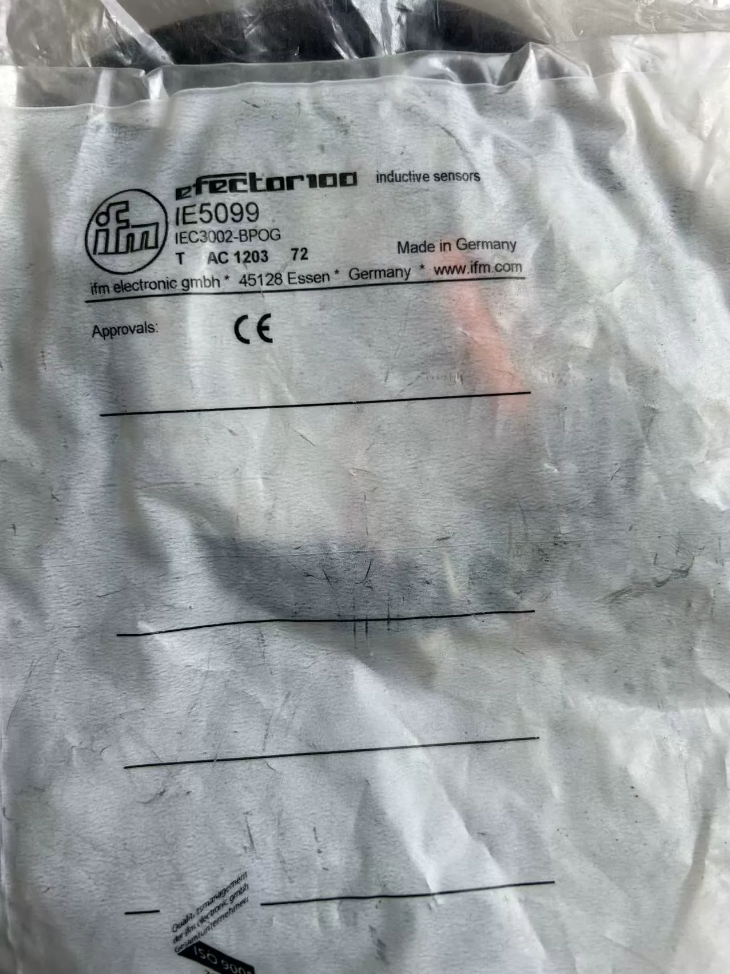
IE5099 = IEC3002-BPOG
(IE5099는 주문 부품 번호입니다.; IEC3002-BPOG는 시리즈 사양 모델을 나타냅니다.)
- IEC: Series of inductive proximity 센서 with M8 plastic thread IFM
- 3002: Rated sensing distance Sn = 2 mm
- 비: 3-wire DC type
- 피: PNP 출력
- 영형: 평상시 열림 (아니요)
- G: PVC straight cable (2m as standard factory length; 6m variant available as IE5100)
- 핵심 하드웨어 사양
2.1 기계적 치수
스레드 사양: M8×1.0, PBT plastic housing
Overall length: 35 mm, Non-flush mount design
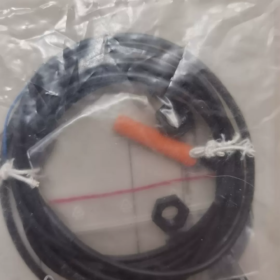
Standard accessories: 2 pieces of M8 locking nuts
케이블: 3×0.14 mm² PVC sheath, 표준 길이 2 중
순중량: 43.1 g
보호 등급: IP67 (waterproof and dustproof, allows short-term washdown)
2.2 전기적 매개변수 (Official IFM Factory Standards)
| 목 | 매개변수 값 |
| 공급 전압 | DC 10~36 V (compatible with standard industrial DC24V systems) |
| 무부하 전류 소비 | <15 mA (~에 24 V operating condition) |
| 출력 유형 | 3-wire DC PNP Normally Open (아니요) |
| 맥스. 부하 전류 | 200 엄마 (can directly drive PLC inputs and relay coils) |
| 출력 전압 강하 | ≤2.5 V |
| 스위칭 주파수 | 800 헤르츠 (suitable for high-speed counting and conveyor positioning) |
| 보호 기능 | 역극성 보호, 단락 보호, 과부하 보호 |
| Rated Sensing Distance Sn | 2 mm |
| Stable Operating Range | 0~1.6 mm (reliable detection zone) |
| Actual Tolerance Sr | 2 ±10% mm |
| Hysteresis Range | 1%~15% of rated distance (anti-jitter design) |
| Switch Point Offset | ±10% Sr |
2.3 Material Correction Factors (Sensing Distance Attenuation)
Mild Steel St37: 1.0 (reference standard)
스테인레스 스틸: 0.7
놋쇠: 0.4
알류미늄: 0.3
구리: 0.2
2.4 Environmental Operating Conditions
작동 온도: -25℃ ~ +85℃
보관 온도: -25℃ ~ +90℃
EMC Standards: 안에 60947-5-2, EN55011 Class B
- Standard 3-Wire Wiring Definition (Global Uniform Color Code)
| 와이어 색상 | 정의 | 배선 지침 |
| BN Brown | DC+ Positive Power Supply | Connect to 24V positive rail and PLC module 24V common terminal |
| BU Blue | DC- Negative Power Supply | Connect to 0V / power ground |
| BK Black | PNP 신호 출력 | Connect to PLC digital input terminal (액티브 하이) |
PNP Wiring Logic
No metal target nearby: Black signal wire = 0 다섯, no input signal to PLC
Metal enters sensing zone: Black signal wire ≈ 24 다섯, PLC receives trigger signal
- Mounting Specifications (Mandatory Requirements for Non-flush Installation)
- Mounting Clearance (Prevent Mutual Interference)
Two sensors mounted side-by-side on the same axis: Center distance ≥12 mm
Adjacent side mounting: Gap ≥8 mm
- Detection Distance Control
Maintain the gap between metal target and sensing face within 0~1.6 mm. Signal loss will occur if the distance exceeds 1.6 mm.
- 조임 토크
Tightening torque for M8 nuts: 0.8~1.2 N·m. Do not over-tighten to avoid cracking plastic threads.
- Wiring Separation Rules
Maintain a minimum clearance of 30 cm between sensor cables and power cables for inverters / 접촉기. Route wires perpendicularly when crossing to reduce interference.
- Cable Protection
Avoid long-term bending and crushing; reserve a 5 cm slack buffer at cable joints.
- 응용 시나리오
- Workpiece presence detection on assembly lines, conveyor counting, high-speed indexing positioning (800 Hz high-frequency operation)
- Metal presence detection on automated machine tools, cylinder piston position feedback
- 포장 기계, 물류 분류, material counting on conveying equipment
- Compatible with digital inputs of full series PLCs: Omron CJ/CP/NJ, Siemens S7, Mitsubishi FX/Q
- Cross-Series Alternative Model Comparison
| 모델 | 감지거리 | 출력 유형 | 케이블 길이 | 차이점 |
| IE5099 IEC3002-BPOG | 2 mm | PNP 아니요 | 2 중 | Standard general-purpose model |
| IE5100 IEC3002-BPOG/6M | 2 mm | PNP 아니요 | 6 중 | Long cable for long-distance wiring |
| IE5098 IEC3002-BPKG | 2 mm | PNP NC Normally Closed | 2 중 | For applications requiring NC signal |
| IE5089 IEC3002-BNOG | 2 mm | NPN 아니요 | 2 중 | Replacement for NPN-type PLC input systems |
- 문제 해결 매트릭스
| 결함 현상 | 근본 원인 | 해결책 |
| Yellow LED off and no signal output when metal target approaches | 1. Reversed brown/blue power wires; 2. 아래 공급 전압 10 다섯; 3. 끊어진 케이블 | Verify wiring polarity, measure DC24V supply, inspect cable segments for breaks |
| Yellow LED stays lit even without metal target | 1. Excessively short mounting gap; 2. Interference from surrounding metal brackets; 3. Internal output transistor breakdown | Widen mounting clearance, remove surrounding metal obstructions, replace the sensor |
| Flickering, intermittent signal | 1. Cable runs close to high-power sources causing interference; 2. Target moving speed exceeds 800 헤르츠; 3. Loose nuts leading to distance drift | Fit ferrite core on cable for shielding, reduce moving speed, retighten and secure nuts |
| No PLC input signal but sensor yellow LED works normally | 1. Loose black signal wire connection; 2. Mismatched polarity of PLC input common terminal; 3. Load current over 200 엄마 | Tighten terminals of black wire, confirm 24V common terminal for PNP modules, add intermediate relay for load expansion |
| No LED indicator light on sensor at all | Open circuit in power supply loop, blown power fuse | Inspect DC24V circuit breaker and terminal block wiring |
- 엄격한 설치 & Usage Prohibitions
- Do not embed flush into metal brackets. This model is designed exclusively for non-flush mounting. Embedding will drastically shorten sensing distance or cause complete failure.
- Do not exceed total load current of 200 엄마; otherwise the output transistor will burn out.
- Do not immerse cable in oil, strong acid or alkali for long periods; PVC cables are not resistant to highly corrosive media.
- Do not connect directly to AC220V mains; only DC 10~36V power supply is supported.
- Do not bundle multiple sensor cables with power cables for long-distance parallel routing in the same trunking.
- Standard Packing List
- 1 × IE5099 sensor main unit (with 2m 3-core PVC cable)
- 2 × M8 plastic locking nuts
- Original manufacturer operation manual, CE certification documents
Full Specification of Switching Frequency for IFM IE5099 (IEC3002-BPOG)
- Official Rated Parameter
Standard Switching Frequency: 800 헤르츠 (rated value under DC operation)
정의: The sensor can complete a maximum of 800 full switching cycles per second: metal enters sensing zone → output ON; metal leaves sensing zone → output OFF.
Response Cycle Conversion
Single full switching cycle = 1 ¶ 800 = 1.25 ms
The sensor features ultra-fast total response time including internal detection and output toggle, ideal for high-speed dynamic detection applications.
- Key Supporting Dynamic Parameters (Critical for Stable High-Frequency Operation)
- Hysteresis: 1%~15% Sr
Sr = 2 mm (rated sensing distance), hysteresis range: 0.02~0.3 mm
기능: Eliminate frequent false signal triggering caused by mechanical vibration and tiny jitter, balancing high-speed response and anti-interference performance.
- Stable Effective Detection Zone: 0~1.6 mm
Detection sensitivity drops sharply beyond 1.6 mm, leading to frequent pulse loss under high-frequency working conditions.
- Output Driving Capacity
맥스. 부하 전류 200 엄마. Can be wired directly to PLC high-speed input terminals without intermediate relay expansion for high-speed counting.
- Calculation of Equipment Linear Speed at 800 헤르츠 (On-site Selection Reference)
예: Metal baffles evenly arranged on conveyor, each baffle 1 mm thick with 1 mm gap between adjacent pieces
Total width of one metal piece plus gap = 2 mm
맥스. number of workpieces passing per second = 800
Linear speed = 800 × 2 mm = 1600 mm/s = 1.6 밀리미터/초
Meets requirements for conveyor belts, indexing plates, high-speed stamping positioning and encoder synchronous counting;
Higher linear speeds are achievable with thinner workpieces and smaller gaps.
- High-Frequency Operation Limitations & 지침
- Sensing Distance Attenuation by Metal Material Reduces Max. Stable Switching Frequency
Mild Steel: Correction factor 1.0, stable full-speed operation at 800 헤르츠
스테인레스 스틸 (0.7), 놋쇠 (0.4), 알류미늄 (0.3), 구리 (0.2): Effective sensing distance decreases, resulting in lower actual stable switching frequency. Reduce mounting clearance accordingly.
- Wiring Interference Degrades Effective Frequency
Parallel routing of sensor cables with inverter / contactor power cables without shield grounding introduces high-frequency noise, causing pulse loss and signal flickering.
Countermeasure: Maintain ≥30 cm clearance between signal and power cables, cross wires perpendicularly, implement single-point shield grounding inside control cabinets.
- Excessive Load Is Forbidden
Frequent high-speed switching with load current approaching the 200 mA upper limit causes output heating and reduced maximum switching frequency. 가득한 800 Hz performance can be maintained when driving low-current PLC inputs (<10 엄마).
- Mounting Regulation Restrictions
This sensor is an M8 plastic-thread Non-flush type. Embedding into metal bases weakens magnetic fields and severely impairs high-frequency response. Center distance between two side-by-side sensors shall be ≥12 mm to avoid magnetic field crosstalk and pulse dropout.
- Cross-Series Horizontal Comparison (Reference for High-Frequency Selection)
| 모델 | 스위칭 주파수 | 주택 유형 | Application Difference |
| IE5099 IEC3002-BPOG | 800 헤르츠 | M8 plastic thread straight cable | General medium-high speed assembly lines, cylinder position detection |
| IFB3002-BPKG (M12 metal) | 1400 헤르츠 | Metal thread connector type | Ultra-high speed indexing, 고속 계산 |
| IEK3002-BBPOG | 1000 헤르츠 | M8 metal thread | Balanced speed and mechanical impact resistance |
- Typical High-Frequency Application Scenarios
- High-speed workpiece counting for packaging & logistics conveyor belts
- High-speed position feedback for rotary indexing tables and cams
- Rapid position confirmation for stamping equipment and robotic manipulators
- Pulse acquisition for PLC high-speed counter modules (CJ1W-CT021, Siemens 224XP high-speed inputs)
- High-Frequency Fault Diagnosis (Insufficient Switching Frequency / Pulse Loss)
| 현상 | 근본 원인 | 해결책 |
| Normal counting at low speed, pulse loss at high speed | 1. Mounting gap over 1.6 mm; 2. Severe attenuation from aluminum/copper targets; 3. Cable interference | Reduce detection gap; replace targets with steel; separate signal and power wiring |
| Flickering yellow LED and unstable output under 800 Hz operation | Load current approaching 200 mA upper limit | Install series intermediate relay to lower sensor output load |
| Mutual interference between multiple sensors running high-frequency detection on one track | Mounting center distance less than 12 mm | Increase center spacing of side-by-side sensors |


NH42-63-318x560.png "CHINT PC형 자동절환스위치 (ATS)NH42-63/4SZ")