Contacteur,disjoncteur,capteur,Encodeur,API,Convertisseur

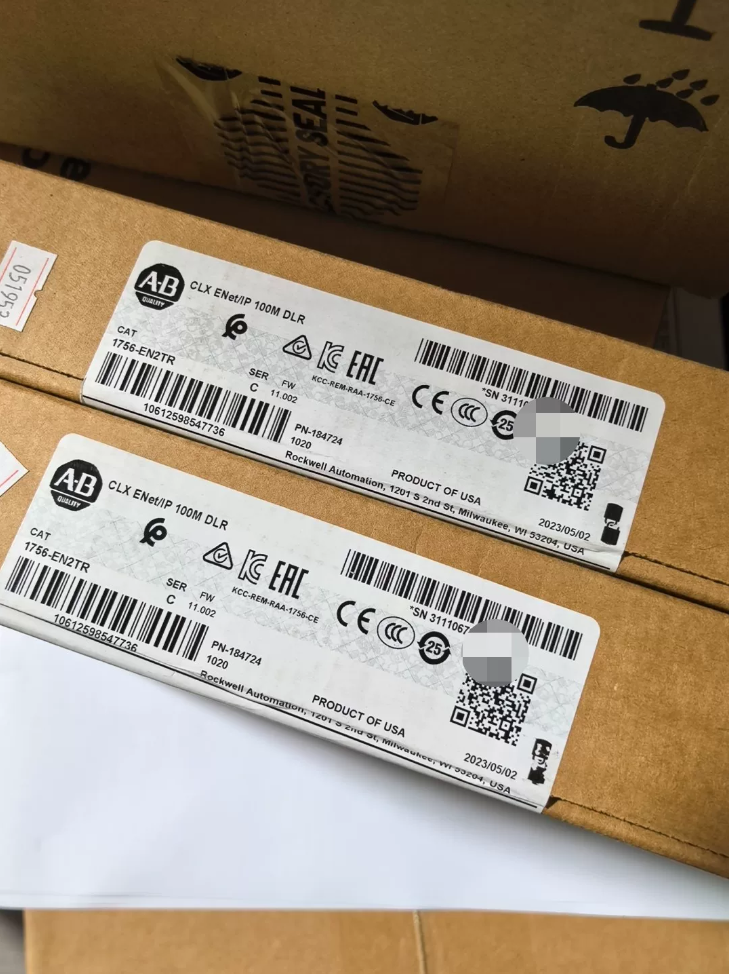

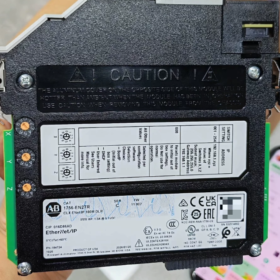
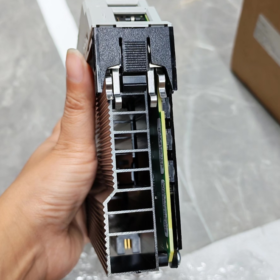
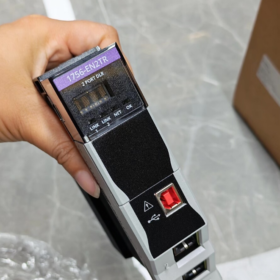
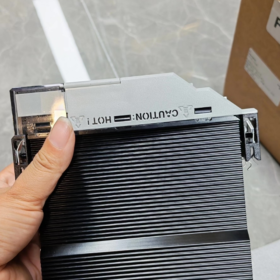
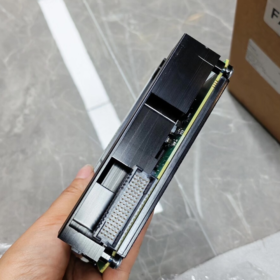
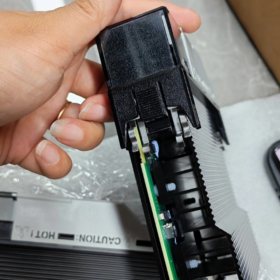
1756:ControlLogix platform series
DANS:Rockwell EtherNet/IP communication
2:Dual-port Ethernet
T:Twisted-pair copper interface
R.:DLR (Device-Level Ring) soutien (core identifier)
Spécifications techniques de base
| Article | Paramètre |
| Interfaces | 2×RJ45 with embedded switch, both ports share one single IP address, independent sub‑networks are not supported |
| Vitesse | 10/100 Mbps auto‑negotiation |
| Backplane Power Consumption | 5.1À DC, 1UN; power dissipation 5.1W |
| CIP Connections | Max.. 256 CIP connections; 128 TCP connections |
| Message Processing | 25000 PPS; supports up to 8‑axis CIP Motion |
| Topologies | Star, linear daisy‑chain, DLR Device‑Level Ring (single‑link fault self‑recovery) |
| Température de fonctionnement | 0~+60℃; 1756‑EN2TRXT wide‑range version: ‑25~+70℃ |
| Installation | Any slot in ControlLogix chassis, RIUP hot‑swap supported |
| Firmware Series | Mainstream Series‑C; suffix K: 1756‑EN2TRK conformal coated version |
| Isolement | Basic insulation between Ethernet and backplane; USB port for temporary commissioning only, prohibited in hazardous areas |
⚠️Important: EN2TR only supports DLR ring redundancy. PRP dual-network and dual-IP hot-standby redundancy are NOT available. Two ports operate as an embedded switch, not two independent network adapters.
Primary Application Scenarios
- EtherNet/IP remote I/O and distributed I/O (par exemple. 1734-AENTR) for ControlLogix controllers
- DLR ring architecture: chaînes de montage, machines d'emballage, traitement de l'eau, manutention des matériaux, auto network self-recovery upon single cable breakage
- IHM & SCADA host communication; CIP-Motion servo motion network
- Preferred upgrade replacement for legacy 1756-ENBT, delivering greatly improved performance
Sélection de séries & Comparaison
| Modèle | Ports | DLR | Gigabits | Caractéristiques |
| 1756‑EN2T | 1×RJ45 | ❌ | ❌ | Basic single‑port EtherNet/IP, no ring support |
| 1756‑EN2TR | 2×RJ45 | ✅ | ❌ | Dual‑port DLR, widely deployed in projects |
| 1756‑EN2TP | 2×RJ45 | ❌ | ❌ | PRP dual‑network redundancy, dual independent IP addresses |
| 1756‑EN4TR | 4×RJ45 | ✅ | ✅ | Gigabits, CIP‑Security, 512 connections, next‑generation upgrade option |
Options de remplacement
- Remplacement direct: 1756-EN2TR (Series-C). Keep consistent firmware revision; plug-and-play without program modification
- Mise à niveau des performances: 1756-EN4TR (Gigabit-Ethernet, higher connection capacity, CIP security support)
- Harsh environment variants: 1756-EN2TRXT wide-temperature; 1756-EN2TRK conformal coating
Installation du matériel & IP Configuration Guidelines
- RIUP hot-swap supported; hot-swap forbidden in hazardous / explosive areas
- IP configuration methods:
Module thumbwheel: setting static IP `192.168.1.xxx` via setting 1-254; position 999 enables BOOTP/DHCP assignment
Static IP assignment via BOOTP-DHCP tool; configure IP inside Studio5000 project and download
- DLR ring wiring: Port1 connects upstream device, Port2 connects downstream device; close both ends to form a ring. At least one DLR Supervisor (ring manager) must exist in the ring. Ordinary non-managed switches cannot be inserted into DLR ring, which causes ring flapping and communication failure.
- Cable requirement: minimum Cat5e shielded Ethernet cable
Dépannage courant
- Ring convergence failure: Ordinary switches or multiple Supervisor nodes inside ring. Remove non-managed switches and retain exactly one Supervisor.
- I/O glitch after cable break: DLR convergence time exceeds RPI request packet interval. Use PRP module (EN2TP) for motion-critical applications.
- Duplicate IP alarm: Both ports connected to same switch network. One port for ring connection only; never plug both ports into common switch.
- Electronic key error 160114: Firmware mismatch between project definition and physical hardware. Enable compatible-module setting or upgrade module firmware.
Key LED Indicators
D'ACCORD: Module status; steady green = normal; flashing red = self-test; solid red = module fault
LNK/ACT: Port link & data activity indicator
NET: Network status
DLR: Device-Level Ring status
I can provide further materials upon request:
- Minimal DLR ring configuration steps (Studio5000)
- Index for official 1756-EN2TR Chinese manual
- Inspection checklist for second-hand modules
1756-EN2TR Main Application Scenarios
Module positioning: Dual-port EtherNet/IP communication module for ControlLogix platform with DLR Device-Level Ring. Embedded switch shares one IP address; PRP dual-network redundancy is unsupported.
- DLR Device-Level Ring (Avantage de base)
For field-level networks requiring self-recovery (<3 ms convergence) against single cable damage. Supports star, linear daisy-chain and closed DLR ring topologies.
Manutention des matériaux & lignes de tri; conditionnement & lignes de remplissage; soudage automobile & assembly station networks
Remote I/O ring for water treatment, stations de pompage, tunnels and bridges; reduces switch count and cabling cost
Ring prerequisites: All ring nodes must be DLR-capable. Exactly one DLR Supervisor is required. Ordinary non-managed switches shall not be inserted.
- Distributed Remote I/O Master Communication
Acts as backplane-mounted EtherNet/IP interface for ControlLogix, connecting remote I/O adapters such as 1734-AENTR and 1738-AENTR.
Collect DI/DO, AI/AO signals for widely dispersed field points in large-scale plants
Direct upgrade substitute for legacy 1756-ENBT; no chassis or program modification, higher connection capacity and message performance.
- CIP-Motion Motion Control Network
Supports up to 8-axis CIP-Motion servos, interfacing with Kinetix servos and PowerFlex variable-frequency drives.
Real-time servo control for packaging machines, material handling equipment and machine tools.
Note: When running CIP-Motion over DLR ring, properly tune RPI interval to avoid motion glitches triggered by ring convergence events.
- IHM, SCADA & MES Data Exchange
Interfaces with PanelView HMI terminals, FactoryTalk SCADA hosts; upload production data to MES systems
Acquire data from VFDs, smart instruments and third-party EtherNet/IP devices
Maximum 256 CIP connections and 128 TCP connections support multi-device concurrent communication.
- Industry-Specific Typical Deployments
- Fabrication automobile: Soudage & paint shops, connecting robots, station I/O and VFDs via DLR ring per cell.
- Nourriture & beverage packaging: Remplissage, labelling and end-of-line packaging; daisy-chain / DLR wiring cuts field switch quantity.
- Municipal water treatment: Waste-water & clean-water plants, pump-station remote-I/O rings with central SCADA supervision.
- Warehouse & logistique: AS/RS automated warehouses, sortation conveyors for long-distance daisy-chain or DLR networking.
❌ Not-Recommended Use-Cases (Pièges de sélection)
- Dual-independent-IP / PRP true dual-link redundancy: Select 1756-EN2TP instead of EN2TR. EN2TR ports function as bridged switch ports rather than two independent NICs.
- Gigabit requirement: EN2TR is 10/100 Mbps only; upgrade to 1756-EN4TR for gigabit speed.
- Dual-network hot-standby for redundant controller systems: Not suitable; use two separate communication modules.
Network Topologies Supported by 1756-EN2TR
Hardware key fact: Dual ports implement internal Layer-2 switch, one shared IP with two MAC addresses; not two independent network interface cards.
✅ Three Supported Topologies
- DLR Device-Level Ring (Fonctionnalité de base)
Module can operate as a regular DLR ring node or be configured as DLR Supervisor (ring manager).
Wire Port1 to upstream device and Port2 to downstream device, close both ends to form closed ring.
Automatic self-healing when one cable fails; convergence time <3 MS.
Exigences: Every ring participant must support DLR. Only one Supervisor node allowed within ring. Non-managed switches must be excluded.
Use-case: Field-level redundant networking for conveyors, water-treatment and assembly lines.
- Linear Daisy-Chain Topology
Port1 connects upstream device; Port2 daisy-chains next DLR-capable I/O device. Both ends remain open without ring closure.
Eliminates field switches by cascading devices sequentially and lowers hardware cost.
Inconvénient: Any intermediate cable failure takes down all downstream devices. No fault-tolerant recovery.
- Topologie en étoile
Use only one RJ45 port to connect to standard switch; leave second port unused.
Traditional widely-adopted EtherNet/IP topology for HMI, SCADA and remote-I/O connections.
⚠️Strict prohibition: Never plug both ports into the same ordinary switch. This creates Layer-2 loop, triggers duplicate-IP alarm and collapses network traffic.
❌ Unsupported Topologies (Pièges de sélection)
- PRP parallel dual-network redundancy: EN2TR does not implement PRP protocol. Choose 1756-EN2TP for physically separate redundant networks.
- Separate sub-networks / dual-IP for two ports: Hardware limitation forces single shared IP; different sub-nets cannot be assigned per port.
- Dual-NIC hot-standby for redundant controller pairs: Cannot realize true dual-network redundancy; deploy two discrete communication modules.
Topology Quick Reference Table
| Topologie | Redondance | Port Utilization | Application typique |
| DLR Closed Ring | Single‑link fault self‑recovery | Port1+Port2 closed loop | Lignes d'assemblage, distributed I/O with high cable‑failure risk |
| Linear Daisy‑Chain | No redundancy | Port1+Port2 open‑end cascade | Long‑run cabling, cost‑sensitive projects accepting single‑point‑of‑failure risk |
| Star | No redundancy | One single port only | Control‑room side for HMI / SCADA / multi‑drop remote I/O |
Supplément: Although CIP-Motion can run on DLR ring, cable break-triggered convergence may cause transient I/O or motion jitter. Star topology or PRP module is preferred for high-performance motion applications.


NH42-63-318x560.png "Commutateurs de transfert automatiques de type PC CHINT (ATS)NH42-63/4SZ")