Contacteur,disjoncteur,capteur,Encodeur,API,Convertisseur


Modèle & Explication des spécifications
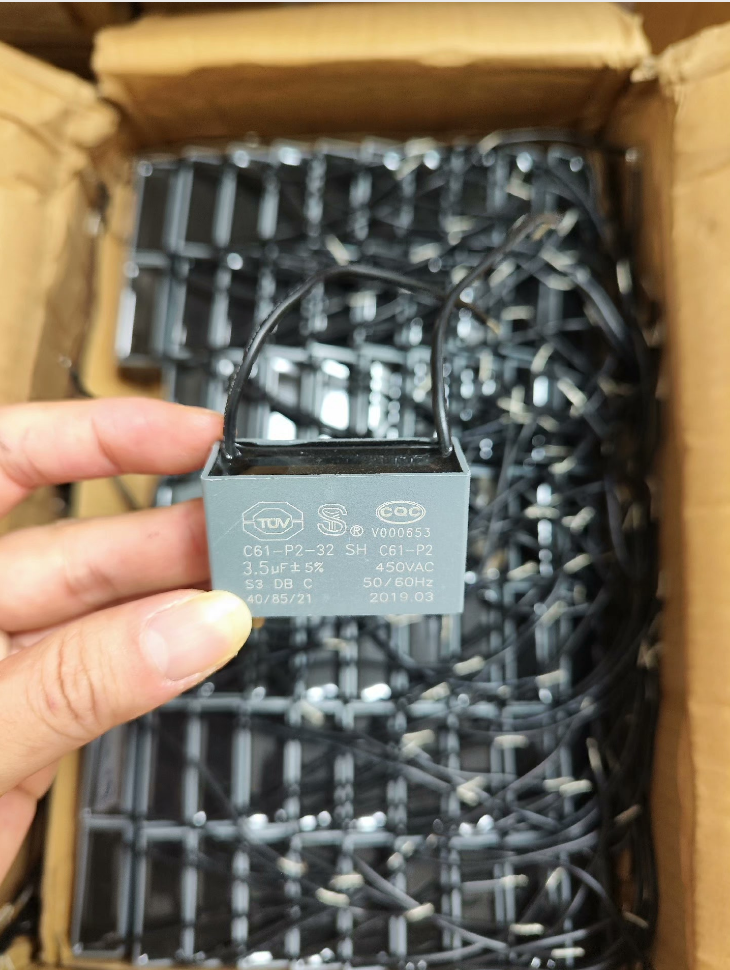
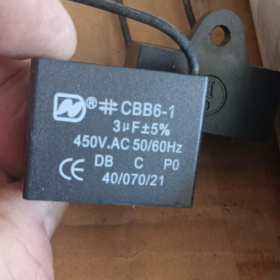
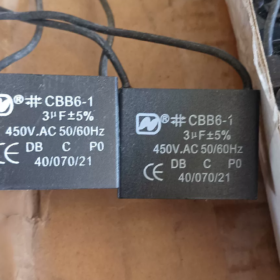
Définition du modèle CBB61
- CBB: Film polypropylène métallisé condensateur (non polaire, faible perte, auto-réparateur et antidéflagrant intégré)
- 61: Série standard de condensateurs de sortie à boîtier plastique spécialement conçus pour le démarrage/le fonctionnement de moteurs à courant alternatif monophasé
- 3µF: Capacité nominale de 3 microfarads; tolérances dominantes dans l'industrie: ±5% (Catégorie J) / ±10% (Catégorie K)
- Tension nominale standard: 450ACC (modèle universel pour alimentation secteur domestique 220V), compatible avec une alimentation 50/60 Hz
- Spécifications électriques de base
| Article | Spécification standard |
| Capacité nominale | 3.0µF |
| Tolérance de capacité | ±5% (Catégorie J) / ±10% (Catégorie K) |
| Tension CA nominale | 450ACC (La tension de remplacement ne doit pas être inférieure à 400 VAC) |
| Fréquence Applicable | 50Hz / 60Hz |
| Matériau diélectrique | Film polypropylène métallisé |
| Facteur de dissipation tanδ | ≤0,002 (génération de chaleur ultra faible, adapté à un fonctionnement continu à long terme) |
| Température de fonctionnement | -40℃ ~ +70℃ (Classe climatique 40/70/21) |
| Structure | Boîtier en plastique noir ignifuge, scellement en résine époxy, fils doubles (non polaire) |
| Caractéristiques de sécurité | Auto-guérison après une panne de surtension, structure de décompression antidéflagrante, conforme à la norme ignifuge UL94 V0 |
| Durée de vie | Classe B, 10,000 heures de fonctionnement continu |
| Normes applicables | GB/T 3667.1, CEI60252-1 |
III. Principe de fonctionnement
Un moteur asynchrone monophasé ne peut pas démarrer tout seul. Ce condensateur est connecté en série avec l'enroulement auxiliaire du moteur pour générer un champ magnétique tournant par déphasage et fournir un couple de démarrage.. Pendant le fonctionnement, il maintient continuellement le couple du moteur, améliore le facteur de puissance et réduit la génération de chaleur des enroulements.
Manifestations de défauts sans condensateur fonctionnel: Le moteur ronronne après la mise sous tension, ne tourne que lorsqu'on le pousse manuellement, fonctionne à basse vitesse avec une puissance insuffisante, et s'arrête fréquemment.
- Scénarios d'application complets (3μF correspond aux ventilateurs basse consommation)
- Équipement de ventilation domestique (Le plus largement utilisé)
Ventilateurs de sol, ventilateurs de bureau, ventilateurs muraux, ventilateurs de plafond, ventilateurs de circulation
Ventilateurs principaux pour hottes de cuisine, petits ventilateurs, ventilateurs d'extraction de salle de bains
Ventilateurs à flux croisés pour climatiseurs intérieurs, petits ventilateurs de refroidissement, ventilateurs de climatiseur portables
- Moteurs pour petits appareils électroménagers
Moteurs de drainage et ventilateurs de déshydratation auxiliaires des petites machines à laver
Ventilateurs centrifuges pour déshumidificateurs et purificateurs d'air
Moteurs d'alimentation en air pour petits humidificateurs, radiateurs et souffleurs d'air chaud
- Petit équipement industriel monophasé
Petits ventilateurs de refroidissement pour machines-outils, ventilateurs de dissipation thermique pour armoires de commande électrique
Petites pompes à eau propre 220 V, pompes à eau atomisées, compresseurs d'air miniatures
Petits ventilateurs de dissipation thermique pour lignes de production, ventilateurs de refroidissement pour équipements de transformation des aliments
- CVC & Équipement commercial
Petits ventilateurs intérieurs de climatiseurs centraux, petits moteurs pour rideaux d'air
Ventilateurs de dissipation thermique pour réfrigérateurs de dépanneurs et congélateurs vitrines
- Exigences obligatoires pour la sélection du modèle & Remplacement
- La capacité doit être adaptée: Seulement 3μF est acceptable; 2.5μF ou 4μF ne peuvent pas être utilisés comme substituts
Capacité plus petite: Couple de démarrage insuffisant, faible vitesse de rotation, surchauffe du moteur et grillage des enroulements
Plus grande capacité: Courant excessif entraînant un grillage rapide des bobines du moteur
- Tension nominale ≥450VAC: Les modèles basse tension de 250 V/330 V sont interdits de remplacement., car ils ont tendance à gonfler et à éclater
- Doit adopter des condensateurs à film CBB61; les condensateurs électrolytiques ne sont pas autorisés (les condensateurs électrolytiques sont polaires et sujets aux fuites de liquide sous courant alternatif)
- La longueur du câble et les trous de montage doivent correspondre selon les besoins; non polaire sans distinction de câblage positif/négatif
- Phénomènes de panne typiques & Solutions
| Phénomène de défaut | Cause première de la défaillance du condensateur | Solution |
| Le ventilateur bourdonne après la mise sous tension et ne tourne pas à moins d'être poussé manuellement | Dégradation de capacité, la capacité descend en dessous de 2μF | Remplacer directement par CBB61 3μF/450V |
| Vitesse de rotation et volume d'air évidemment réduits | Vieillissement des condensateurs et capacité insuffisante | Remplacer par un nouveau condensateur |
| Le disjoncteur se déclenche ou le fusible saute quelques secondes après la mise sous tension | Panne de court-circuit interne du condensateur | Coupez l'alimentation électrique pour le remplacement et inspectez les enroulements du moteur. |
| Logement bombé, fuite de colle, noircissement et surchauffe | Surchauffe à long terme ou tension de tenue insuffisante | Remplacez immédiatement et vérifiez si le moteur est bloqué |
| Rotation intermittente et puissance insuffisante | Mauvais contact interne du condensateur | Remplacer par un tout nouveau condensateur |
VII. Points clés de sécurité pour l'installation & Remplacement
- Couper l'alimentation avant l'opération! Court-circuitez les deux fils avec un tournevis pour une décharge complète afin d'éviter un choc électrique.
- Les deux fils sont non polaires et peuvent être connectés arbitrairement à l’une ou l’autre extrémité de l’enroulement auxiliaire du moteur..
- Fixez le condensateur loin des parties génératrices de chaleur du moteur pour éviter un vieillissement accéléré causé par une température élevée..
- Enveloppez les bornes de câblage avec des matériaux isolants pour éviter les courts-circuits et les étincelles.
- Ne serrez pas et ne pliez pas le boîtier du condensateur pour éviter tout dommage à l'étanchéité et toute pénétration d'humidité..
VIII. Scénarios d'application inappropriés
- Compresseurs et compresseurs d'air haute puissance (des condensateurs CBB60 de grande capacité sont nécessaires)
- Moteurs à courant continu et circuits à courant continu des onduleurs (conçu exclusivement pour AC, pas pour un fonctionnement CC à long terme)
- Équipement fermé haute température (des modèles personnalisés résistants aux hautes températures sont requis pour les environnements supérieurs à 75 ℃)
NH42-63-318x560.png "Commutateurs de transfert automatiques de type PC CHINT (ATS)NH42-63/4SZ")